


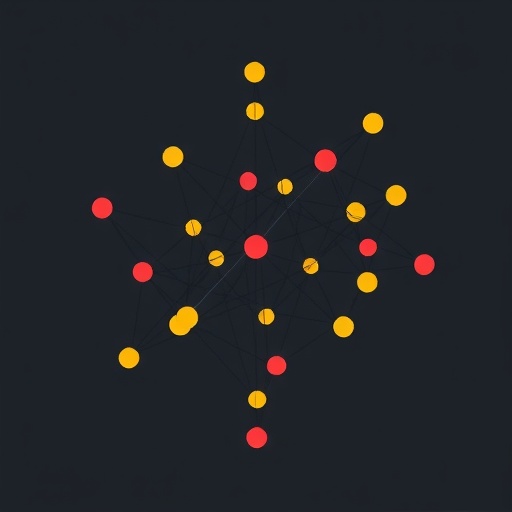
Researchers in Iran have unveiled a new machine learning framework that tackles one of the most stubborn problems in network science: how to reliably group the nodes of an attributed graph into meaningful communities. The method, developed by Elham Khodaparast and Mina Jamshidi of the Graduate University of Advanced Technology in Kerman, jointly reshapes the attributes attached to each node so that they become smoother across the network while simultaneously preserving the deep geometric structure encoded in the graph’s topology. Published in the International Journal of Data Science and Analytics, the approach delivered striking gains on standard benchmarks, including roughly a 25 percent jump in accuracy on the large-scale LargeCora citation network compared with the second-best competing method, and a 4.5 percent improvement on Citeseer.
Attributed graph clustering, sometimes described as community detection in attributed networks, sits at the heart of countless modern applications. Social media platforms group users with shared interests; recommendation systems cluster products and customers; biological databases organize proteins and genes according to interaction networks and functional annotations. In all of these settings, the data arrive as a graph, where nodes represent entities and edges capture relationships, and each node carries a vector of attributes describing its content. The task is to partition the nodes so that members of the same cluster are densely connected to one another and share similar characteristics.
The difficulty, as Khodaparast and Jamshidi explain, lies in reconciling two sources of information that do not always agree. The first is attribute smoothness, the principle that connected nodes in a well-behaved network should tend to carry similar attributes. Real-world graphs frequently violate this expectation: two linked papers may share few citation-relevant keywords, or two connected users may post about entirely different topics. Raw attributes are therefore often noisy and far from smooth, which degrades any clustering algorithm that depends on them. The second issue is geometry. Beyond the immediate neighborhood of any node, graphs harbor deep structural patterns, high-order proximities that reveal which pairs of nodes are close not because they share an edge but because they occupy similar positions in the wider topology. Capturing this deep geometrical structure is essential for accurate community detection, yet most existing methods treat smoothness and geometry as separate problems, addressed by different modules or optimized sequentially rather than simultaneously.
The new framework rejects that separation. At its core is a joint learning procedure that updates the node attributes themselves before and during clustering. Instead of accepting the raw attribute matrix as a fixed input, the method refines it along two coupled objectives. The first objective drives the attributes toward smoothness over the graph, using the deep structure of the network obtained from high-order proximities. High-order proximity is a concept borrowed from network embedding research: rather than considering only direct links, it measures how strongly two nodes are related through paths of length two, three, or more, so that nodes that “see” the same neighborhoods are pulled together. By propagating and refining attributes over this enriched proximity structure, the framework ensures that the feature values vary smoothly not just across adjacent nodes but across entire communities.
The second objective is subtler and constitutes one of the paper’s central innovations. The researchers update the attributes so that the geometrical structure induced by the attributes themselves resembles the structure of the graph. In other words, if one constructs a similarity graph purely from the refined attributes, its shape should closely mirror the shape of the original network. This alignment prevents a drift that plagues many attribute-based clustering pipelines, in which the feature space evolves in directions disconnected from the topology, eventually producing clusters that make sense in feature space but not on the graph, or vice versa. By forcing the two geometries to agree, the framework keeps the clustering grounded in both views of the data at once.
Mathematically, the approach can be understood as a constrained optimization problem in which the attribute matrix is the variable to be learned. The objective function combines a smoothness term, which penalizes large differences between the attributes of nodes with high-order proximity, and a structural consistency term, which rewards attribute-induced similarity patterns that match the graph’s connectivity. Because the deep structure is captured through high-order proximities rather than raw adjacency, the smoothness term operates on a richer, transitive notion of node similarity, allowing information to flow across multi-hop paths. The two terms are optimized jointly, so that improvements in one reinforce the other: smoother attributes yield a cleaner induced geometry, and better alignment with the topology in turn guides the smoothness updates. The paper includes the full algorithmic procedure, presented as an iterative scheme that alternates between updating the attributes and evaluating the structural agreement until convergence.
The authors evaluated their method on four widely used real-world benchmark datasets: Cora, Citeseer, Wiki, and LargeCora. These citation and document networks are standard proving grounds for attributed graph clustering because they offer ground-truth communities, published research categories, along with bag-of-words style node attributes. Performance was measured with clustering accuracy and F1-measure, two complementary metrics: accuracy captures the fraction of nodes assigned to the correct community under the best label matching, while the F1-score balances precision and recall of cluster assignments.
The results were decisive. On LargeCora, a scaled-up version of the Cora citation corpus, the proposed framework achieved approximately 25 percent higher accuracy than the second-best method, an unusually large margin in a field where incremental gains of one or two percentage points are common. On Citeseer, the improvement was 4.5 percent. In F1-measure, the method outperformed every compared algorithm on all four datasets, Cora, Citeseer, Wiki, and LargeCora, and secured the second-best F1 score on Pubmed, another biomedical citation benchmark. The consistency of the gains across datasets of different sizes and domains suggests that the joint learning principle, rather than a dataset-specific trick, is responsible for the improvement.
The significance of this work extends beyond benchmark leaderboards. Community detection in attributed graphs underpins downstream tasks ranging from fraud detection in financial networks to drug repositioning in biomedical knowledge graphs, and the quality of the clustering directly limits what those systems can achieve. A method that measurably improves accuracy and F1 on standard academic graphs offers a template that can be adapted wherever nodes carry both relational and attribute information. Moreover, the emphasis on aligning attribute-induced structure with graph topology speaks to a broader trend in graph machine learning, echoing ideas from graph signal processing and graph learning research, where the goal is not merely to process data living on graphs but to reshape the data so that the graph and the signals become mutually informative.
The study also fills a gap the authors identified in the existing literature. Previous techniques have typically addressed attribute smoothness and deep geometric structure independently, either by designing smoothness regularizers on top of fixed features or by learning structural embeddings that ignore the content of the nodes. Methods that do attempt integration often lack a mechanism for updating the attributes so that their geometry converges to that of the graph. By making the attributes themselves the meeting point of both objectives, and by grounding smoothness in high-order rather than first-order proximity, the Kerman team’s framework demonstrates that the neglected simultaneous treatment of the two problems yields concrete, quantifiable benefits.
The authors report that no external funding was received for the work and declare no conflicts of interest. The research, conducted within the Department of Applied Mathematics, positions joint optimization of feature smoothness and structural consistency as a promising direction for the next generation of graph clustering algorithms, at a time when the volume of attributed network data, from social platforms to knowledge bases, continues to grow faster than the tools available to organize it.
Cite Scienmag News
Denise Maddox. (September 6, 2026). New method blends latent similarity and smooth features for graph clustering. Scienmag. https://scienmag.com/new-method-blends-latent-similarity-and-smooth-features-for-graph-clustering/
Denise Maddox. "New method blends latent similarity and smooth features for graph clustering." Scienmag, 6 September 2026, https://scienmag.com/new-method-blends-latent-similarity-and-smooth-features-for-graph-clustering/. Accessed 6 September 2026.
Denise Maddox. "New method blends latent similarity and smooth features for graph clustering." Scienmag. September 6, 2026. https://scienmag.com/new-method-blends-latent-similarity-and-smooth-features-for-graph-clustering/


