


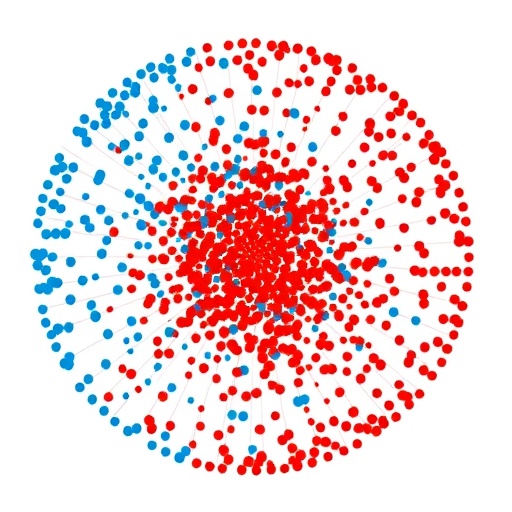
Runze Chen and Qiangkui Leng of the School of Electronics and Information Engineering at Liaoning Technical University have introduced a new algorithm that promises to reshape how machine learning systems handle one of their most stubborn problems: class imbalance. In a study published in Knowledge and Information Systems, the researchers present DPDO, a dynamic Poisson disk oversampling method that borrows an idea from computer graphics and applies it to the task of manufacturing synthetic training data for underrepresented classes. Their approach, tested across 27 benchmark datasets against eleven established oversampling techniques, achieved superior results in both F1 score and G-mean, two of the most widely trusted metrics for evaluating performance on imbalanced classification problems.
Class imbalance is everywhere in real-world data. In medical image classification, fraudulent credit transactions, software defect prediction, and machine fault diagnosis, the examples that matter most — the rare disease case, the fraudulent payment, the defective component — are vastly outnumbered by ordinary ones. When a classifier is trained on such lopsided data, it tends to learn a simple, profitable shortcut: predict the majority class almost all the time. The resulting model can appear highly accurate while being nearly useless for its actual purpose, because it misses precisely the cases it was built to catch. The problem is not marginal. Studies cited by the authors span domains from multi-resident activity recognition to credit risk assessment, and a substantial research literature has grown around techniques for correcting the imbalance before a classifier ever sees the data.
The most influential of these techniques is SMOTE, the synthetic minority oversampling technique introduced by Chawla and colleagues in 2002. Rather than altering the classifier or simply duplicating minority examples, SMOTE changes the data distribution itself. It works by selecting a minority-class sample, finding one of its nearest neighbors, and generating a new synthetic sample somewhere along the straight line connecting the two points — a process known as linear interpolation. By repeating this operation, SMOTE inflates the minority class with plausible new instances and gives the classifier more material to learn from. The idea spawned a family of descendants: Borderline-SMOTE focuses synthesis on samples near the decision boundary between classes, ADASYN concentrates on hard-to-learn examples, and MWMOTE assigns weights to minority instances based on their importance. Cluster-based variants, fuzzy rough prototype selection methods, and density-aware approaches have pushed the concept further.
Yet Chen and Leng identify a shared weakness running through much of this lineage. Nearly all SMOTE-derived methods rely exclusively on local linear interpolation between a sample and its nearest neighbors. They are, in effect, nearsighted. The synthesis process looks only at the immediate vicinity of each point and never considers the global neighborhood structure of the data — the overall shape, spacing, and organization of the minority class as a whole. The consequence is that generated samples can cluster too tightly, overlap with the majority class, or fail to represent the full diversity of the minority distribution. The samples are locally plausible but globally unrealistic, and the diversity of the augmented dataset suffers as a result.
The authors’ solution draws on an unexpected source: Poisson disk sampling, a technique long used in computer graphics to distribute points evenly across a surface. The defining property of Poisson disk sampling is that any two generated points are guaranteed to be separated by at least a minimum radius. This blue-noise characteristic produces distributions that are uniform yet random-looking — precisely the quality that avoids both the clumping of naive random sampling and the rigidity of regular grids. In graphics, this property makes Poisson disk sampling ideal for stippling, texture synthesis, and Monte Carlo rendering. In the context of oversampling, the same mathematics becomes a tool for placing synthetic minority samples at comfortable distances from one another, covering the feature space evenly without overcrowding any region.
DPDO operates in several carefully ordered stages. First, the algorithm performs noise removal. For each sample, it calculates the total distance to its K-nearest neighbors; samples whose neighborhoods are anomalously distant or structurally inconsistent are treated as noise and excluded from the synthesis process. This cleaning step matters because interpolating from noisy or mislabeled points propagates errors into the synthetic data. Second, DPDO identifies clusters of minority points with similar features, recognizing that real-world minority classes are rarely single coherent blobs — they often consist of several distinct subgroups, each with its own character. Third, and most distinctively, the algorithm dynamically expands the oversampling region within these clusters. Rather than using a fixed-radius sampling disk, DPDO adapts the region based on the structural constraints of each cluster, growing the area from which new samples are drawn in response to the local geometry. Within the circular region thus defined, the Poisson disk criterion governs the placement of new synthetic points, ensuring adequate spacing while the dynamic expansion ensures coverage.
The result, the authors report, is a set of synthetic minority samples that are more realistic, more uniform, and more diverse than those produced by conventional methods. The global neighborhood awareness prevents the algorithm from piling new samples into already crowded areas or placing them in regions that violate the overall distribution of the class. The density-adaptive control, meanwhile, lets the algorithm respond to local conditions: sparse regions receive more aggressive expansion, while dense cores are treated more conservatively. The combination addresses both the diversity problem and the authenticity problem that limit purely local interpolation schemes.
The empirical evaluation was unusually thorough. The authors compared DPDO against eleven representative oversampling baselines across 27 benchmark datasets, a scale that lends statistical weight to the findings. Performance was assessed using the F1 score, which balances precision and recall, and G-mean, which measures the geometric mean of classification accuracy on each class and is therefore sensitive to neglect of the minority class. To guard against spurious conclusions, the researchers applied Friedman’s rank-based statistical test — a nonparametric method that avoids assumptions of normality — followed by Holm’s sequentially rejective multiple test procedure to control for the risk of false positives across many comparisons. DPDO’s superiority held under this scrutiny, indicating that the gains are systematic rather than artifacts of particular datasets or lucky splits.
The implications extend well beyond benchmark datasets. Class imbalance learning has become a foundational concern in modern applied machine learning, and the literature the authors survey touches on everything from imbalanced graph learning to cost-sensitive medical diagnosis. The paper’s reference list alone maps the field’s breadth: oversampling methods for machine fault diagnosis with small and imbalanced data, evaluation practices for imbalanced medical image classification, undersampling methods based on minority class density, deep generative approaches to oversampling, and class-imbalanced learning on graphs. A more effective, principled data-level method could improve any pipeline in which rare events must be detected reliably — an increasingly common requirement as machine learning systems are deployed in high-stakes settings.
It is worth emphasizing what DPDO does not do. It does not modify the classifier, add costs to misclassification, or require access to a generative deep model. Like SMOTE before it, it operates entirely at the data level, reshaping the training distribution before learning begins. This makes it compatible with virtually any standard classification algorithm — support vector machines, decision trees, neural networks — and relatively straightforward to integrate into existing workflows. It also sidesteps some of the practical difficulties of deep generative oversampling, which can be data-hungry and unstable when the minority class is, by definition, small.
The work also represents a pleasing example of cross-disciplinary transfer. Poisson disk sampling was developed for problems that had nothing to do with classification: distributing samples for rendering, arranging elements in stippled artwork, and generating well-spaced designs in geometric contexts. Recognizing that the blue-noise property solves an analogous problem in feature space — how to add points that are both well-distributed and faithful to an underlying structure — is the kind of conceptual leap that drives methodological progress in machine learning. The authors’ earlier work on oversampling borderline minority instances, published in Complex Intelligent Systems, clearly informed the new algorithm’s attention to where synthetic samples should live relative to the decision boundary.
The study, received in December 2025 and accepted in July 2026, was supported in part by the National Natural Science Foundation of China under grant 61602056, along with funding from Liaoning Technical University, including a PhD startup foundation grant and a GPU resource support program. Chen conducted the experimental research, and Leng wrote the main manuscript, with both authors reviewing the final paper. The work arrives as the machine learning community continues to grapple with the gap between laboratory benchmarks and messy real-world data, where imbalance is the rule rather than the exception. By combining a decades-old insight from computational geometry with a modern understanding of what makes synthetic samples useful, DPDO offers a reminder that sometimes the best new tool for a data science problem has been waiting in another field all along.
Cite Scienmag News
Denise Maddox. (September 6, 2026). Dynamic Poisson disk oversampling tackles class imbalance using minority clusters. Scienmag. https://scienmag.com/dynamic-poisson-disk-oversampling-tackles-class-imbalance-using-minority-clusters/
Denise Maddox. "Dynamic Poisson disk oversampling tackles class imbalance using minority clusters." Scienmag, 6 September 2026, https://scienmag.com/dynamic-poisson-disk-oversampling-tackles-class-imbalance-using-minority-clusters/. Accessed 6 September 2026.
Denise Maddox. "Dynamic Poisson disk oversampling tackles class imbalance using minority clusters." Scienmag. September 6, 2026. https://scienmag.com/dynamic-poisson-disk-oversampling-tackles-class-imbalance-using-minority-clusters/


