


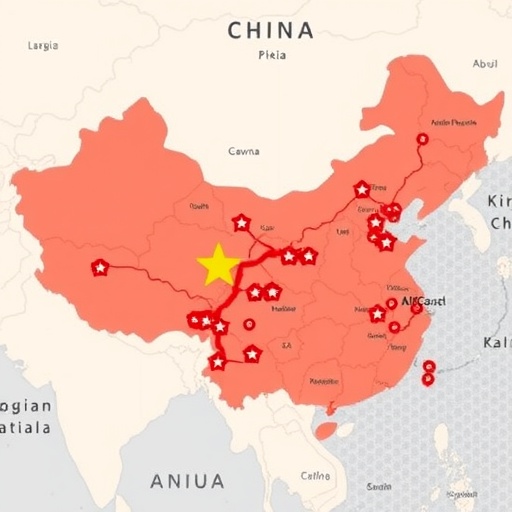
China’s digital-finance revolution is increasingly being examined not only as a story of mobile payments and online banking, but also as a force capable of reshaping the country’s long-standing urban–rural divide. A study by L. Zhao, published in Scientific Reports in 2026, investigates how digital financial inclusion and urban–rural integration develop together across China. Rather than viewing provinces and cities as isolated economic units, the research focuses on the spatial associations linking them, asking whether progress in one region is connected to—and potentially reinforced by—development in another.
The subject is significant because China’s economic geography remains deeply uneven. Large metropolitan areas generally benefit from stronger digital infrastructure, more sophisticated financial institutions, higher incomes and greater access to education. Rural communities, by contrast, have historically faced longer distances to banks, limited credit options and weaker connections to formal financial services. Digital platforms have begun to change that equation. Mobile payment systems, internet lending, online insurance and app-based investment services can reach users without requiring a traditional bank branch nearby. Yet access alone does not guarantee inclusion, and the impact of digital finance may depend on infrastructure, regulation, digital literacy and the broader strength of local economies.
Zhao’s study brings these issues together through the concept of synergy. In this context, synergy refers to the extent to which digital financial inclusion and urban–rural integration support one another rather than advancing along separate tracks. Digital finance can help rural households receive payments, obtain credit, sell products through e-commerce and participate in wider markets. At the same time, stronger urban–rural integration can create the income, connectivity and commercial activity needed for digital financial services to expand. The relationship is therefore potentially circular: improved finance may accelerate integration, while integration may create new demand for digital finance.
The research’s distinctive feature is its emphasis on spatial association networks. A conventional regional comparison might rank areas from highest to lowest and examine differences between them. Network analysis asks a different question: which regions are connected, how strong are those connections and what role does each region play within the larger system? In a spatial association network, regions can be represented as nodes, while statistically meaningful relationships between them form links. These links may reflect similar development patterns, spillover effects or coordinated changes. The approach makes it possible to identify not only leading regions, but also intermediaries, clusters and areas that remain weakly connected to the national development process.
This framework is particularly useful for studying China, where economic activity, migration, infrastructure and information flows cross administrative boundaries. A county or city may benefit from financial innovation developed elsewhere, while rural producers may depend on urban logistics, platforms and consumers. Spatial statistical tools can be used to detect whether high or low levels of development cluster geographically, while network measures can describe the structure of those connections. Indicators such as network density, degree centrality and clustering help reveal whether the system is becoming more integrated, whether influence is concentrated in a few hubs and whether regional cooperation is broadening over time.
The word “evolution” in the article title points to a dynamic analysis rather than a single snapshot. Digital financial inclusion is changing rapidly as smartphones, broadband coverage, cloud computing and artificial intelligence lower the cost of delivering financial services. Urban–rural integration is also evolving through rural revitalization policies, transport expansion, migration, agricultural modernization and the growth of online commerce. Tracking the relationship over successive periods can show whether cooperation is becoming more widespread or whether development remains concentrated in established economic centers. It can also reveal whether the network is shifting from a hub-and-spoke structure toward a more balanced pattern of regional interaction.
Such an analysis can expose a crucial distinction between digital access and meaningful financial inclusion. A person may technically possess a mobile payment account yet remain unable to obtain affordable credit, insurance or investment products. Researchers therefore commonly assess digital financial inclusion through multiple dimensions, including the breadth of access, the depth of service use and the degree of digitalization. Urban–rural integration is similarly broader than simple income convergence. It may involve the movement of labor, equalization of public services, coordinated infrastructure, industrial linkages and the circulation of goods, capital and information. Examining these dimensions together allows the study to address whether digital finance is narrowing structural gaps or merely increasing the speed of transactions in already-advantaged regions.
The findings are likely to matter for policymakers because network-based evidence can change how regional development is designed. If a small number of economically powerful areas act as gateways linking rural regions to national markets, policy could focus on strengthening those connections while preventing excessive concentration. If neighboring regions display strong mutual influence, coordinated financial regulation, interoperable digital platforms and shared infrastructure may produce greater benefits than isolated local initiatives. Conversely, regions that remain peripheral may require targeted investment in broadband, cybersecurity, consumer protection, digital skills and inclusive credit systems. The network perspective directs attention toward relationships, not simply regional scores.
There is also a wider lesson in the study’s approach. Digital finance is often presented as an automatic equalizer, but technology does not erase geography by itself. Platforms can reduce distance, yet unequal education, income, connectivity and institutional capacity can reproduce old disparities in digital form. By examining the spatial structure and changing synergy between finance and integration, Zhao’s research places China’s digital transformation within that more complicated reality. The study offers a framework for understanding whether technological connectivity is translating into shared development—and how regional relationships may determine who benefits most from the next phase of the digital economy.
Cite Scienmag News
Denise Maddox. (August 12, 2026). China’s Spatial Networks Reveal Growing Synergy Between Digital Finance and Urban-Rural Integration. Scienmag. https://scienmag.com/chinas-spatial-networks-reveal-growing-synergy-between-digital-finance-and-urban-rural-integration/
Denise Maddox. "China’s Spatial Networks Reveal Growing Synergy Between Digital Finance and Urban-Rural Integration." Scienmag, 12 August 2026, https://scienmag.com/chinas-spatial-networks-reveal-growing-synergy-between-digital-finance-and-urban-rural-integration/. Accessed 5 September 2026.
Denise Maddox. "China’s Spatial Networks Reveal Growing Synergy Between Digital Finance and Urban-Rural Integration." Scienmag. August 12, 2026. https://scienmag.com/chinas-spatial-networks-reveal-growing-synergy-between-digital-finance-and-urban-rural-integration/


