


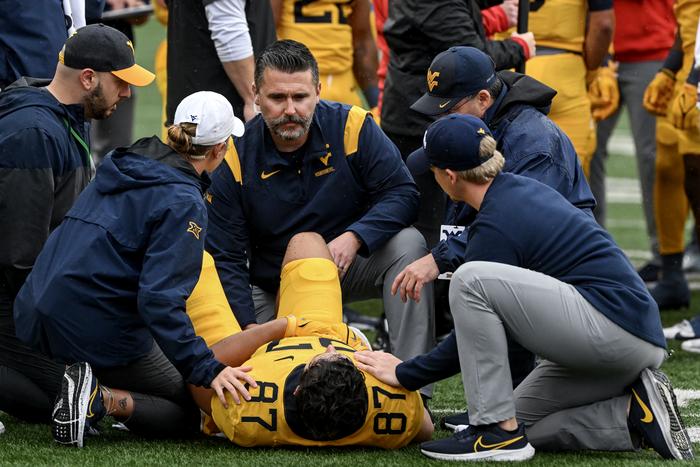
A national position statement on emergency action plan development and implementation in sports from a West Virginia University athletic training researcher sets in motion new priorities for responding to catastrophic injuries. The recommendations apply to sports through all levels, from youth to high school to collegiate and professional leagues.

Credit: WVU Photo/Jennifer Shephard
A national position statement on emergency action plan development and implementation in sports from a West Virginia University athletic training researcher sets in motion new priorities for responding to catastrophic injuries. The recommendations apply to sports through all levels, from youth to high school to collegiate and professional leagues.
“The ultimate goal of this position statement is to reduce unnecessary deaths from sport participation. We want this document to save more lives,” said Samantha Scarneo-Miller, assistant professor and program director for the Master of Science in Athletic Training program in the WVU School of Medicine, who is lead author for the position statement.
Scarneo-Miller was tapped by the National Athletic Trainers’ Association, NATA, to update the organization’s 22-year-old document. The position statement is revised to recommend designating an emergency action plan coordinator who collaborates with other athletic staff, enhancing venue-specific plans to include variables for each sport and comprehensive documentation of incidents.
The leading causes of catastrophic injury in sports are cardiac arrest, exertional heat stroke, traumatic head injury and cervical spine injury.
Published in the National Athletic Trainers’ Association Journal of Athletic Training, the position statement provides a framework for emergency action plan development and implementation. This includes recommendations for the preparations and on-site emergency response of health care professionals and other stakeholders to catastrophic or potentially catastrophic injuries in a pre-hospital setting.
The position statement includes several updates and recommendations. Instead of a one-size-fits-all approach, it offers general guidelines that teams can tailor to their specific settings and best use of resources.
Among those is the integration of a pre-event medical meeting, an informational session previously termed “medical timeout” that will occur before a competition and provide details on emergency procedures and signals, and equipment locations.
Expanding on previous guidelines focusing on venue-specific emergency action plans, the new document suggests incorporating the distinct needs of various sports in relation to the skills of assigned personnel and any changes in facilities, such as new construction.
“Having a plan for just the facility isn’t good enough anymore,” Scarneo-Miller said. “One facility might be used by different teams with different personnel. We need a sport- and venue-specific emergency action plan because coaches and staff have their own unique skills they can contribute to the plan activation.”
The importance of designating an emergency action plan coordinator is also emphasized, suggesting that the duty be shifted solely from athletic trainers to include collaboration with the whole athletic staff. The outcome would result in a plan that is more effective in development and implementation.
“The position statement stresses the importance of having an EAP coordinator that is supported by an interdisciplinary health care team,” Scarneo-Miller said. “The athletic trainer might be the one coordinating the plan, but they have coaches, administrators, physicians and athletes who need to be involved in reviewing and implementing the plan. We’re really trying to emphasize to athletic trainers that they have so many other resources they may not be utilizing.”
The systematic approach to the position statement focuses on evolving medical science and was formulated with input from professionals in a variety of fields, including sports medicine physicians and athletic trainers from multiple settings. It’s the first position statement developed under NATA’s new procedures, emphasizing an objective approach to author team selection, considering diversity in gender, race, location, specialty and setting.
“Previously, clinicians have not been authors on position statements as the documents have been highly focused on the newest research for clinicians to use,” Scarneo-Miller said. “But the NATA is pushing hard to ensure clinicians voices are heard when developing these recommendations, since they are the ones who will be translating this document into clinical practice.”
Scarneo-Miller stressed the importance of unveiling this new position statement. “We invite stakeholders and partners in embracing these essential recommendations, working together to create a culture of preparedness and safety that will protect and benefit our athletes.”
Scarneo-Miller’s presentation of the position statement was part of NATA’s 75th Clinical Symposia and AT Expo June 25-28 in New Orleans.
Journal
Journal of Athletic Training
Method of Research
Systematic review
Subject of Research
People
Article Title
National Athletic Trainers’ Association Position Statement: Emergency Action Plan Development and Implementation in Sport
Article Publication Date
26-Jun-2024
Cite Scienmag News
Courtney Benton. (June 26, 2024). WVU changing the game for sports emergency action plans. Scienmag. https://scienmag.com/wvu-changing-the-game-for-sports-emergency-action-plans/
Courtney Benton. "WVU changing the game for sports emergency action plans." Scienmag, 26 June 2024, https://scienmag.com/wvu-changing-the-game-for-sports-emergency-action-plans/. Accessed 6 September 2026.
Courtney Benton. "WVU changing the game for sports emergency action plans." Scienmag. June 26, 2024. https://scienmag.com/wvu-changing-the-game-for-sports-emergency-action-plans/

