


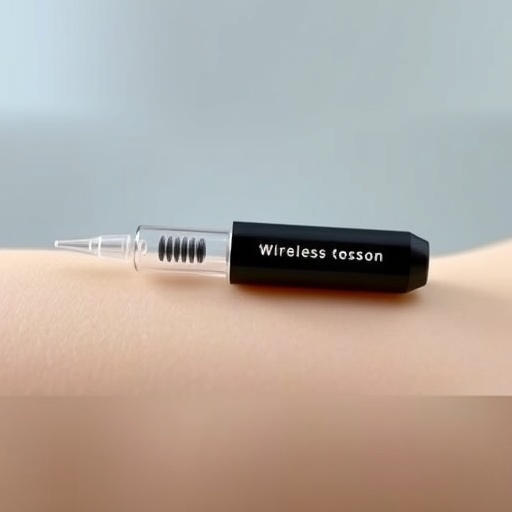
Chronic pain affects more than a billion people worldwide, yet the tools clinicians use to manage it have changed remarkably little in decades. Oral analgesics act systemically, flooding the entire body with medication to treat a pain signal that may originate in a patch of tissue a few millimeters across. Opioids carry dependence risks that have fueled a global public health crisis, while transcutaneous electrical nerve stimulation units rely on bulky external electrodes that deliver current through the skin’s protective barrier rather than directly to the sensory nerves beneath it. A new study published in Nature Communications now describes a wearable device that aims to close this therapeutic gap by combining dissolvable microneedles, programmable electrical stimulation, and internet-connected control into a single patch-sized platform that can be tailored to an individual patient’s pain profile and monitored remotely in real time.
The device, developed by a research team led by Hanul Kim, S.K. Bang and S.Y. Kang and their colleagues, is described as a wireless, Internet of Things-enabled microneedle electroceutical. The term “electroceutical” reflects a growing field in which nerve activity is modulated with electrical signals instead of drugs. Rather than swallowing a capsule that distributes its active compound throughout the bloodstream, a patient wearing an electroceutical receives precisely timed pulses delivered to the exact peripheral nerves that carry pain information from the affected tissue. In the new system, the interface between electronics and biology is an array of microneedles: hair-thin projections, each measuring on the order of hundreds of micrometers, that pierce only the outermost, avascular layer of the skin, the stratum corneum, before reaching the electrically conductive viable tissue below. Because the needles are so short, the penetration is minimally invasive and generally painless, which distinguishes microneedle interfaces from the hypodermic needles used in injections.
The engineering challenge that the researchers set out to solve is fundamentally one of impedance and geometry. Intact skin is an excellent barrier, and it is also a poor electrical conductor; dry stratum corneum can present impedances orders of magnitude higher than the underlying dermis. When a conventional surface electrode delivers current through this barrier, much of the energy is dissipated in the skin itself, producing uncomfortable sensations, heating, or irritation before a therapeutically meaningful current density reaches the target nerve. Microneedle electrodes bypass the barrier altogether. By inserting an array of conductive needles through the stratum corneum and into the viable epidermis and upper dermis, where the free nerve endings that detect noxious stimuli actually reside, the device establishes a low-impedance electrical pathway directly adjacent to the nociceptive afferents whose activity it seeks to modulate. This proximity means that far lower stimulation amplitudes are needed to achieve analgesic effects, reducing power consumption and improving safety margins, both critical considerations for a battery-powered wearable.
The wireless and connected aspects of the platform are what elevate it from a novel electrode design to what the authors call a personalized and connected pain management system. The patch incorporates an onboard stimulation circuit driven by a low-power microcontroller, a wireless radio for communication with a smartphone or gateway device, and sensing electronics that monitor the electrical environment at the needle-tissue interface. Stimulation parameters, including pulse amplitude, frequency, pulse width, and duty cycle, are not hard-wired into the device but are programmable over the wireless link. This architecture means that a clinician, or an automated algorithm running on a connected device, can adjust the stimulation pattern for a specific patient and a specific pain condition without the patient removing the patch. In effect, the device treats the stimulation protocol itself as a prescription, one that can be titrated, revised, and optimized over the course of treatment in the same way a physician adjusts a drug dose.
Personalization is central to the design philosophy because pain is notoriously variable, both between individuals and within a single individual over time. The peripheral and central mechanisms that generate chronic pain differ sharply between, for example, neuropathic pain resulting from nerve injury, inflammatory pain accompanying tissue damage, and nociceptive pain from ongoing mechanical stress. Electrical stimulation protocols that suppress one type of pain may be ineffective or even uncomfortable for another. Frequency is a particularly important variable: low-frequency stimulation on the order of a few hertz is thought to promote the release of endogenous opioids, while higher frequencies in the tens to hundreds of hertz can activate inhibitory interneurons in the dorsal horn of the spinal cord through mechanisms more akin to a local gate-closing effect. By making all of these parameters adjustable and by pairing the patch with a connected software interface, the researchers built a system in which the therapeutic waveform is a tunable variable rather than a fixed property.
The sensing side of the device adds another layer of clinical utility. Because the microneedle electrodes sit in direct electrical contact with the tissue, the same array that delivers stimulation can also acquire physiological signals. Impedance measured across the electrode-tissue interface provides information about skin contact quality, tissue hydration, and potentially local inflammatory state, since inflammation alters the electrical properties of extracellular fluid and tissue. The device can therefore verify that it is properly positioned and functioning before delivering a stimulation session, and it can log data continuously over hours or days of wear. When streamed over the Internet of Things link, these data create a longitudinal record of device usage and tissue status that is invisible to conventional pain treatments. A physician reviewing such a record can see not only how often a patient used the device but how their tissue response evolved, informing decisions about adjusting therapy.
To evaluate the platform, the team combined bench-top characterization, experiments in animal models of pain, and system-level demonstrations of the connected workflow. In the animal studies, the microneedle patch was applied to the skin over regions where experimental pain had been induced, and stimulation was delivered according to programmable protocols. Behavioral assays of pain sensitivity then served as the readout of analgesic efficacy. The results, as reported in the study, demonstrated that wirelessly controlled stimulation through the microneedle interface could measurably reduce pain responses, and that the magnitude of the effect depended on stimulation parameters in ways consistent with the team’s design rationale. The low impedance of the microneedle contact allowed the device to achieve these effects at currents substantially smaller than those required by conventional surface electrodes, validating the core physical argument for the microneedle approach and extending the effective operating life of the battery-powered patch.
The researchers also emphasized the system-level integration that distinguishes their work from earlier microneedle demonstrations. Fabricating a sharp, mechanically robust microneedle array is a well-studied problem; integrating such an array with a flexible substrate, a wireless communication module, a power source, and control electronics in a conformal patch that survives the mechanical stresses of daily wear is considerably harder. The reported device packages these elements so that the rigid electronic components and the flexible skin-contacting regions are distributed to minimize discomfort and motion artifacts. The wireless link supports not only command delivery but also telemetry, enabling the “connected” portion of the system: data flows from patch to cloud or smartphone, and therapeutic instructions flow back. The authors frame this closed digital loop as a template for what they call personalized and connected medicine, in which wearable electroceuticals become nodes in a broader clinical data network.
The clinical implications extend across several major pain populations. Patients with chronic lower back pain, osteoarthritis, diabetic neuropathy, and post-surgical pain all represent conditions in which localized, drug-free neuromodulation could reduce reliance on systemic analgesics, opioids in particular. A connected device also addresses a practical barrier that has limited adherence to existing TENS-style therapy: patients frequently abandon home stimulation programs because they cannot tell whether the device is working, because electrode placement is fiddly, or because there is no feedback loop with their care team. Automatic contact verification, guided parameter adjustment, and remote monitoring are each aimed squarely at this adherence problem. Moreover, the data stream could eventually support machine-learning models that learn, from large populations of connected devices, which stimulation protocols work best for which pain phenotypes, turning each patient’s patch into both a treatment and a source of evidence.
Significant hurdles remain between this demonstration and routine clinical use. Long-term biocompatibility of the needle-tissue interface over multi-day wear, sterilization and single-use manufacturability, regulatory pathways that must treat the device as both a stimulation therapy and a connected data product, and the perennial question of how well animal-model analgesia predicts human therapeutic benefit all require further work. The authors are explicit that the study represents a platform validation rather than an approved therapy. Nevertheless, the convergence they demonstrate, of minimally invasive microneedle electrodes, programmable wireless stimulation, and Internet-connected monitoring, points toward a model of pain care in which the patch on a patient’s back is continuously informed by, and accountable to, the clinical team overseeing their treatment. If that model matures, the management of chronic pain could shift from periodic clinic visits and daily pills toward a continuous, data-rich, and individually calibrated therapy delivered from something no larger than a bandage.
Cite Scienmag News
Ophelia Keating. (September 6, 2026). Wireless smart microneedle device enables connected personalized pain management. Scienmag. https://scienmag.com/wireless-smart-microneedle-device-enables-connected-personalized-pain-management/
Ophelia Keating. "Wireless smart microneedle device enables connected personalized pain management." Scienmag, 6 September 2026, https://scienmag.com/wireless-smart-microneedle-device-enables-connected-personalized-pain-management/. Accessed 6 September 2026.
Ophelia Keating. "Wireless smart microneedle device enables connected personalized pain management." Scienmag. September 6, 2026. https://scienmag.com/wireless-smart-microneedle-device-enables-connected-personalized-pain-management/


