


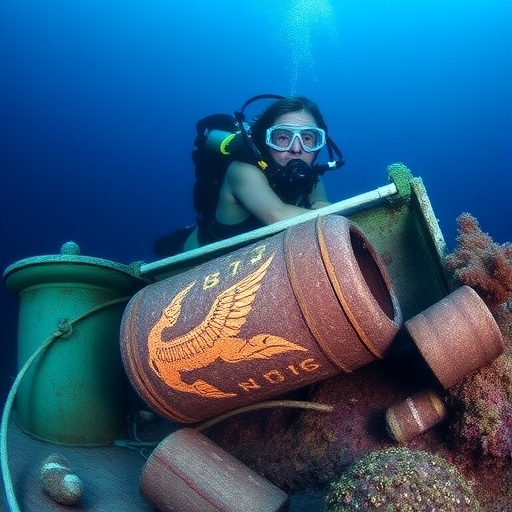
In a surprising revelation concerning the legacy of World War II’s environmental impact, recent research indicates that the sea-dumped munitions on the Baltic Sea floor are becoming thriving habitats for marine life, surpassing the surrounding sediment in biological abundance. This phenomenon challenges preconceived notions about the ecological dangers posed by sunken munitions, highlighting instead their unexpected role as anchoring substrates that foster diverse epifaunal communities despite the presence of toxic explosive compounds.
The backdrop to this study lies in the historical disposal methods of munitions prior to modern environmental regulations. Before international treaties such as the 1972 London Convention on the Prevention of Marine Pollution came into effect, unused explosive ordnance was routinely discarded at sea. These devices inherently contain hazardous substances—such as trinitrotoluene (TNT) and cyclotrimethylenetrinitramine (RDX)—widely recognized for their high toxicity to marine ecosystems. However, the robust metallic casings enclosing this ordnance provide solid surfaces where sessile and mobile marine organisms can attach, colonize, and flourish.
The research team, led by Andrey Vedenin and his colleagues, employed an advanced remotely operated underwater vehicle (ROV) to investigate a newly identified dumping ground in Lübeck Bay within the Baltic Sea. Conducted in October 2024, their expedition combined high-definition video documentation with water sampling and sediment analysis to assess the biological community structure on the warheads and the surrounding seafloor. Notably, they confirmed that the munitions were remnants of V-1 flying bombs—early-cruise missiles used by Nazi Germany during the latter stages of World War II.
Quantitatively, the density of organisms inhabiting the munitions casings vastly exceeded that found in adjacent sediments. Population estimates indicated an average epifaunal abundance of approximately 43,000 organisms per square meter on the hard surfaces of the ordnance, in stark contrast to roughly 8,200 organisms per square meter within the surrounding soft-bottom sedimentary environment. These figures align with prior observations of marine life associated with natural hard substrates in the Baltic Sea, indicating that the presence of a solid habitat is a critical driver of biodiversity and biomass in this region.
However, the water in proximity to these munitions exhibited significant variability in concentrations of explosive residues. Measurements ranged from micromolar to millimolar levels—with TNT and RDX concentrations fluctuating from 30 nanograms per liter up to 2.7 milligrams per liter. This upper limit approaches toxicity thresholds capable of inducing fatal effects in many marine species, underscoring a complex interplay between chemical hazards and habitat availability that influences community composition.
The study’s authors posit that the benefits conferred by the hard substrate outweigh the detrimental impact of dissolved toxins for many marine organisms. Such lifeforms preferentially colonized the metal casings rather than exposed explosive substances, suggesting a behavioral or physiological avoidance of the most contaminated surfaces while still deriving shelter and feeding grounds from the munitions. This nuanced ecological adaptation illustrates the resilience and plasticity of marine ecosystems confronting anthropogenic stressors.
While the munitions currently serve as unconventional marine habitats, the researchers advocate for future management interventions aimed at substituting these hazardous structures with purpose-built artificial substrates. Such replacements could sustain the benthic communities without the ongoing risk of toxic leachates compromising ecosystem health. This recommendation aligns with broader environmental goals to mitigate pollution while preserving and enhancing biodiversity in coastal and marine environments.
Parallel to the Baltic Sea investigation, a complementary study led by David Johnston and colleagues sheds light on another anthropogenic underwater habitat: the “Ghost Fleet” of Mallows Bay in Maryland, USA. This assemblage comprises 147 documented shipwrecks dating back to World War I, intentionally scuttled and burned in the late 1920s. These wrecks have transformed into ecological oases supporting a variety of species, including the osprey (Pandion haliaetus) and the Atlantic sturgeon (Acipenser oxyrinchus).
Utilizing aerial drones equipped with sophisticated imaging technologies, the team produced a comprehensive high-resolution photographic map of the entire fleet, achieving spatial detail down to an average of 3.5 centimeters per pixel. This unprecedented level of detail facilitates interdisciplinary research opportunities, making the dataset invaluable for ongoing archaeological explorations, ecological assessments, and cultural heritage preservation efforts. The Ghost Fleet exemplifies how historical artifacts can evolve into critical components of contemporary aquatic ecosystems.
These studies collectively underscore the complex ecological repercussions of maritime warfare legacies. They emphasize how human conflict, while initially inflicting environmental harm, can also inadvertently create novel habitats that sustain biodiversity in otherwise monotonous or degraded seafloor environments. Understanding these dynamics is vital for informed marine management and the formulation of strategies balancing pollution mitigation with habitat conservation.
Moreover, these findings resonate with global Sustainable Development Goals, particularly SDG 14, which advocates for the conservation and sustainable use of oceans, seas, and marine resources. By revealing unexpected ecological niches formed by wartime debris, these investigations contribute critical insights into harmonizing human maritime activities with the preservation of marine ecosystems.
Looking ahead, interdisciplinary collaborations involving marine biologists, chemists, ecologists, and environmental policymakers will be pivotal in monitoring and managing the long-term fate of sea-dumped munitions and shipwrecks. Advanced technologies such as ROVs, aerial drones, and chemical sensors combined with high-resolution mapping will continue to enhance understanding of these anthropogenic habitats.
In summary, the Baltic Sea’s WWII munitions dumpsite exemplifies a paradox where obsolete war machinery transforms into vibrant underwater biotopes. Despite high-level toxic chemical threats, the hard substrates foster a rich assemblage of marine life, reshaping our perception of contaminated sites as potential refuges rather than solely ecological liabilities. These revelations challenge scientists and conservationists to rethink remediation and habitat restoration policies, integrating historical contexts with contemporary ecosystem needs.
News Publication Date: 25-Sep-2025
Web References: http://dx.doi.org/10.1038/s43247-025-02593-7
Cite Scienmag News
Violet Maxwell. (September 25, 2025). World War Artifacts Beneath the Waves: Creating New Habitats for Marine Life. Scienmag. https://scienmag.com/world-war-artifacts-beneath-the-waves-creating-new-habitats-for-marine-life/
Violet Maxwell. "World War Artifacts Beneath the Waves: Creating New Habitats for Marine Life." Scienmag, 25 September 2025, https://scienmag.com/world-war-artifacts-beneath-the-waves-creating-new-habitats-for-marine-life/. Accessed 4 September 2026.
Violet Maxwell. "World War Artifacts Beneath the Waves: Creating New Habitats for Marine Life." Scienmag. September 25, 2025. https://scienmag.com/world-war-artifacts-beneath-the-waves-creating-new-habitats-for-marine-life/


