


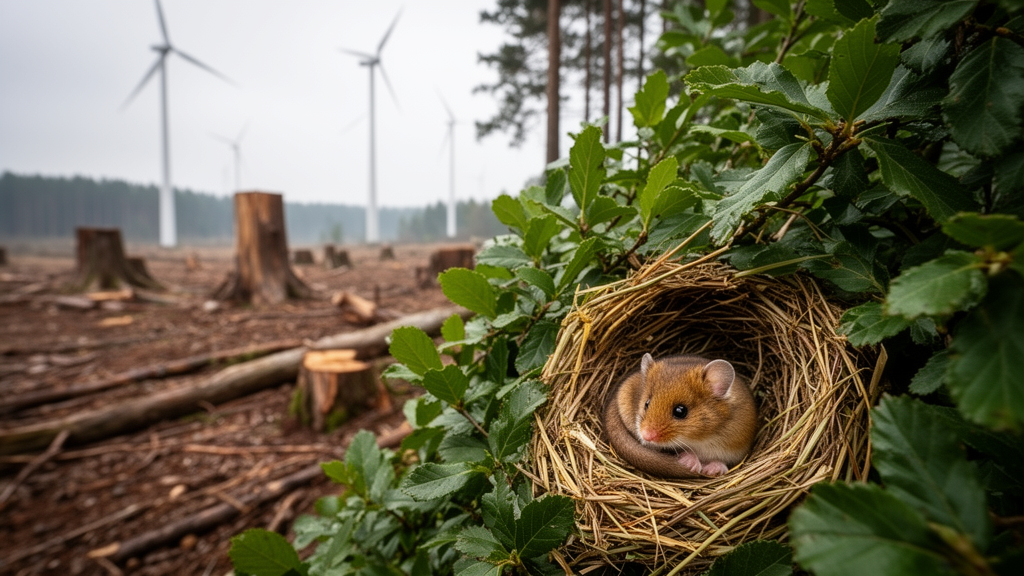
Europe’s race to build renewable energy is colliding with one of its most secretive forest dwellers. The hazel dormouse (Muscardinus avellanarius), a small, tree-climbing rodent protected under the European Habitats Directive, is increasingly finding itself in the footprint of wind energy projects, as taller turbines push construction deeper into forested landscapes. A new modelling study published in the journal Nature Conservation now delivers a pointed challenge to the way developers account for the damage: the widely used rule of thumb that clearing one hectare of forest destroys one dormouse home range badly underestimates the true impact. In the simulations, a single hectare of cleared forest typically sliced through two to four home ranges at once, and in the worst case as many as twelve.
The research team, drawing on one of the few long-term dormouse monitoring datasets in existence, digitised home range maps from a 60-hectare study site embedded in a roughly 3,000-hectare forest in south-western Lithuania. The site holds 272 nest boxes spaced 50 metres apart, checked twice a month from April to October over many years, with every captured dormouse individually ringed. Two seasons were selected to represent contrasting population conditions: 2010, a high-density year with 1.4 adults per hectare and 92 recorded individuals, and 2013, a low-density year with 0.7 adults per hectare and 45 individuals. Using the GIS software QGIS, the researchers reconstructed each animal’s home range as a minimum convex polygon around its capture points, buffered by 25 metres.
Onto this living map, the team superimposed a barrage of simulated clear-cuts, the bare patches of felled ground needed to erect and assemble wind turbines. Sixteen scenarios were tested, combining two shapes, compact squares and elongated strips, with four sizes of one, two, four and six hectares, each under both low and high population densities. For every scenario, 1,000 random clear-cut placements were generated within the monitoring grid, and each was intersected with the mapped home ranges. Statistical models, including Poisson generalised linear models for the count of affected home ranges and beta regressions for the proportion of each range overlapped, then quantified how the damage scaled with size, shape, density and sex. A home range counted as affected if more than five per cent of its area was cleared.
The headline result is stark. At low density, a one-hectare clear-cut affected a median of two home ranges; at high density, the median rose to four, with a maximum of twelve home ranges touched by a single square hectare cut. Because dormouse densities in commercial forests are naturally low, roughly one to two adults per hectare, individual ranges are surprisingly small, yet they are packed together and overlap extensively. In the high-density year, more than half of the total home range area consisted of ground shared by two to four individuals. When half the population’s ground is doubles-up territory, any felling operation is mathematically guaranteed to hit multiple animals at once, not one.
Scale matters enormously. At low density, growing the cut from one to six hectares raised the median number of affected home ranges from two to six, equivalent to roughly four to thirteen per cent of the whole population for a single felling site. The statistical models showed that the increase was far steeper at high density: for females, moving from a one-hectare to a six-hectare cut more than tripled the number of affected ranges, with a rate ratio of about 3.17. Shape played a subtler role. Strip-shaped cuts, at high density, intersected significantly more individual home ranges than square cuts, nine per cent more for females and twelve per cent more for males. Squares, however, devoured a larger share of each range they touched, overlapping female ranges by roughly 6.5 to 7.1 percentage points more than strips did.
Sex-specific vulnerability emerged as one of the most consistent findings. Male dormice roam larger territories, so more male home ranges were clipped by every clear-cut configuration, up to 79 per cent more than female ranges for the largest strip cuts. But females, with their smaller ranges, lost a proportionally greater slice of their world: at high density, female overlap exceeded male overlap by between 7.9 and 15.9 percentage points on square cuts. That asymmetry carries real demographic weight, because breeding females are the engine of population growth. If adult female numbers dip below a critical threshold, breeding events and autumn juvenile recruitment collapse, and a local population can slide towards decline even when males remain relatively abundant.
The consequences for individual animals are often lethal rather than merely inconvenient. Dormice are famously reluctant to flee disturbance: in a previous study, most individuals stayed put even when chainsaws operated nearby, leaving them exposed to being crushed by felled trees or vehicles. The danger peaks in winter, when dormice lie in torpor and cannot escape, and between May and October, when breeding females may abandon litters amid felling and timber transport. Survivors face a second bottleneck: their remaining habitat is now smaller, and if neighbouring forest is already occupied or unsuitable, they may be unable to establish a new range at all. Unlike conventional forestry clear-cuts, which regenerate into valuable early-succession dormouse habitat within a few years, the area permanently cleared for a turbine pad and its infrastructure is lost for good.
The study’s authors argue that the German planning convention, in which one hectare of clearance is offset as the loss of exactly one home range, should be retired in favour of site-specific assessment. Their data show that a one-hectare cut typically affects two to four ranges, and that the fraction of each range destroyed climbs steadily with cut size and population density. Practical recommendations follow directly from the results: keep clear-cuts as small as possible, favour elongated configurations over compact squares where the surroundings allow, never shrink occupied forest patches below the roughly 20 hectares thought necessary for a stable dormouse population, and time felling to avoid both winter torpor and the summer breeding season. Directional felling, which guides timber away from occupied areas, may also shepherd animals towards intact habitat.
There are important caveats, and the researchers are candid about them. Nest-box monitoring, while reliable, likely underestimates true home range sizes, since dormice can use boxes and surrounding vegetation without being detected, meaning the reported number of affected ranges is probably a conservative floor rather than a ceiling. The five per cent overlap threshold is an operational choice, not an ecological one, as no study has yet established how much of a range can be cleared before a dormouse is seriously harmed. The simulations also excluded fragmentation effects from new roads built for construction and maintenance, which can itself barrier movement and mate-finding. The team calls for real-world monitoring of actual clear-cuts using a before-after, control-impact design to validate the modelled predictions.
The broader tension the study exposes is uncomfortable but unavoidable: meeting Paris Climate Goals requires wind energy to supply over a third of global electricity by 2050, and in Germany alone more than 2,500 wind turbines, about nine per cent of the national fleet, already stand in forest, each 2024 installation permanently clearing a median of 0.56 hectares, double the footprint of a decade earlier. Solving one environmental crisis by deepening another is a poor trade, and the hazel dormouse has become a test case for whether green infrastructure can be sited with genuine ecological precision. The message from Lithuania’s long-term data is clear: habitat loss for a territorial, low-density mammal does not scale in neat one-hectare units, and mitigation rules built on that assumption will keep undercounting the casualties.
Subject of Research: Impacts of wind-energy clear-cuts on hazel dormouse home ranges
Article Title: Considering hazel dormouse ( Muscardinus avellanarius ) home ranges to assess the impacts of development projects
Article References: Considering hazel dormouse ( Muscardinus avellanarius ) home ranges to assess the impacts of development projects. (n.d.). https://doi.org/10.3897/natureconservation.64.160352
Image Credits: AI Generated
DOI: 10.3897/natureconservation.64.160352
Keywords: hazel dormouse, wind energy, home range, clear-cut, forest ecology, habitat loss, population density, QGIS simulation, Habitats Directive, renewable energy, wildlife conservation, Germany
Cite Scienmag News
Alan Morgan. (October 16, 2026). Wind Farm Clear-Cuts Hit Far More Dormouse Homes Than Planners Assume. Scienmag. https://scienmag.com/wind-farm-clear-cuts-hit-far-more-dormouse-homes-than-planners-assume/
Alan Morgan. "Wind Farm Clear-Cuts Hit Far More Dormouse Homes Than Planners Assume." Scienmag, 16 October 2026, https://scienmag.com/wind-farm-clear-cuts-hit-far-more-dormouse-homes-than-planners-assume/. Accessed 16 October 2026.
Alan Morgan. "Wind Farm Clear-Cuts Hit Far More Dormouse Homes Than Planners Assume." Scienmag. October 16, 2026. https://scienmag.com/wind-farm-clear-cuts-hit-far-more-dormouse-homes-than-planners-assume/


