


Fungi are the invisible infrastructure of life on land. They recycle nutrients, partner with plant roots in symbioses that underpin entire forests, and stabilize ecosystems against disturbance. Yet when it comes to the law, they have been treated as an afterthought. Despite decades of appeals from mycologists, no fungus appears in the international legal instruments that govern wildlife conservation in the European Union, with one lone exception: a group of reindeer lichens, Cladonia sect. Cladina, listed under plants in an annex of the Habitats Directive. A new study published in IMA Fungus now delivers the first consolidated picture of how Europe’s legally protected fungi are actually distributed across national laws, and the picture is one of striking fragmentation.
The research team assembled and standardized every national list of legally protected fungi and lichens across the EU’s member states, drawing on documents scattered through government gazettes and legal portals, most of them written only in their national languages. After correcting outdated names and taxonomic synonyms against the MycoBank reference database, they arrived at a total of 884 non-lichenized fungal taxa and 787 lichenized taxa protected under the national legislation of 18 member states. It is the first time these scattered regulations have been unified into a single, taxonomically coherent dataset, giving researchers and legislators a common baseline for comparison.
The headline finding is how lopsided the protection is. Of the 27 EU member states, only 15 protect non-lichenized fungi at the national level and 16 protect lichens, and the numbers involved vary enormously, from as few as three species to more than 400. A handful of countries dominate almost completely: Croatia, Finland, and Poland together account for 88.3 percent of all legally protected non-lichenized fungi, while Finland, Poland, and Luxembourg account for 93.4 percent of protected lichens. Finland alone lists 472 lichen taxa, more than half of the entire EU total, and contributes nearly two-thirds of all lichen species protected in only a single country.
That last statistic carries real weight. Of the 884 protected non-lichenized fungi, 73.4 percent are singletons, meaning they are legally protected in just one member state. Among lichens the figure climbs to 80.1 percent. If any of these countries amended their legislation tomorrow, hundreds of species would lose their only legal safeguard in the entire Union. Many of these singletons belong to notoriously difficult groups, such as the corticioid and webcap-rich Cortinariaceae or the crustose Verrucariaceae, precisely the taxa that tend to be overlooked in broader conservation assessments. The data show that singleton species are far less likely to have been assessed for the global IUCN Red List than species protected across multiple countries, with odds roughly four times lower, leaving genuinely rare species in a bureaucratic blind spot.
Statistical analysis of the national lists revealed that they are not independent inventories but follow clear geographic patterns. Using the Sørensen dissimilarity index and Mantel tests, the researchers demonstrated a significant correlation between similarity in protected species composition and geographic proximity for both fungi and lichens, meaning neighboring countries tend to protect similar species. Hierarchical clustering grouped the three Baltic states together in both analyses, while Hungary, Poland, and Slovakia clustered on fungal protection. Interestingly, the lists of non-lichenized fungi were significantly nested: countries with shorter lists tended to protect subsets of a widely recognized core of priority species, suggesting an emerging international consensus built on years of fungal conservation advocacy. Lichen lists showed no such nesting, implying far less agreement on which lichens matter most.
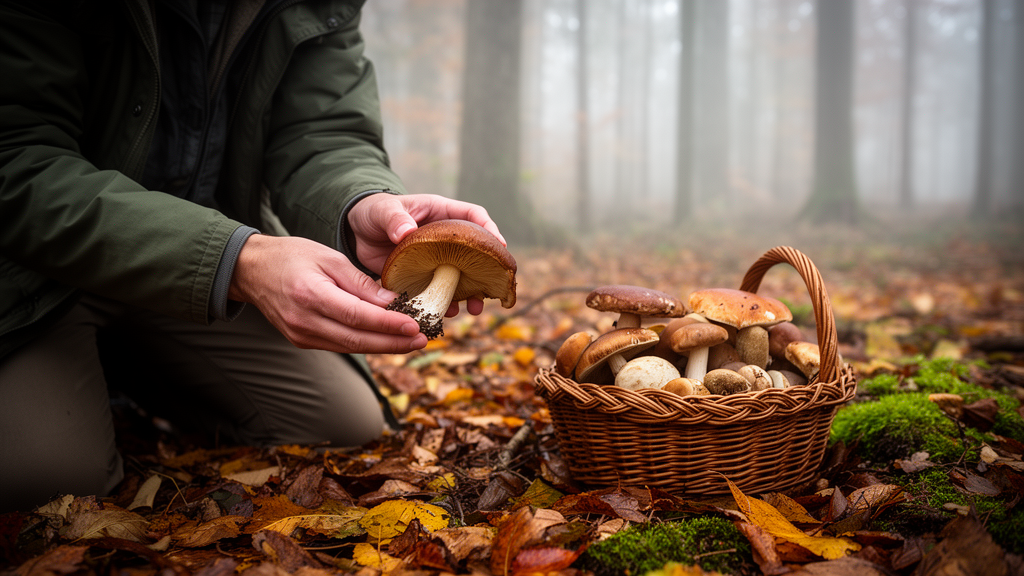
The study also exposes a deep aesthetic and cultural bias in what gets protected. The most heavily represented fungal families, Boletaceae, Agaricaceae, and Russulaceae, are exactly the ones that produce large, familiar mushrooms, many of them prized edibles. Charismatic porcini and their relatives dominate national schedules, while microfungi and species with inconspicuous or underground fruiting bodies are scarcely represented at all. Among lichens, three large families, Parmeliaceae, Verrucariaceae, and Ramalinaceae, make up more than a third of protected taxa. This bias matters beyond symbolism: legal listing is what brings a species into permitting procedures, environmental impact assessments, and monitoring programs in protected areas, so underlisted groups effectively fall outside those regulatory machinery entirely.
One persistent misconception the authors work to dispel is the confusion between Red Lists and legal protection. Red Lists, which most EU member states now maintain for fungi, are advisory tools that flag species of conservation concern but confer no legal status whatsoever. Legal protection, by contrast, is binding: it can restrict harvesting, trigger assessment requirements, and create accountability when permits are issued. The researchers note that evidence for legal protection improving species outcomes is strongest in charismatic animals, notably birds listed under the EU Birds Directive, while poorly funded groups like fungi reap fewer benefits, especially where enforcement and monitoring are sparse. Notably, long-term studies show that mushroom picking itself does little harm to fungal populations, so the value of listing popular edible species lies less in harvest limits than in the systemic record-keeping and institutional obligations that listing creates.
The authors propose a series of practical fixes. A centralized EU database of nationally protected species, hosted within existing infrastructure such as the European Nature Information System, would make the current patchwork visible and updatable at negligible financial cost, and could dynamically link legislative names to currently accepted taxonomy through systems like the GBIF Backbone Taxonomy. The recently adopted Nature Restoration Regulation offers another opening, requiring member states to conduct environmental monitoring on six-year reporting cycles; folding fungal diversity into those frameworks would generate population data for protected taxa while sharpening habitat-condition assessments. Habitat protection under the Habitats Directive already shelters substantial fungal diversity, but only incidentally; the study argues for making that benefit deliberate by considering fungi explicitly when habitats are designated and, ultimately, by listing fungal species in the international instruments themselves, from the Bern Convention onward.
The gaps extend to global science as well. While global IUCN Red List coverage of fungi has grown from just 56 assessed species in 2018 to more than 1,300 today, roughly half of assessed fungi turn out to be threatened, and European lichens remain largely absent from global assessments because existing lichen evaluations are dominated by species from the Americas. With 787 lichen taxa under national protection in the EU and four-fifths of them single-country species, the mismatch between national concern and global neglect leaves European lichens acutely vulnerable to shifts in domestic policy. A systematic IUCN assessment of European lichens, the authors conclude, is overdue. Until fungi are written into the same international frameworks that safeguard birds, bats, and orchids, Europe’s most consequential organisms will continue to depend on a patchwork of national laws, three-quarters of which protect each species in only a single place.
Subject of Research: Legal protection of fungi and lichens under national legislation in EU member states
Article Title: The legally protected fungi and lichens in the EU
Article References: Janowski, D. (2026). The legally protected fungi and lichens in the EU. IMA Fungus, 17, Article e202399. https://doi.org/10.3897/imafungus.17.202399
Image Credits: AI Generated
DOI: 10.3897/imafungus.17.202399
Keywords: fungi, lichens, conservation law, European Union, IUCN Red List, biodiversity, Habitats Directive, species protection, mycology, national legislation, singleton species, Nature Restoration Regulation
Cite Scienmag News
Roger Howard. (October 16, 2026). Fungi Fall Through Legal Cracks Across the EU, First Pan-European Audit Reveals. Scienmag. https://scienmag.com/fungi-fall-through-legal-cracks-across-the-eu-first-pan-european-audit-reveals/
Roger Howard. "Fungi Fall Through Legal Cracks Across the EU, First Pan-European Audit Reveals." Scienmag, 16 October 2026, https://scienmag.com/fungi-fall-through-legal-cracks-across-the-eu-first-pan-european-audit-reveals/. Accessed 16 October 2026.
Roger Howard. "Fungi Fall Through Legal Cracks Across the EU, First Pan-European Audit Reveals." Scienmag. October 16, 2026. https://scienmag.com/fungi-fall-through-legal-cracks-across-the-eu-first-pan-european-audit-reveals/


