


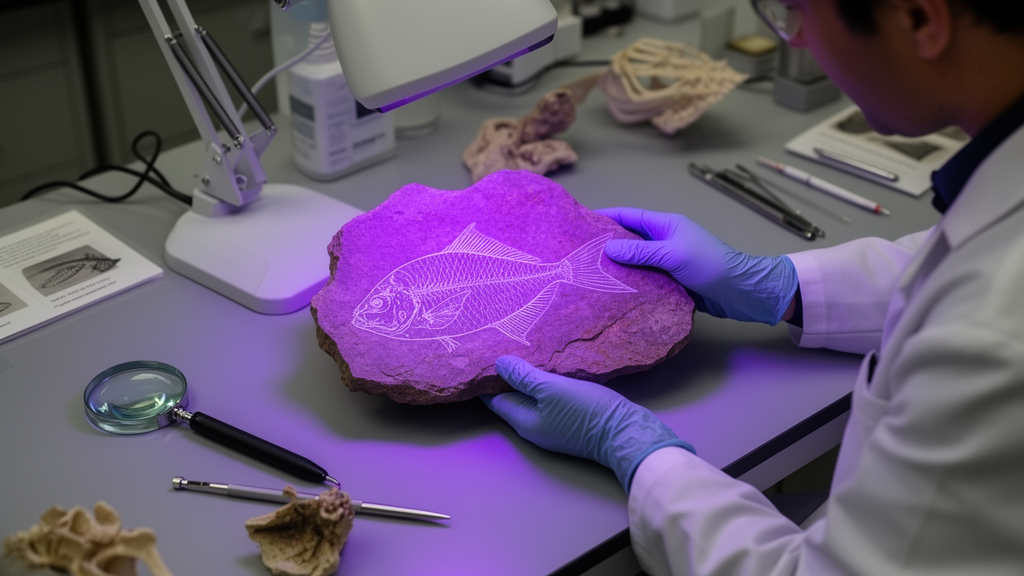
A quiet revolution is unfolding in the limestone slabs of southern Germany and the clay pits of eastern England. A new study published in the Swiss Journal of Palaeontology has re-described one of the most enigmatic families of Jurassic ray-finned fishes, the Mesturidae, and in doing so has split a single long-recognized genus into three, named two brand-new genera, and unveiled the first known juveniles of a fish that grew to more than half a meter in length. The work, based on decades of specimen hunting, newly discovered fossils, and ultraviolet photography, redraws a branch of the fish family tree that has puzzled palaeontologists since the nineteenth century.
The fishes in question belong to the Pycnodontiformes, an order of deep-bodied, often strikingly round bony fishes that thrived from the Late Triassic to the Eocene. Pycnodonts were equipped with pavement-like crushing teeth on the vomer and prearticular bones of the palate, an adaptation for cracking hard-shelled prey such as snails, clams, and sea urchins. Their evolutionary position, however, has long been contested. They have been variously classified as ganoidei, chondrosteans, relatives of aspidorhynchiform and pachycormiform fishes, sister group to teleosts, and stem-group teleosteans. More recent analyses place them among the most basal of all neopterygian fishes, a conclusion the new study endorses, while stressing that more basal pycnodontiforms still need to be described before their origins can be pinned down with confidence.
At the heart of the study is Mesturus verrucosus, the type species of the genus Mesturus, first described by Wagner in 1862 from a single large specimen of 50.7 centimeters total length from the Upper Jurassic limestones of Eichstätt in the Solnhofen Archipelago of Bavaria. Because that holotype was poorly preserved, Wagner figured only the caudal fin, whose rounded, unforked posterior margin served as his main justification for separating Mesturus from the related genus Gyrodus. Woodward provided a more detailed account in 1895 based on a better specimen now in the Natural History Museum in London. Yet for more than 150 years the species remained known almost exclusively from a handful of large adults, and its identity was muddied by a trail of misassigned specimens stretching through the literature.
The new work untangles that confusion with surgical precision. Specimens from the French locality of Cerin that Saint-Seine described in 1949 as Mesturus verrucosus are shown to belong to Gyrodus, a conclusion already hinted at by earlier authors and confirmed here by the crenulated tooth rims and central tubercles visible in the published illustrations. More significantly, several well-known specimens from the Solnhofen Archipelago that had been figured as Mesturus verrucosus by Frickhinger, Kriwet, Lambers, and Arratia and Schultze are now removed from the species and erected as a new genus and species, Goodichthys prettii. The dentition was the giveaway: the teeth of these specimens bear a granulated rim and a central cavity, whereas true Mesturus teeth are smooth, without crenulations, and carry a single median ridge set at ninety degrees to the body axis.
Goodichthys prettii is no minor player. Reaching up to 29 centimeters in total length, it is a medium-sized pycnodontiform with a slender body, a body depth of only 52 to 57 percent of standard length, and a suite of unique features. It possesses the longest caudal peduncle covered with massive scales of any known pycnodontiform, with the origin of the caudal fin lying far behind the last dorsal and anal fin rays. It also sports large, horizontally elongated scales below the cleithrum and in the throat region, a feature unique among the order. Its dorsal and anal fins are elongated and strip-like, with only 19 to 22 fin rays that branch at most twice, compared with the 29 to 30 dorsal fin rays of Mesturus verrucosus. Its scale rows do not bifurcate, another fundamental contrast with the type genus.
The second new genus, Aminiichthys, rescues a species that Woodward described in 1895 and 1896 from the Middle Jurassic Oxford Clay near Peterborough, England, as Mesturus leedsi. Known only from heads, dentitions, anterior trunk fragments, and a piece of caudal fin, Aminiichthys leedsi was a giant of its time, probably reaching up to 50 centimeters and likely the stratigraphically oldest pycnodontiform to achieve such dimensions. It differs from Mesturus in the granulated margins and shallow apical indentations of its crushing teeth, in the absence of bifurcating scale rows, and in bearing larger but fewer granules on its scales and cranial bones. The study also sorts out a long-standing confusion over which specimen is the holotype, confirming that it is NHMUK PV P.8382, as Woodward himself fixed it, not the specimens erroneously cited by later authors. A sobering note accompanies the English material: fossils from the Oxford Clay are threatened by pyrite oxidation, and many articulated specimens are already cracking or disintegrating.
Perhaps the most exciting discoveries are the babies. Four to nine small specimens of Mesturus verrucosus, between 38 and 87 millimeters in total length, from Eichstätt and Painten have been assigned to the species for the first time and described in detail as juveniles. Newly taken ultraviolet photographs, particularly effective on fossils from Eichstätt and Solnhofen where bones fluoresce, reveal a wealth of previously unknown anatomy. In the smallest juveniles, the scales are incompletely developed, with only their anterior margins formed, and both the body scales and the dorsal ridge scales carry relatively large spines. In slightly larger juveniles, the ridge scales bear up to five smaller spines, and the granulations of the lateral line scales begin to appear. The neural spines are clearly visible beneath the incomplete scale cover, and in the smallest specimen the first 24 neural spines are separated from their neural arches, with only the posteriormost nine fused, a strikingly basal condition shared with other early pycnodontiforms.
The juveniles also settle a question of growth. Adult Mesturus verrucosus are among the largest known pycnodontiforms, exceeded only by Gyrodus circularis, with all five known adults between 435 and 507 millimeters total length and a body depth of 62 to 67 percent of standard length. The juveniles are even rounder, with body depths of 79 to 94 percent of standard length. Crucially, the elongated Goodichthys, with its 52 to 57 percent body depth, cannot be an intermediate growth stage between the juveniles and adults of Mesturus, which removes one of the last obstacles to recognizing the two as distinct genera. The authors’ identification of the juveniles rests on matching counts of scale rows and of dorsal and anal pterygiophores between young and old specimens.
To place the new genera in context, the study presents a new cladistic analysis of the Pycnodontiformes using 106 characters and 41 taxa, searched heuristically with PAUP. The analysis yielded six most parsimonious trees of 687 steps and confirms the Mesturidae as a distinct family, now defined by imbricate scales covering the whole body, jagged sutural connections between trunk scales, cheeks covered by a mosaic of irregular polygonal dermal elements, a roughly horizontal vomer, and a large caudal peduncle with multiple scale rows in adults. Within the family, Mesturus verrucosus stands apart by its bifurcating scale rows, a feature otherwise known in the order only in Arduafrons prominoris, and by its smooth, ridged teeth. The analysis also places the Gyrodontidae as more basal than the Mesturidae, repositions Eomesodon as sister to a clade containing the brembodontids, macromesodontids and pycnodontids, and excludes the fragmentary taxa Paramesturus and Micropycnodon because too many of their characters remain unknown.
The result is a cleaner, more honest picture of a once-muddled branch of Jurassic life. The family Mesturidae now comprises Mesturus verrucosus from the late Kimmeridgian and early Tithonian of the Solnhofen Archipelago, Goodichthys prettii from the Eichstätt Basin, and Aminiichthys leedsi from the Callovian of England, together with the Cretaceous genus Micropycnodon. For a group whose relationships have been debated since Berg’s day, the combination of fresh juvenile material, ultraviolet imaging, and a revised phylogeny marks a substantial step forward, and further studies of the Gyrodontidae and other basal pycnodontiforms are already in preparation.
Subject of Research: Taxonomic revision and phylogeny of the Jurassic pycnodontiform fish family Mesturidae
Article Title: Mesturidae Nursall, 1996 ( Actinopterygii , Pycnodontiformes ) from the Jurassic of England and Germany
Article References: Mesturidae Nursall, 1996 ( Actinopterygii , Pycnodontiformes ) from the Jurassic of England and Germany. (n.d.). https://doi.org/10.3897/sjp.145.193008
Image Credits: AI Generated
Keywords: Mesturidae, Pycnodontiformes, Mesturus verrucosus, Jurassic, Solnhofen, Oxford Clay, Aminiichthys, Goodichthys, UV fluorescence, phylogeny, paleontology, ray-finned fishes
Cite Scienmag News
Gavin Prescott. (October 16, 2026). Jurassic Fish Family Reshuffled as UV Light Reveals Baby Pycnodonts and Two New Genera. Scienmag. https://scienmag.com/jurassic-fish-family-reshuffled-as-uv-light-reveals-baby-pycnodonts-and-two-new-genera/
Gavin Prescott. "Jurassic Fish Family Reshuffled as UV Light Reveals Baby Pycnodonts and Two New Genera." Scienmag, 16 October 2026, https://scienmag.com/jurassic-fish-family-reshuffled-as-uv-light-reveals-baby-pycnodonts-and-two-new-genera/. Accessed 16 October 2026.
Gavin Prescott. "Jurassic Fish Family Reshuffled as UV Light Reveals Baby Pycnodonts and Two New Genera." Scienmag. October 16, 2026. https://scienmag.com/jurassic-fish-family-reshuffled-as-uv-light-reveals-baby-pycnodonts-and-two-new-genera/


