


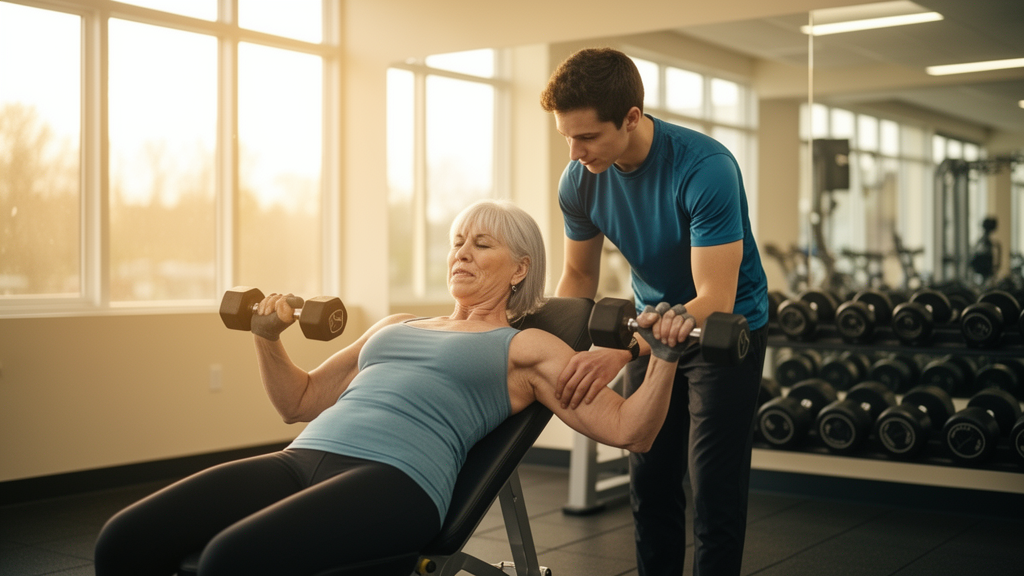
Twelve weeks of supervised resistance training, in which frail older adults pushed their muscles to the point of volitional failure, produced measurable improvements in depressive symptoms, executive function, and quality of life, according to a secondary analysis of the TEAMS randomized controlled trial published in BMC Geriatrics. Perhaps the most striking finding, however, was what did not matter: the load on the bar. Across training intensities ranging from 20 to 80 percent of each participant’s one-repetition maximum, the psychosocial and cognitive benefits emerged with striking consistency, suggesting that how hard the muscles work at the cellular level may matter less than the simple, repeated act of training them.
The study, led by Mohammed Benali of the Amsterdam University of Applied Sciences together with colleagues at VU University, Amsterdam University Medical Center, and Deakin University, focused on a population that exercise science has often shied away from. Frailty, a syndrome of reduced physiological reserve and heightened vulnerability to stressors, affects a growing share of community-dwelling older adults and is associated with fatigue, fear of falling, low mood, and creeping cognitive decline. Because frail individuals are frequently excluded from or underrepresented in exercise trials, clinicians have lacked firm evidence on whether resistance training is not only safe for them but psychologically restorative, and at what intensity it should be prescribed.
The research team analyzed data from 295 participants with a mean age of 74 years, about 69 percent of whom were women. All took part in twice-weekly, supervised resistance training sessions over three months, with the explicit instruction to continue each set until volitional muscular failure, the point at which no further repetition can be completed with proper form. Participants had been randomized in the parent TEAMS trial to receive training alone or training combined with a dietary protein intervention, allowing the researchers to test whether additional protein amplified the psychosocial and cognitive effects of exercise. Training intensity was individually calibrated, spanning the remarkably wide range of 20 to 80 percent of one-repetition maximum, a fraction of the narrow, high-intensity protocols that dominate much of the resistance training literature.
The results paint a coherent picture of broad benefit. Depressive symptoms declined significantly over the twelve weeks, with a standardized effect estimate of β = −0.167 and a 95 percent confidence interval of −0.27 to −0.06. Quality of life, measured with the 12-item Short Form Health Survey, improved with an effect estimate of β = +1.26 (95 percent CI 0.62 to 1.91). Crucially, the cognitive gains were substantial and appeared across multiple domains of executive function, the suite of higher-order mental processes, including set-shifting, inhibition, and working memory, that govern planning, multitasking, and everyday decision-making and that are among the first capacities to erode in cognitive aging.
The executive function battery was rigorous. On the Trail Making Test Part A, which measures processing speed and visual scanning, participants improved by an average of 4.71 seconds. On Part B, which adds the demands of task-switching between numbers and letters, the average improvement was 12.11 seconds, a clinically meaningful margin on a test where every second counts. Performance on the Stroop Color–Word Test, which probes the ability to suppress an automatic response in favor of a controlled one, improved with a log-transformed effect of −0.091, and Letter Fluency scores, reflecting verbal working memory and retrieval, rose by an average of 2.46 words. Together, these converging measures suggest that the training did not merely sharpen speed but strengthened the underlying inhibitory and attentional machinery of the aging brain.
Why might lifting weights to failure influence mood and cognition in frail elders? The authors and the broader literature point to several plausible mechanisms. Resistance exercise acutely elevates circulating growth factors such as brain-derived neurotrophic factor, which supports synaptic plasticity and hippocampal function. Regular training improves vascular health and cerebral blood flow, reduces systemic inflammation, a recognized contributor to both depression and cognitive decline, and enhances sleep, itself a powerful regulator of mood and memory. There is also a psychological dimension: mastering progressively demanding physical tasks can restore self-efficacy, and the supervised, social setting of twice-weekly sessions provides structure and contact that counter isolation, a potent risk factor for late-life depression.
The finding that intensity, from 20 to 80 percent of one-repetition maximum, did not consistently moderate these effects carries real practical weight. High-load training in frail populations has long raised safety concerns, and the fear of injury or cardiovascular strain has sometimes kept practitioners prescribing token loads that deliver little stimulus. If lighter loads, lifted to the same point of volitional failure, produce comparable psychosocial and cognitive gains, then programs can be tailored to individual tolerance, preference, and comorbidity without sacrificing benefit. Volitional failure, in this framing, may be the true common denominator: a level of perceived exertion that signals sufficient mechanical and metabolic stimulus regardless of the absolute weight on the machine.
The protein intervention told a more sobering story. Participants who received the dietary protein supplement alongside training experienced a significantly greater reduction in fear of falling compared with those who trained without it, with a log-transformed effect of −0.257 (95 percent CI −0.491 to −0.023). Fear of falling is a disabling phenomenon in its own right, restricting activity and accelerating physical decline even in those who have never fallen, so this single benefit is not trivial. But on depressive symptoms, anxiety, pain, fatigue, sleep quality, executive function, and quality of life, the protein intervention produced no consistent additional effects. For a field that has often assumed nutrition and exercise are synergistic partners for aging bodies, the result is a useful corrective, at least for outcomes beyond muscle mass and strength.
The authors are careful to frame these analyses as exploratory. As a secondary analysis of an existing randomized trial, the study was not primarily powered or designed to test psychosocial and cognitive endpoints, and the linear mixed models, which accounted for repeated measurements within individuals, cannot rule out confounding or chance findings in the way a fully powered primary trial could. The findings should therefore be interpreted cautiously, and the researchers themselves emphasize that the intensity results point toward feasibility for further investigation rather than a definitive prescription. Funding came from the Dutch Research Council through the Taskforce for Applied Research SIA, with in-kind and financial support from Carezzo Nutrition BV and Fonterra, neither of which had any role in study design, analysis, or publication.
Even with those caveats, the study adds to a rapidly shifting consensus about aging. Frailty, once viewed as an inevitable slide toward dependency, is increasingly understood as a partially reversible state, and structured resistance training is emerging as one of the most potent levers available. That the benefits documented here extend beyond muscle to mood, mental sharpness, and self-rated quality of life, and that they arise across a forgiving range of training intensities, is precisely the kind of evidence that can translate into community programs. For the millions of frail older adults living at home, the message from Amsterdam is quietly radical: the weights need not be heavy, but the effort must be real, and twelve weeks may be enough to begin turning back the clock on both body and mind.
Subject of Research: Effects of resistance training intensity and dietary protein supplementation on psychosocial outcomes, executive function, and quality of life in frail community-dwelling older adults
Article Title: Effects of resistance training intensity and a dietary protein intervention on psychosocial outcomes, executive function, and quality of life in frail community-dwelling older adults
Article References: Effects of resistance training intensity and a dietary protein intervention on psychosocial outcomes, executive function, and quality of life in frail community-dwelling older adults. (n.d.). https://doi.org/10.1186/s12877-026-08487-3
Image Credits: AI Generated
DOI: 10.1186/s12877-026-08487-3
Keywords: resistance training, frailty, older adults, executive function, quality of life, depressive symptoms, dietary protein, fear of falling, TEAMS trial, training intensity, BMC Geriatrics, randomized controlled trial
Cite Scienmag News
Cassandra Pierce. (October 16, 2026). Lifting to Failure Boosts Mood and Brain Power in Frail Older Adults, Whatever the Weight. Scienmag. https://scienmag.com/lifting-to-failure-boosts-mood-and-brain-power-in-frail-older-adults-whatever-the-weight/
Cassandra Pierce. "Lifting to Failure Boosts Mood and Brain Power in Frail Older Adults, Whatever the Weight." Scienmag, 16 October 2026, https://scienmag.com/lifting-to-failure-boosts-mood-and-brain-power-in-frail-older-adults-whatever-the-weight/. Accessed 16 October 2026.
Cassandra Pierce. "Lifting to Failure Boosts Mood and Brain Power in Frail Older Adults, Whatever the Weight." Scienmag. October 16, 2026. https://scienmag.com/lifting-to-failure-boosts-mood-and-brain-power-in-frail-older-adults-whatever-the-weight/


