


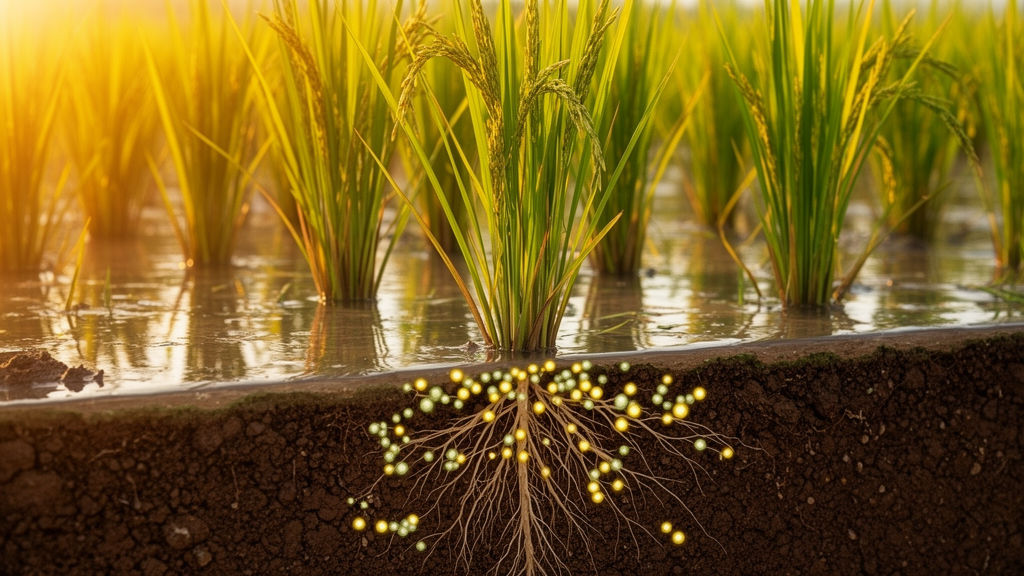
For thousands of years, humans have bred rice for bigger grains, stronger stems and higher yields, and in the process they quietly stripped away something invisible but vital: the bacterial partners that once helped the plant feed itself. Now, a large-scale study published in Nature Microbiology shows that those lost microbial allies can be brought back, not by spraying fields with probiotics, but by reintroducing a single genetic locus from wild rice. The work, led by Jingjing Chang, Dianwen Wang, Chunjie Tian and Eiko Kuramae, with collaborators across China, the Netherlands and the United States, demonstrates that beneficial root microbes can be genetically inherited through hybridization and that one receptor-like kinase gene from wild rice is enough to re-recruit a nitrogen-fixing bacterial community in modern cultivated rice.
The team’s central concept is what they call microbiome re-domestication, an extension of the earlier microbiome rewilding hypothesis. Rewilding proposes simply reintroducing wild microbial diversity to crops; re-domestication goes further, using host genetic variation from wild relatives to restore the plant-microbe interactions that were counterselected during domestication and breeding. Modern rice varieties were largely bred for above-ground traits under high fertilizer inputs, which means the below-ground microbial partnerships adapted to low-nutrient environments were never part of the selection criteria. The researchers hypothesized that if host genes governing microbiome recruitment could be identified and reintroduced, the beneficial functions those microbes provide, particularly nitrogen acquisition, could be recovered in elite cultivars without sacrificing their agronomic quality.
To test this, the researchers built two recombinant inbred line (RIL) populations, each of 100 lines, by crossing cultivated rice varieties, the japonica cultivar Longgeng 31 and the indica cultivar Huanghuazhan, with Chinese Dongxiang common wild rice, Oryza rufipogon, the northernmost naturally distributed wild rice germplasm in China and a genotype carrying cold and nutrient-deficiency resistance loci. Field experiments were conducted at the National Agricultural Station in Liaoheyuan, Jilin Province, on temperate black soil. Using 16S rRNA amplicon sequencing of 424 samples, including bulk soil, parental rhizospheres and both RIL populations, the team first defined the core rhizobacterial community specific to the paternal wild rice, excluding taxa shared with the cultivated parents. That analysis yielded 45 core amplicon sequence variants in the japonica cross and 48 in the indica cross, of which 20 were shared between the two populations.
The critical question was whether these wild-derived bacteria would persist in hybrid progeny carrying mostly cultivated genomes. They did. Gaiella, for example, was detected in 88.5 percent of the japonica RIL accessions and 96.6 percent of the indica accessions, while Acinetobacter, Paenarthrobacter and Duganella reached 60.5, 64.6 and 80 percent respectively in the japonica population. Partial Mantel tests then linked the abundance of these core taxa to plant phenotypes: in the japonica population, ground diameter and total nitrogen content correlated significantly with the core community, while in the indica population, root biomass, chlorophyll and spike length did. This established that the inherited microbiome was not merely present but functionally associated with nitrogen-related traits.
Quantitative trait locus mapping, performed with the R package R/qtl2 on genotypic and phenotypic data from the same individual plants, identified 31 QTL peaks associated with the abundance of 17 core bacterial taxa. Notably, positive effects tended to associate with wild-rice alleles, and Acinetobacter and Vogesella were consistently wild-allele enriched. The chromosomal locations differed between populations, with Acinetobacter linked to chromosome 4 in the japonica cross but chromosome 2 in the indica cross, yet the overall message was consistent: specific host loci influence the abundance of specific bacterial taxa. Because rice typically uses only about 30 to 40 percent of applied nitrogen, the team focused on nitrogen-cycling functions, using FAPROTAX to infer ecological roles. Seven core taxa, including Acinetobacter, Novosphingobium, Sideroxydans, Streptomyces, Pantoea, Bacillus and Pseudomonas, were predicted nitrogen fixers, and one QTL overlapped the known nitrogen-use-efficiency gene OsAMT1;3, an ammonium transporter.
The most striking finding came when the researchers overlapped their microbiome QTLs with rice domestication loci. They sequenced whole genomes of 382 accessions, 117 wild and 265 cultivated, and calculated the ratio of nucleotide diversity between wild and cultivated rice across the genome, identifying 21 domestication loci. Two strong selective sweeps coincided with QTLs for Acinetobacter and Pantoea, meaning the very genomic regions controlling recruitment of these beneficial bacteria bear the fingerprints of human selection. In other words, as ancient farmers selected rice for non-shattering seeds and other traits, they inadvertently selected against the alleles that recruited nitrogen-fixing microbes. The Acinetobacter locus showed the strongest additive effect, the greatest phenotypic variance explained and the most pronounced selective sweep, making it the obvious candidate for functional dissection.
Transcriptomics then pinpointed the gene. The researchers grew wild rice in sterilized soil, non-sterilized soil and sterilized soil inoculated with a synthetic community of nine Acinetobacter strains isolated from wild-rice rhizosphere, including strains related to A. baumannii, A. halotolerans and A. sichuanensis. KEGG pathway analysis revealed that nitrogen metabolism was the only pathway significantly enriched in both comparisons. Within a 0.64 megabase region on chromosome 4 associated with Acinetobacter, only one gene met the stringent criteria of upregulation in both treatments, a log2 fold change above 2 and above-average transcript abundance: OsRLK (Os04g0659300), a receptor-like kinase found predominantly in wild rice. Receptor-like kinases are cell-surface proteins that mediate signaling between plants and their environment, and related DUF26/CRK kinases have been implicated in symbiotic nitrogen fixation in legumes, making OsRLK a biologically plausible candidate for sensing or recruiting beneficial bacteria.
Functional validation followed. The team cloned the wild-rice OsRLK into an overexpression vector under a maize ubiquitin promoter and generated CRISPR/Cas9 knockout mutants, then inoculated all lines with the Acinetobacter synthetic community in pot experiments. The results were decisive: total nitrogen content and dry biomass were significantly higher in SynCom-inoculated wild rice and OsRLK-overexpressing lines, but no differences appeared with a heat-killed SynCom or without inoculation, proving the effect depends on living bacteria. After 30 days, Acinetobacter abundance, nifH gene abundance, a key marker of nitrogen fixation, and nitrogenase protein levels ranked OsRLK-1 and wild rice highest, followed by OsRLK-2, then wild type, with knockout mutants lowest. Crucially, field trials showed that OsRLK overexpression lines significantly increased effective panicle number, seed-setting rate, thousand-grain weight and grain yield per plant, demonstrating that the microbiome effect translates into real agronomic performance.
Haplotype analysis across 105 rice accessions revealed why the gene had been lost. OsRLK coding sequences fall into three haplotypes, with the wild-rice HAP1 variant carrying 18 amino acid differences from the cultivated HAP2 variant, and Acinetobacter abundance was significantly higher in HAP1 accessions. Intriguingly, the major domestication gene Sh4, which controls seed shattering, lies only about 2 centimorgans from OsRLK, raising the possibility that beneficial OsRLK alleles were dragged to low frequency by linkage with Sh4 during selection for non-shattering rice. Because that distance is resolvable by recombination, the authors suggest that marker-assisted selection or genome editing could introgress the wild allele into elite cultivars while minimizing linkage drag, though they caution that practical deployment requires further validation and that trade-offs, including immune regulation, remain possible.
The broader significance of this work lies in reframing how we think about crop improvement. Rather than treating the microbiome as an external input to be engineered separately, the study shows that microbiome composition is itself a heritable, genetically tractable trait, shaped by domestication and recoverable through breeding. By connecting host loci to functionally validated core microbiota and to nitrogen-use efficiency under real field conditions, the researchers move beyond the correlation-based studies previously reported for maize, foxtail millet, tomato, barley and wheat. If the microbiome re-domestication framework can be extended to other crops and other nutrients, the era of breeding plants not just for what they are, but for the microbial partners they attract, may have quietly begun in the flooded paddies of northeastern China.
Subject of Research: Genetic recovery of beneficial rhizosphere microbiota from wild rice to improve nitrogen-use efficiency in cultivated rice
Article Title: Wild rice locus enables microbiome re-domestication for enhanced nitrogen-use efficiency
Article References: Chang, J., Wang, D., Yao, Z., Pang, Y., Zhang, H., Wang, C., Xie, Y., Sun, Y., Zhang, J., Li, W., Liang, A., Li, X., Chen, D., Chen, H., Chen, X., Wang, E., Tran, L.-S. P., Wang, J., Raaijmakers, J. M., … Kuramae, E. E. (2026). Wild rice locus enables microbiome re-domestication for enhanced nitrogen-use efficiency. Nature Microbiology. https://doi.org/10.1038/s41564-026-02498-x
Image Credits: AI Generated
DOI: 10.1038/s41564-026-02498-x
Keywords: rice, microbiome, nitrogen-use efficiency, Oryza rufipogon, domestication, QTL mapping, receptor-like kinase, Acinetobacter, nitrogen fixation, plant-microbe interactions, synthetic community, crop breeding
Cite Scienmag News
Alan Morgan. (October 8, 2026). Wild Rice Gene Recruits Nitrogen-Fixing Bacteria to Boost Crop Efficiency. Scienmag. https://scienmag.com/wild-rice-gene-recruits-nitrogen-fixing-bacteria-to-boost-crop-efficiency/
Alan Morgan. "Wild Rice Gene Recruits Nitrogen-Fixing Bacteria to Boost Crop Efficiency." Scienmag, 8 October 2026, https://scienmag.com/wild-rice-gene-recruits-nitrogen-fixing-bacteria-to-boost-crop-efficiency/. Accessed 8 October 2026.
Alan Morgan. "Wild Rice Gene Recruits Nitrogen-Fixing Bacteria to Boost Crop Efficiency." Scienmag. October 8, 2026. https://scienmag.com/wild-rice-gene-recruits-nitrogen-fixing-bacteria-to-boost-crop-efficiency/


