


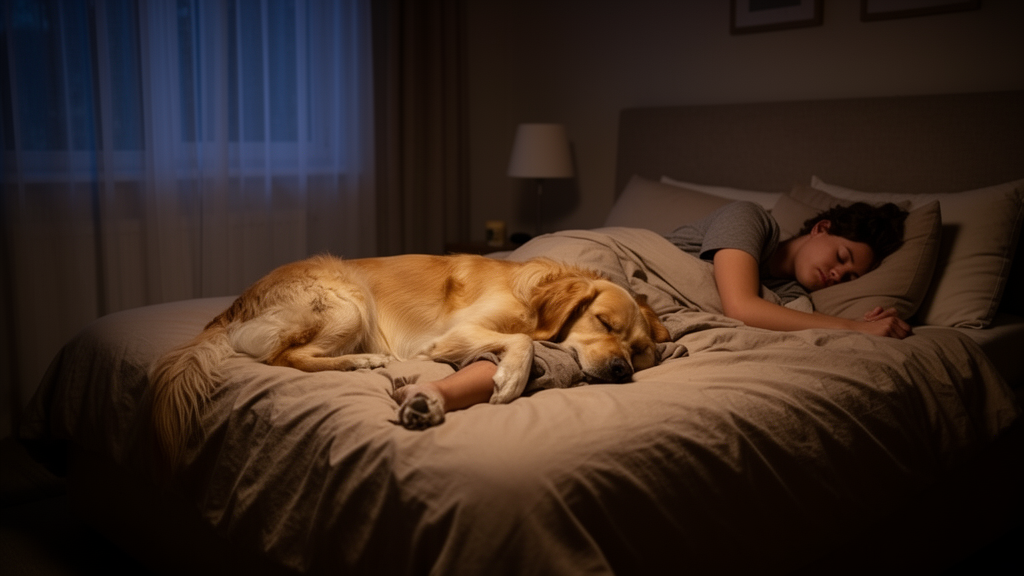
For millions of dog owners, the question of whether sharing a bed with a furry companion helps or hurts sleep has long been a matter of anecdote, guilt, and groggy morning speculation. A new study published on October 7, 2026 in the open-access journal PLOS One offers some of the clearest objective evidence yet on the subject, and its central finding is reassuring: sleeping alongside a dog probably does not disrupt human sleep as much as many owners might fear. The research, led by Ming Fei Li of the University of Toronto in Canada and Lavania Nagendran of the University of Toronto Mississauga, together with colleagues, examined the nighttime activity patterns of dogs and their owners to determine, quite literally, who is disturbing whom.
The intuitive assumption that humans and their dogs affect one another’s sleep schedules has circulated widely among veterinarians, sleep researchers, and pet owners alike. Yet, as the authors note, little rigorous research has been carried out in this area, and the studies that do exist have produced conflicting results. Some earlier work has suggested that co-sleeping with pets fragments sleep, while other investigations have reported neutral or even positive effects on perceived rest. This patchwork of findings left a genuine gap in the scientific understanding of one of the most common domestic arrangements in the world, given that a substantial share of dog owners in many countries report sharing their bed or bedroom with their animals at least part of the time.
To address the question with objective data rather than self-report alone, the research team recruited 25 humans and their 38 dogs. Each participant wore an activity monitor on the wrist, while each dog wore a matching monitor on the collar. These devices, known as actigraphs, do not measure sleep directly in the way a clinical polysomnography lab would, but they record movement continuously and allow researchers to infer sleep duration, sleep efficiency, and patterns of nighttime waking from periods of stillness and motion. Actigraphy has become a standard tool in sleep science precisely because it can capture many consecutive nights of data in a person’s natural home environment, free from the artificiality of a sleep laboratory.
Over a period of four weeks, the monitors accumulated a detailed record of when each human and each dog was active and when they were at rest. When the researchers analyzed these records, a striking pattern emerged: nighttime activity in humans and their dogs was strongly correlated. Owners and their animals commonly became active around the same time during the night, rising, shifting, or stirring in loose synchrony. This tight coupling suggests that the sleep of dogs and their owners is genuinely intertwined, with movement in one member of the household rippling into the other rather than each sleeping on an independent schedule.
But the direction of that influence turned out to be more surprising than many owners might expect. In the majority of cases, the humans began moving before the dogs did. That ordering implies that, contrary to the common complaint that a restless dog wakes its owner, owners are more often disturbing their dogs’ sleep than the other way around. The answer to the study’s central question of who is disrupting whom, the authors conclude, appears to be a bit of both, with mutual disturbance flowing in both directions across the bed or bedroom, but with humans frequently initiating the nighttime motion that both species then share.
Perhaps the most practically important finding concerns sleep quality and duration. Sharing the bed with a dog did not significantly impact sleep duration or sleep quality as measured by the activity monitors, even in cases where owners reported feeling as though their dogs were disturbing their sleep. This mismatch between what people believed was happening and what the devices recorded points to a broader phenomenon familiar to sleep researchers: discrepancies between objective and subjective sleep measures. People frequently misjudge how well or how poorly they slept, and the study’s authors highlight this gap explicitly, noting that their findings suggest nighttime activity in humans and dogs is closely coupled while perceptions of disruption may not match the physiological record.
The authors summarize their takeaway in their own words: “Our findings suggest that nighttime activity in humans and dogs is closely coupled and there may be discrepancies between objective and subjective sleep measures.” That combination of coupled movement and preserved sleep quality helps explain why so many owners report both that their dogs wake them and that they would not dream of banishing the animals from the bedroom. The disturbances, it seems, are real but brief and frequent enough to be absorbed without meaningfully degrading the overall architecture of a night’s rest for either species.
The results also align with some previous research on the benefits and drawbacks of co-sleeping with dogs, a literature that has variously documented comfort, security, warmth, and companionship on one side and potential fragmentation on the other. By adding tightly synchronized actigraphy data from both members of the human-dog dyad, the new study gives that literature a more symmetrical picture than it has had before, treating the dog not merely as an environmental disturbance but as a sleeping partner whose rest is itself shaped by the human presence. The authors caution, however, that the study includes a limited sample and no dog-less control group, which means the findings should be interpreted with appropriate care. The 25 humans and 38 dogs who wore the monitors represent a starting point rather than a definitive population-level verdict.
Future studies, the researchers note, will need to include more data on dogs of different ages and breeds, since a young, energetic puppy and a senior companion dog are likely to have very different nocturnal profiles, and breed-specific traits may shape how strongly a dog’s activity is coupled to its owner’s. Larger and more diverse samples, ideally with control groups of owners who do not co-sleep with their animals, would allow researchers to separate the effects of sharing a bed from the effects of simply living with a dog. The work was supported by Discovery Grants from the Natural Sciences and Engineering Research Council of Canada, and the authors declared no competing interests.
For now, the practical message for dog owners is refreshingly simple. If you share your bed with your dog and feel guilty about the tossing and turning you believe you inflict on each other, the actigraphy data suggest that both of you are probably getting pretty good sleep anyway. The nighttime dance of mutual stirring is real, measurable, and tightly synchronized, but it does not appear to cost either species meaningful rest. In the ongoing negotiation over blankets, space, and 3 a.m. wiggle sessions, science has delivered a verdict that both dogs and their humans can live with: you disturb each other, but not enough to matter.
Subject of Research: Objective measurement of nighttime activity and sleep in co-sleeping dogs and their owners
Article Title: Dogs and owners disturb each other in the night, but still get pretty good sleep
Article References: Dogs and owners disturb each other in the night, but still get pretty good sleep. (n.d.). Original publication
Image Credits: AI Generated
DOI: Not provided
Keywords: dogs, human-animal co-sleeping, sleep quality, actigraphy, PLOS One, nighttime activity, sleep disruption, human-dog bond, sleep research, observational study, pet owners, sleep monitors
Cite Scienmag News
William Thompson. (October 8, 2026). Nightly nudges: Dogs and owners disrupt each other’s sleep yet rest well. Scienmag. https://scienmag.com/nightly-nudges-dogs-and-owners-disrupt-each-others-sleep-yet-rest-well/
William Thompson. "Nightly nudges: Dogs and owners disrupt each other’s sleep yet rest well." Scienmag, 8 October 2026, https://scienmag.com/nightly-nudges-dogs-and-owners-disrupt-each-others-sleep-yet-rest-well/. Accessed 8 October 2026.
William Thompson. "Nightly nudges: Dogs and owners disrupt each other’s sleep yet rest well." Scienmag. October 8, 2026. https://scienmag.com/nightly-nudges-dogs-and-owners-disrupt-each-others-sleep-yet-rest-well/


