


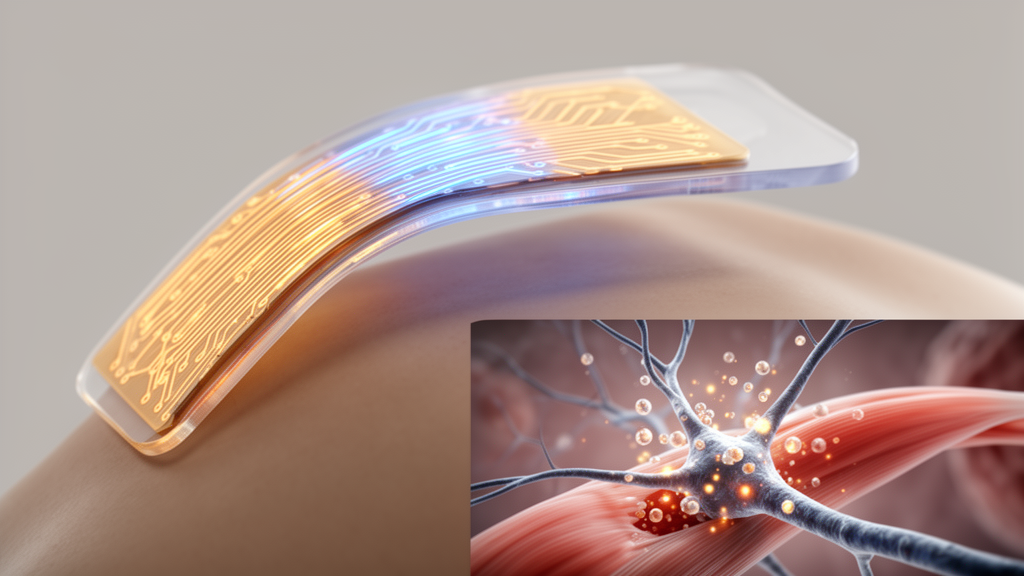
Every time you pick up a coffee cup, your nervous system performs a quiet miracle of engineering. At the neuromuscular junction, the specialized synapse where a motor neuron meets a muscle fiber, mechanical forces are translated into graded electrical signals that adjust the strength of the connection itself. Now, a team of researchers in India has borrowed that biological design principle and packed it into a device thinner than a human hair. Writing in npj Flexible Electronics, Tanmayee Parida and Aloke Kanjilal of the Shiv Nadar Institution of Eminence, together with Subrat Kumar Swain and Debarun Sengupta, report a flexible, two-terminal memristor whose synaptic strength can be programmed simply by bending it. The work points toward a new class of soft, adaptive electronics in which the act of touching the world is not merely sensed but directly written into the device’s memory.
The device itself is deceptively simple in architecture. It consists of a vertical stack of silver, hexagonal boron nitride, and indium tin oxide, all deposited on a flexible polyethylene terephthalate substrate. Hexagonal boron nitride, often nicknamed white graphene, is a layered insulating crystal whose atomically flat sheets can be stacked like a deck of cards. In a conventional memristor, electrical pulses program the resistance state, and mechanical deformation is usually treated as a nuisance, a source of noise or failure to be engineered away. The Shiv Nadar team inverted that logic. In their device, bending is the programming signal. When the flexible substrate flexes, the hBN flakes within the stack slide laterally relative to one another, and that sliding perturbs the stacking arrangement and the inter-flake tunneling distance that governs how easily electrons can hop across the layered insulator.
The elegance of the mechanism lies in what does not happen. Because the programming arises from interlayer sliding rather than from stretching the crystal lattice itself, the hBN sheets are never strained at the atomic level. The covalent bonds within each flake remain intact, which means the process is non-destructive and, crucially, reversible. Straighten the device and the flakes can slide back, restoring the previous tunneling gap and the previous conductance state. This stands in sharp contrast to many flexible memristor designs, where repeated mechanical cycling gradually degrades the active material through crack formation, atomic displacement, or electromigration. Here, deformation is not damage; it is information. The researchers describe this as a mechanoelectronic design principle, one in which the physical interaction between device and environment becomes the write mechanism for synaptic plasticity.
What makes the comparison to the neuromuscular junction more than a metaphor is the way the device responds to bending. Biological mechanosensitive neurons transduce deformation into graded changes in synaptic strength, with both the amplitude and the dynamics of the response modulated by the magnitude and history of the mechanical stimulus. The hBN memristor reproduces this co-modulation quantitatively. Different bending conditions produce different families of conductance states, and the temporal evolution of those states mirrors the amplitude and dynamics seen in their biological counterparts. In other words, the device does not simply switch between on and off; it exhibits the continuous, history-dependent plasticity that neuroscientists associate with real synapses, where the same stimulus can produce different outcomes depending on what came before.
To demonstrate that these mechanically programmed states are more than a laboratory curiosity, the team put the device to work as an artificial synapse in a computational brain. The conductance values measured under varying bending conditions were used as analog synaptic weights in a fully connected neural network, the workhorse architecture of modern machine learning. The network was trained on MNIST, the classic benchmark of handwritten digit recognition that has served for decades as a proving ground for neuromorphic hardware. Across all bending conditions tested, the network achieved classification accuracy exceeding 91 percent. That figure matters because it shows that the mechanically induced conductance states are not random or noisy; they are stable, distinguishable, and useful as computational elements. A synapse that changes when you bend it, yet still supports high-accuracy inference, is a synapse that could live inside a prosthetic hand or a soft robot.
The implications for flexible and wearable neuromorphics are considerable. Current approaches to tactile sensing in soft electronics typically separate the sensing element from the computing element: a pressure sensor converts touch into an electrical signal, which is then routed to a processor that decides what it means. That separation costs power, latency, and wiring complexity, all of which are precious commodities in a wearable device. A memristor that programs itself through touch collapses that boundary. The sensing and the memory update are the same physical event, happening at the same place at the same time. For applications such as electronic skin, adaptive prosthetics, or soft robotic grippers that must learn from contact, this kind of co-located mechanosensation and plasticity could dramatically simplify the hardware stack.
The choice of materials is also strategically significant. Hexagonal boron nitride is chemically robust, thermally stable, and widely studied as a protective encapsulant and tunneling barrier in two-dimensional electronics. Its layered structure, with weak van der Waals forces between sheets and strong covalent bonds within them, is precisely what enables the sliding mechanism at the heart of the device. The silver and indium tin oxide electrodes provide the vertical conduction path, and the PET substrate supplies the flexibility that makes the whole concept possible. Because the active mechanism does not rely on electrochemical filament formation or oxygen vacancy migration, the usual culprits behind memristor variability and endurance limits, the device sidesteps several long-standing reliability problems in the field.
There are, of course, hurdles between a promising laboratory demonstration and a deployable technology. The reported work establishes the principle and the benchmark performance, but scaling from individual devices to the dense crossbar arrays needed for practical neuromorphic systems will require careful control of device-to-device uniformity, particularly for a mechanism that depends on the precise stacking of exfoliated or grown two-dimensional flakes. Integration with conventional readout circuitry, long-term cycling stability under millions of bending events, and compatibility with large-area manufacturing are all questions that the field will now press forward. The authors acknowledge support from the Science and Engineering Research Board and the Department of Science and Technology in India, reflecting the growing investment in flexible neuromorphic platforms worldwide.
Still, the conceptual shift is hard to overstate. For half a century, computing has treated memory and processing as separate functions and mechanical deformation as an enemy of reliability. This work suggests a future in which the shape of a device is part of its computational state, in which a bend is a bit, and in which soft machines learn the way our muscles do, through the very act of moving. The neuromuscular junction has been quietly optimizing that trick for hundreds of millions of years. With a few atomic layers of boron nitride and a flexible plastic backing, engineers have finally started to take notes.
Subject of Research: Mechanosensitive hexagonal boron nitride memristors for flexible neuromorphic computing
Article Title: Neuromuscular Junction Inspired Mechanosensitive hBN-based Memristors for Flexible Neuromorphics
Article References: Parida, T., Swain, S. K., Sengupta, D., & Kanjilal, A. (2026). Neuromuscular Junction Inspired Mechanosensitive hBN-based Memristors for Flexible Neuromorphics. npj Flexible Electronics. https://doi.org/10.1038/s41528-026-00647-0
Image Credits: AI Generated
DOI: 10.1038/s41528-026-00647-0
Keywords: memristor, hexagonal boron nitride, neuromorphic computing, flexible electronics, neuromuscular junction, synaptic plasticity, mechanosensitive, interlayer sliding, MNIST, wearable devices, two-dimensional materials, artificial synapse
Cite Scienmag News
Denise Maddox. (October 8, 2026). Bendable Memory Device Mimics the Body’s Nerve-Muscle Synapse. Scienmag. https://scienmag.com/bendable-memory-device-mimics-the-bodys-nerve-muscle-synapse/
Denise Maddox. "Bendable Memory Device Mimics the Body’s Nerve-Muscle Synapse." Scienmag, 8 October 2026, https://scienmag.com/bendable-memory-device-mimics-the-bodys-nerve-muscle-synapse/. Accessed 8 October 2026.
Denise Maddox. "Bendable Memory Device Mimics the Body’s Nerve-Muscle Synapse." Scienmag. October 8, 2026. https://scienmag.com/bendable-memory-device-mimics-the-bodys-nerve-muscle-synapse/


