


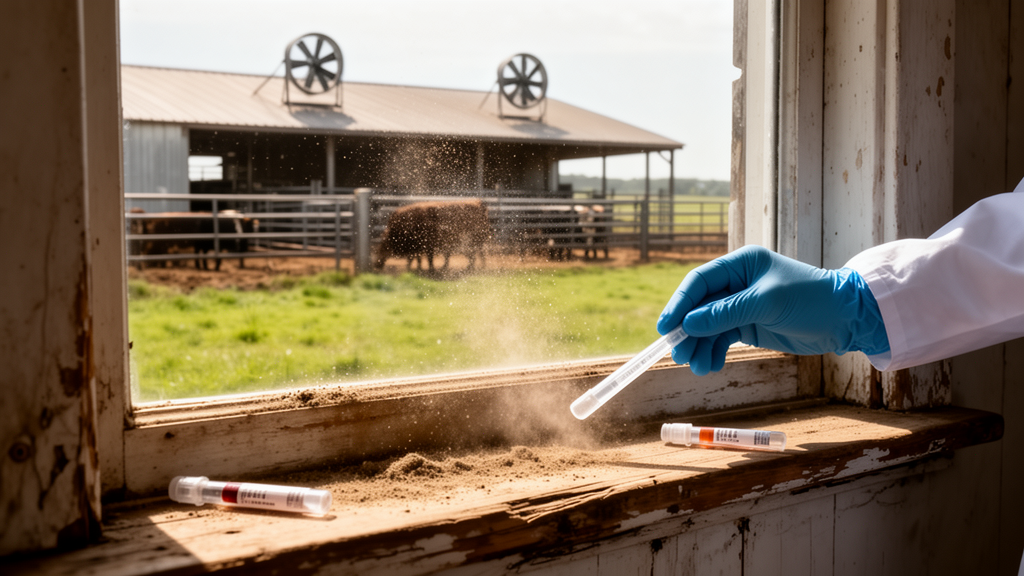
In the rolling farmland of Iowa, where confinement barns and feedlots punctuate the horizon, the antibiotics used to keep livestock healthy may be quietly reshaping the microbial ecology of nearby homes. A new study published in the Journal of Exposure Science & Environmental Epidemiology reports that people living closer to more intensive animal feeding operations carry a measurably higher burden of antimicrobial resistance genes in the dust of their own bedrooms. The research, led by Kathryn R. Dalton of the University of Iowa College of Public Health together with colleagues at the National Institutes of Health, is the first to connect the indoor home dust resistome — the full collection of resistance genes within a microbial community — to residential proximity to industrial livestock production. The findings suggest that the farm-to-home pathway for drug-resistant genes may run straight through the front door.
Antimicrobial resistance, or AMR, is one of the most formidable threats in modern medicine. Resistance arises naturally in microorganisms, but the widespread use of antimicrobials in human medicine and animal agriculture has dramatically accelerated the proliferation of resistant strains. The stakes are enormous: widely cited projections estimate that without intervention, drug-resistant infections could claim ten million lives per year by 2050 and place a cumulative 100 trillion US dollars of economic output at risk. Rural communities bear a disproportionate share of this burden, both because of healthcare access disparities that complicate antimicrobial stewardship and because of environmental exposures that are largely absent in urban settings. Among the most significant of these exposures are animal feeding operations, facilities that concentrate large numbers of livestock and the substantial quantities of manure and antimicrobials that come with them.
Scientists have long suspected that these operations act as reservoirs and sources of resistance genes. Previous studies have detected elevated levels of resistant bacteria and genes in soil, water, and air surrounding livestock facilities, and in the nasal passages of people who live or work nearby. One striking earlier finding showed that genes conferring tetracycline resistance were up to one thousand times more abundant in airborne particulate matter collected downwind of livestock operations compared with upwind samples. Resistant bacteria carrying genes for macrolide, beta-lactam, fluoroquinolone, and sulfonamide resistance have also been isolated from farm environments where multiple antibiotics are in use. What remained unclear, however, was whether these environmental genes could make their way into the intimate indoor environments where people spend most of their lives — and where dust can be inhaled, ingested, and transferred to the human microbiome on a daily basis.
To answer that question, the research team turned to the Agricultural Lung Health Study, a nested case-control investigation of asthma within the broader Agricultural Health Study of licensed pesticide applicators in Iowa. Between 2009 and 2013, trained staff collected dust samples from the bedrooms of participants during home visits. The team then extracted DNA from 534 of these samples and performed whole genome shotgun metagenomic sequencing, a technique that reads all genetic material in a sample rather than targeting a single organism. This approach is critical because resistance genes do not stay confined to one species; they move between diverse microbes through horizontal gene transfer, a process that accelerates the evolution of multi-drug resistance and the emergence of so-called superbugs. By characterizing the entire resistome rather than a single pathogen, the researchers could capture the full landscape of resistance in each home.
Identifying resistance genes required a rigorous bioinformatic framework. The team used the Comprehensive Antimicrobial Resistance Database, an expertly curated ontology of AMR genes, along with its Resistance Gene Identifier software, accepting only perfect or strict matches to minimize false positives. Samples harboring genes conferring resistance to two or more different drug classes were classified as multi-drug resistant. On the exposure side, the researchers obtained permit records from the Iowa Department of Natural Resources covering 13,467 animal feeding operations, matched facility permit dates to home visit dates with a two-year buffer to ensure the operations were active at the time of sampling, and calculated the number of facilities and the number of standardized livestock animal units within 2, 5, and 10 kilometers of each participant’s front door. One animal unit is equivalent to a mature 1,000-pound cow, allowing facilities of different species to be compared on a common scale.
The exposure assessment went further, incorporating both distance and wind. For each home, the number of animal units at each nearby facility was weighted by the inverse of the squared distance, with short distances standardized to avoid outsized weights. The team then obtained daily wind direction data from the North American Regional Reanalysis and, for each month in the year before the home visit, determined whether each residence lay within the 180-degree downwind sector of a facility relative to the prevailing wind. The proportion of downwind months was multiplied by the distance-weighted animal units, producing a wind-weighted exposure metric designed to capture the plausible aerial transport of resistant microbes and genes from barns to homes.
The results were unambiguous. At least one AMR gene was detected in 138 of the 534 dust samples, or 26 percent, and 88 samples — 17 percent — carried genes resistant to two or more drug classes, qualifying as multi-drug resistant. In total, the researchers identified 383 unique resistance genes across all samples. Tetracycline resistance dominated, accounting for 41 percent of detected genes, followed by macrolide resistance at 20 percent, with antibiotic target protection being the most common resistance mechanism. Homes with AMR-positive dust samples sat near a significantly greater number of feeding operations than AMR-negative homes, and the same pattern held for multi-drug resistance, with median facility counts within 10 kilometers of 2.89 versus 2.71 on the log scale for AMR and 2.94 versus 2.71 for MDR.
The regression models, adjusted for demographic and household factors including gender, farm residence and work, farming type, asthma status, pet ownership, and house condition, quantified the association precisely. Each one-unit increase in the log-transformed number of feeding operations within 10 kilometers was associated with a 27 percent increase in the odds of detecting AMR genes in household dust, and each log-unit increase in the wind-weighted, distance-weighted animal units raised the odds by 13 percent. In practical terms, homes in the third quartile of facility density had 30 percent higher odds of AMR detection than those in the first quartile, and homes in the third quartile of weighted animal units had 28 percent higher odds. The associations were stronger for multi-drug resistance: a 42 percent increase in odds per log-unit increase in facilities within 10 kilometers, and nearly 70 percent higher odds for facilities within 2 kilometers. Notably, cattle and swine operations drove the associations, while poultry facilities did not — a difference the authors suggest may reflect management-related differences in how resistance genes are disseminated from different types of operations.
The study’s strengths are considerable. With 534 homes, it is the largest population to date assessing AMR in community sources in relation to livestock proximity, and its metagenomic approach captures resistance across entire microbial communities rather than in cultured pathogens alone. It is also the first to examine how external environmental exposures shape the indoor home resistome, which may be a more direct contributor to the human microbiome than outdoor environmental reservoirs. Yet the authors are careful about the limits of their work. They did not collect biological samples from residents, so the link between dust resistomes and actual infections in occupants remains to be established. The precise exposure pathway — whether wind dispersion, transfer on clothing and footwear, or another route — could not be determined. Because most participants were farmers, generalizability to the broader public is uncertain, and factors such as water sources and antimicrobial cleaning products were not evaluated and may modify the observed relationships.
Even with those caveats, the implications are sobering. Resistance genes identical to those found in environmental sources have been detected in human infections, and horizontal gene transfer means that genes residing in harmless environmental bacteria can migrate into human pathogens. The new findings indicate that the indoor environments people inhabit are not sealed off from agricultural surroundings; instead, they appear to reflect the density and distance of the livestock operations that dominate the rural landscape. As the authors note, combating AMR in the environment could help reverse the projected trajectory of drug-resistant infections and their enormous public health and economic costs. For the millions of people who live near intensive animal agriculture, the dust settling quietly in their bedrooms may now be recognized as a sentinel — and potentially a reservoir — of one of medicine’s most urgent challenges.
Subject of Research: Association between residential proximity to animal feeding operations and antimicrobial resistance genes in household dust
Article Title: Residential proximity to intensive animal agriculture associates with increased prevalence of antimicrobial resistance in homes
Article References: Dalton, K. R., Lee, M., Fisher, J. A., Richards-Barber, M., Beane Freeman, L. E., Jones, R. R., & London, S. J. (2026). Residential proximity to intensive animal agriculture associates with increased prevalence of antimicrobial resistance in homes. Journal of Exposure Science & Environmental Epidemiology. https://doi.org/10.1038/s41370-026-00982-4
Image Credits: AI Generated
DOI: 10.1038/s41370-026-00982-4
Keywords: antimicrobial resistance, animal feeding operations, household dust, resistome, metagenomics, livestock, Iowa, public health, horizontal gene transfer, multi-drug resistance, rural health, environmental epidemiology
Cite Scienmag News
Juliet Wilcox. (October 8, 2026). Living Near Livestock Farms Linked to Drug-Resistant Genes in Household Dust. Scienmag. https://scienmag.com/living-near-livestock-farms-linked-to-drug-resistant-genes-in-household-dust/
Juliet Wilcox. "Living Near Livestock Farms Linked to Drug-Resistant Genes in Household Dust." Scienmag, 8 October 2026, https://scienmag.com/living-near-livestock-farms-linked-to-drug-resistant-genes-in-household-dust/. Accessed 8 October 2026.
Juliet Wilcox. "Living Near Livestock Farms Linked to Drug-Resistant Genes in Household Dust." Scienmag. October 8, 2026. https://scienmag.com/living-near-livestock-farms-linked-to-drug-resistant-genes-in-household-dust/


