


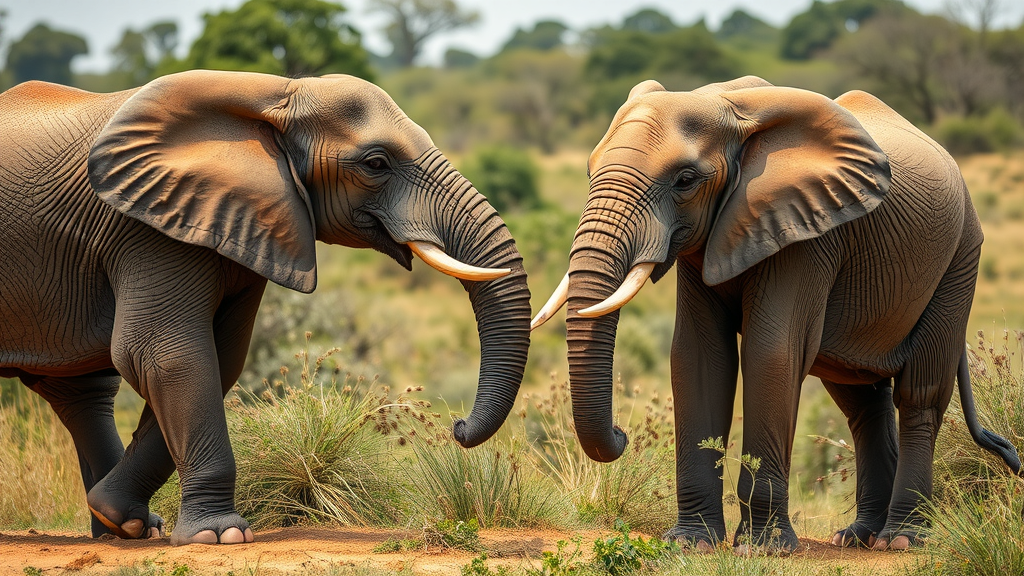
Wild African savannah elephants appear to do something remarkable during their frequent squabbles: they talk each other down with their bodies. A new study of two wild populations in South Africa has documented 41 distinct gesture types deployed during agonistic interactions, the everyday conflicts over water, food, and space that could otherwise spiral into dangerous escalation. The findings, published in the journal Animal Cognition, provide the first systematic evidence that wild elephants gesture intentionally toward members of their own species, a capacity long considered a hallmark of the great apes.
The research, led by Vesta Eleuteri of the University of Vienna together with Anna Letrari, Lucy Bates of the University of Portsmouth, Catherine Hobaiter of the University of St Andrews, and Angela Stoeger of the University of Vienna and the Vienna Zoo, focused on goal-directed intentionality. In the study of animal communication, this term describes a specific and demanding criterion: a signaller must persist in or modify its signalling until the recipient produces the desired response, rather than simply emitting signals as emotional leaks. Signals that meet this test are treated as deliberate attempts to change another individual’s behaviour, not mere expressions of arousal.
To test for this capacity in the wild, the team observed elephants in two South African protected areas, Addo Elephant National Park and Marakele National Park, with ethical approval from the University of Vienna and permits from South African National Parks. By systematically recording what elephants did with their trunks, ears, heads, and bodies during conflicts, and crucially, what happened next, the researchers could ask whether gestures were tailored to outcomes. The answer, they report, was yes: elephants used their gestures to pursue two clearly identifiable goals, which the authors summarise as “Move away” and “Stop behaviour”.
The repertoire itself is strikingly rich. The 41 gesture types were derived from 32 underlying gesture actions, meaning that elephants combine a core set of movements into a larger array of communicative forms. In agonistic contexts, a gesture might involve an elephant extending its trunk toward a rival, positioning its body to block another’s path, or directing a movement that tells a herd mate to back off or cease an unwelcome action. This kind of context-specific vocabulary suggests that elephant gestures are not a general-purpose background hum of movement but a targeted signalling system brought out precisely when the stakes of social interaction rise.
One of the study’s most intriguing results concerns comparison between populations. The gesture types used by the Addo and Marakele elephants largely overlapped, pointing to a shared, species-wide repertoire for agonistic communication rather than two fully independent local dialects. Yet the two populations were not interchangeable. They differed in which gesture types they used most frequently, and they also differed in what they fought over: elephants in Addo competed primarily over water, while those in Marakele competed over reeds. The pattern suggests a common communicative toolkit shaped by shared evolutionary history, with local ecology and social circumstances influencing which tools get used most often.
For the authors, this pattern supports what they describe as the convergent evolution of extensive and flexible intentional gestural communication in elephants. Convergence is a powerful concept in evolutionary biology: when distantly related lineages independently arrive at similar solutions to similar problems, it suggests that the solution is driven by shared pressures rather than shared ancestry. Elephants and apes last shared a common ancestor roughly 100 million years ago, so if both lineages evolved large, flexible, intentional gesture repertoires, the driving forces are likely to be found in their shared social and ecological circumstances, such as long-lived, fission-fusion societies, complex relationships, and frequent conflicts of interest that must be managed without constant physical combat.
The methodological significance of the study lies in extending intentionality research beyond its traditional subjects. Most evidence for goal-directed gesturing in non-human animals comes from great apes, particularly chimpanzees, bonobos, gorillas, and orangutans, whose repertoires have been catalogued in detail over decades of fieldwork. Semi-captive elephants had previously shown goal-directed intentionality when gesturing to humans, but whether wild elephants gesture intentionally to one another had not been systematically explored until now. By applying the same rigorous criteria used in ape research to a lineage separated from primates by vast evolutionary distance, the study strengthens the case that intentional communication is not a primate invention but a solution that evolution can reach more than once.
Agonistic interactions are an ideal window into this capacity because they sit at the intersection of conflict and cooperation. In species that live in stable social groups, outright fighting is costly: injuries can be debilitating, and damaged relationships can undermine the cooperation that group living depends on. Communication offers a cheaper alternative. A gesture that persuades a rival to move away, or that halts an annoying or threatening behaviour before it escalates, resolves the conflict without contact. The finding that elephants deploy a rich gestural repertoire in exactly these contexts suggests that their communication may play a direct role in keeping the peace within herds and between neighbouring groups.
The study also carries practical implications beyond the laboratory and the field notebook. Understanding how elephants communicate, and what triggers conflict between them, could inform conservation management in places where elephants and humans compete for the same resources, such as water points in arid landscapes or crops at the edge of protected areas. If elephants use predictable gestural signals to manage their own disputes, managers and researchers may gain new ways to interpret elephant behaviour, anticipate escalation, and design interventions that reduce conflict on both sides of the species boundary.
For now, the headline result stands on its own: in the waterholes of Addo and the reed beds of Marakele, wild elephants are doing something that looks remarkably deliberate. They choose from a repertoire of dozens of gesture types, aim those gestures at specific goals, and keep signalling until their audience responds. Two populations with different resources and different habits share most of the same communicative vocabulary, hinting at a deep evolutionary heritage. As research on animal cognition continues to push beyond the great apes, elephants, with their enormous brains, long memories, and intricate societies, are emerging as one of the clearest cases that complex, intentional communication has evolved more than once on Earth.
Subject of Research: Intentional gestural communication in wild African savannah elephants during agonistic interactions
Article Title: Elephant gestural communication during agonistic interactions: repertoire, intentionality, and goals
Article References: Eleuteri, V., Letrari, A., Bates, L., Hobaiter, C., & Stoeger, A. (2026). Elephant gestural communication during agonistic interactions: repertoire, intentionality, and goals. Animal Cognition. https://doi.org/10.1007/s10071-026-02108-7
Image Credits: AI Generated
DOI: 10.1007/s10071-026-02108-7
Keywords: elephants, gestural communication, intentionality, agonistic behaviour, animal cognition, African savannah elephant, Addo Elephant National Park, Marakele National Park, convergent evolution, ethology, conflict resolution, social behaviour
Cite Scienmag News
Drew Townsend. (September 25, 2026). Wild Elephants Use Dozens of Deliberate Gestures to Defuse Conflict, Study Finds. Scienmag. https://scienmag.com/wild-elephants-use-dozens-of-deliberate-gestures-to-defuse-conflict-study-finds/
Drew Townsend. "Wild Elephants Use Dozens of Deliberate Gestures to Defuse Conflict, Study Finds." Scienmag, 25 September 2026, https://scienmag.com/wild-elephants-use-dozens-of-deliberate-gestures-to-defuse-conflict-study-finds/. Accessed 5 October 2026.
Drew Townsend. "Wild Elephants Use Dozens of Deliberate Gestures to Defuse Conflict, Study Finds." Scienmag. September 25, 2026. https://scienmag.com/wild-elephants-use-dozens-of-deliberate-gestures-to-defuse-conflict-study-finds/


