


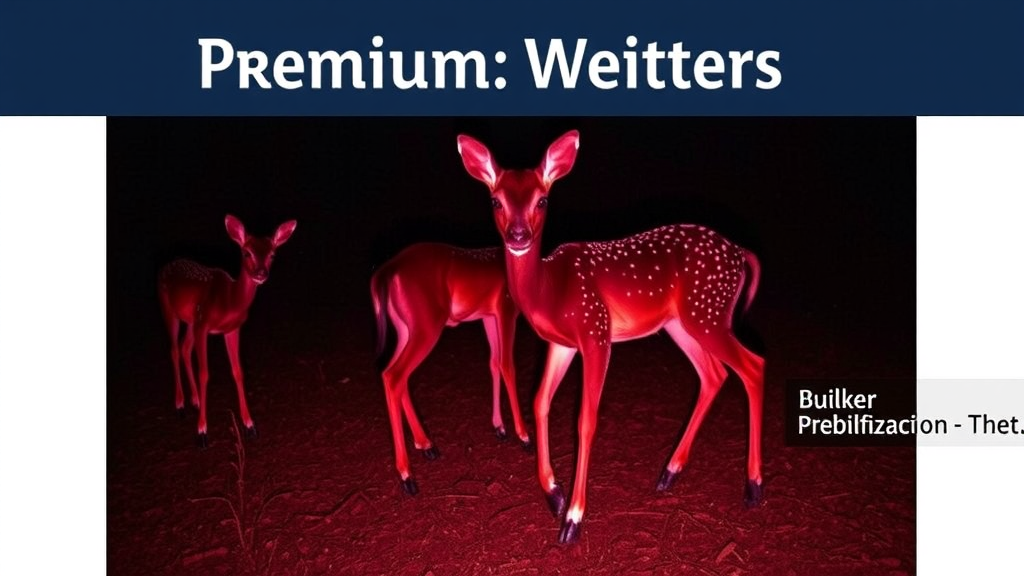
In the quiet hours after closing time at Frankfurt Zoo, infrared cameras recorded something rarely seen by human eyes: the first ten nights of life for two yellow-backed duiker calves, born a year apart to the same mother. A new case study published in Discover Animals by Melina Kurzawe, Nadine Manstein-Kuhn, Sabrina Linn and Paul W. Dierkes of Goethe University Frankfurt and Frankfurt Zoo has now turned those 280 hours of footage into the most detailed picture yet of how this elusive, near-threatened antelope behaves during the most dangerous phase of its life. The findings matter because yellow-backed duikers, the largest of all forest duikers, are notoriously difficult to breed in captivity, and calf mortality is one of the main obstacles standing between zoos and a self-sustaining insurance population for the species.
The yellow-backed duiker (Cephalophus silvicultor) occupies the widest range of any forest duiker, stretching across western and central Africa, where it inhabits moist lowland and montane forests and avoids open landscapes. The International Union for Conservation of Nature classifies the species as near threatened, and like most of its relatives its numbers are declining. Zoos have kept yellow-backed duikers since 1946, yet reproduction rates remain low and rearing offspring remains problematic. Juveniles of various duiker species frequently succumb to infections, paternal cannibalism, physiological or genetic defects, or environmental factors, and a link has been observed between inadequate maternal care and high infant mortality. Within the European Association of Zoos and Aquaria, the species is now managed under an Ex-situ Program that places special emphasis on juvenile survival, a priority made more urgent by the fact that only roughly 500 such programs exist for more than 42,000 threatened species worldwide.
Because the species lives in dense forest regions, field research is exceptionally difficult, and camera-trap studies have produced conflicting pictures of its daily rhythm, describing it as diurnal and nocturnal in some cases and mainly nocturnal with activity peaks at dusk in others. Nocturnal resting behavior and sleep patterns have remained almost entirely unexplored. This gap matters for welfare science, because sleep, particularly rapid eye movement (REM) sleep, is considered a potential indicator of stress and well-being in animals. While true REM sleep can only be confirmed with electroencephalography, researchers have shown that a characteristic body posture, lying with the head and body on the ground, can serve as a non-invasive proxy. During REM sleep, pronounced muscle atonia forces animals into this recumbent position, so scoring the proportion of time spent in the lying-head-down posture offers an approximation, though not a direct measurement, of REM sleep. The same approach has been applied to giraffes, common elands and a range of other zoo-housed ungulates, making results directly comparable across studies.
The Frankfurt team analyzed video footage from infrared cameras mounted near the ceilings of the stables, covering the period from 5 p.m. to 7 a.m. over ten consecutive nights beginning at birth, for two calves born in 2023 and 2024 and their mother, a female named Dolly born in 2015 at Omaha’s Henry Doorly Zoo. Using the open-source Behavioral Observation Research Interactive Software, the researchers scored an ethogram spanning three categories: general behavior, preferred position and spatial proximity. The two births also created an accidental natural experiment in husbandry. In 2023, mother and calf were housed in two separate stalls, one lined with bark mulch containing a keeper-prepared nest and one bedded with straw, directly adjacent to the male’s enclosure. In 2024, the pair occupied a single larger stall lined with bark mulch, with straw only in the nest, and with no spatial proximity to the male.
The results paint a portrait of a species that spends most of the night doing precisely nothing. Lying was the dominant behavior for every individual observed. Dolly lay down for 74.60 percent of the night in 2023 and 74.95 percent in 2024, a remarkably consistent budget across two different years and two different enclosures. When she was active, feeding dominated, accounting for roughly 13 to 15 percent of the night, while the lying-head-down posture occupied between about 8.6 and 10 percent of her time. The calves were even more sedentary. The 2023 female lay down for 86.77 percent of the night, with 54.34 percent of her time in the head-down posture, while her 2024 brother lay down for 83.26 percent, spending 45.33 percent of the night with his head on the ground. Suckling and walking each claimed only around 2 percent of the calves’ nights. These figures slot neatly into existing ungulate literature: even-toed ungulates such as cattle and Bovidae lie down far more at night, between roughly 68 and 88 percent, than odd-toed species like horses and zebras, which lie down only 20 to 26 percent of the night, and the duiker dam’s figures align closely with similarly sized African antelopes such as the sitatunga.
Age emerged as a clear driver of the differences between mother and offspring, confirming patterns documented across mammals and birds, in which juveniles spend far more time lying and lying with the head on the ground than adults. But the comparison between the two calves carried a more troubling signal. The 2023 calf, which died after 26 days, spent a noticeably higher proportion of her nights in the REM-like head-down posture than her healthy brother did the following year. Previous work on giraffe calves found that sick animals, including those that died prematurely, allocate more time to REM sleep than healthy ones. In light of that pattern, the elevated posture score in the 2023 calf may have been an early, non-invasive indicator of an underlying health problem. After her death, the calf was found to have been infected with Cryptosporidium, a parasitic protozoan known to reduce weight gain and increase diarrhea in juvenile livestock, although neither symptom was observed and the infection’s role in the death remains unclear. The finding has already changed management: the mother is now vaccinated twice during each pregnancy, and all calves, including the 2024 male, receive two vaccinations after birth.
The footage also revealed a nocturnal rhythm with distinct structure. The dam was most active at 7 p.m., followed by a feeding peak around 1 a.m. and a nursing peak at 4 a.m., with her lowest inactivity at 9 p.m. and a steady rise in activity through the small hours. The calves followed a similar schedule, and suckling occurred mostly after midnight, peaking at 4 a.m. This partly matches the declining-activity pattern reported for species from African buffalo to Arabian oryx and blue wildebeest, and the three-peak structure echoes that recorded for the sitatunga, a species of comparable size and weight. Whether this rhythm reflects the demands of rearing young or is typical of the species in general remains an open question, but the pattern gives zoo staff a concrete timetable for when mothers and calves are most likely to need undisturbed conditions.
Perhaps the most consequential findings concern mother-offspring dynamics and enclosure design. Yellow-backed duikers, like duikers generally, are thought to employ a hiding strategy, in which the calf remains concealed in a fixed location for weeks or months while the mother visits periodically to nurse, an approach that maximizes growth rate and reduces weaning age because milk energy goes into growth rather than movement. The study confirmed that this strategy persists under zoo conditions: the 2024 calf spent 82.68 percent of the night in the prepared nest, and both calves had direct physical contact with their mother for only about 12 to 13 percent of the night, essentially limited to nursing. In 2023, however, the calf rejected the prepared nest, spending just 3.32 percent of her time there and instead occupying the straw-bedded second box for 93.38 percent of the night, alongside her mother and without visual barriers. The contrast suggests that the presence and especially the placement of a suitable nest site can determine whether a calf can express its natural hiding behavior at all.
Suckling data added a second layer to the husbandry story. The 2024 calf made a median of 23 suckling attempts per night, with a maximum of 86 in a single night, compared with a median of 6 attempts for the 2023 calf, yet successful suckling events were similar between the two, with medians of 2.5 and 3 per night and median durations of 0.8 and 1.0 minutes. Across all ten nights, each calf accumulated roughly three hours of suckling, differing by only 3.5 minutes. Notably, the calves appeared to initiate suckling themselves, which is atypical for hider species, in which females normally approach the hiding site and call the calf out to nurse. The authors suggest that the unusually high number of attempts and the calf-initiated nursing may both stem from the small enclosures, ranging from 16 to 26 square meters, which forced continuous close proximity between mother and offspring. In the wild, related duiker species hold home ranges of around 400,000 square meters, and goitered gazelle mothers keep 200 to 400 meters from their hidden calves, so the constant contact in a zoo stall likely distorts a finely tuned behavioral system.
The authors are careful to frame the study as a case study with a small sample, a short observation window and housing conditions that changed completely between years, and they note that the posture-based estimate of REM sleep remains an approximation. Even so, the practical recommendations are concrete: provide multiple hiding sites or several bedded boxes in every accessible stable so that mother and calf can select separate areas for nesting and resting, place nests thoughtfully, and give the pair enough space to reduce constant proximity, echoing best-practice guidance developed for the okapi, a related forest ungulate whose own rearing problems were traced to inadequate nesting opportunities. For a species whose ex-situ future depends on a handful of births each year, the message from those ten nights of infrared footage is that the architecture of a quiet stall, and the freedom it gives a hidden calf to stay hidden, may be as important to survival as any vaccine.
Subject of Research: Nocturnal behavior and mother-offspring interactions in zoo-housed yellow-backed duikers during early calf rearing
Article Title: Nocturnal activity patterns and mother-offspring interactions during early rearing in yellow-backed duikers (Cephalophus silvicultor)
Article References: Kurzawe, M., Manstein-Kuhn, N., Linn, S., & Dierkes, P. W. (2026). Nocturnal activity patterns and mother-offspring interactions during early rearing in yellow-backed duikers (Cephalophus silvicultor). Discover Animals, 3(1), Article 96. https://doi.org/10.1007/s44338-026-00252-5
Image Credits: AI Generated
DOI: 10.1007/s44338-026-00252-5
Keywords: yellow-backed duiker, Cephalophus silvicultor, zoo biology, nocturnal behavior, REM sleep posture, mother-offspring interactions, suckling behavior, hiding strategy, calf mortality, enclosure design, ex-situ conservation, EAZA Ex-situ Program
Cite Scienmag News
Margaret Porter. (September 25, 2026). Night Watch: Infrared Cameras Reveal the Secret First Ten Days of Zoo-Born Duiker Calves. Scienmag. https://scienmag.com/night-watch-infrared-cameras-reveal-the-secret-first-ten-days-of-zoo-born-duiker-calves/
Margaret Porter. "Night Watch: Infrared Cameras Reveal the Secret First Ten Days of Zoo-Born Duiker Calves." Scienmag, 25 September 2026, https://scienmag.com/night-watch-infrared-cameras-reveal-the-secret-first-ten-days-of-zoo-born-duiker-calves/. Accessed 4 October 2026.
Margaret Porter. "Night Watch: Infrared Cameras Reveal the Secret First Ten Days of Zoo-Born Duiker Calves." Scienmag. September 25, 2026. https://scienmag.com/night-watch-infrared-cameras-reveal-the-secret-first-ten-days-of-zoo-born-duiker-calves/


