


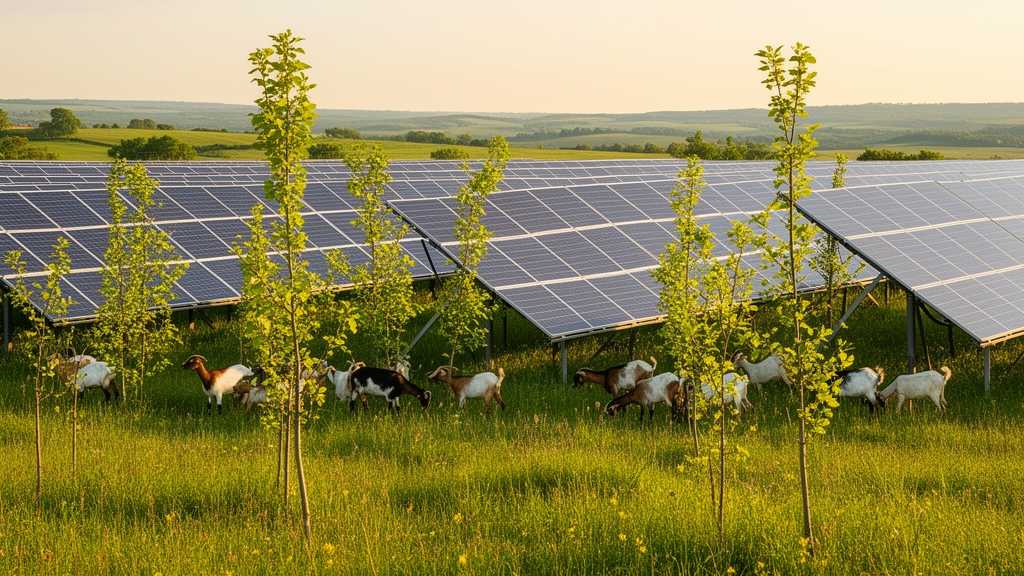
Ground-mounted solar parks have rapidly become one of the defining landscapes of the renewable energy transition, yet according to new research published in the journal One Ecosystem, the way these facilities are managed may be fighting against one of nature’s most unstoppable forces. The study argues that ecological succession—the gradual, predictable change of vegetation over time—is an omnipresent process that solar park planners and operators have largely overlooked, and that ignoring it explains why conventional maintenance keeps failing while a seemingly old-fashioned alternative, grazing livestock, could transform these energy landscapes into genuinely multifunctional, sustainable spaces.
The core problem is deceptively simple. Operators of ground-mounted photovoltaic installations want grassy, herb-rich vegetation beneath and between their panels: green enough to look acceptable and support biodiversity, but never tall or woody enough to shade the modules. Succession research shows that such grassland communities are merely a temporary stage. Left alone, vegetation progresses through grasses and herbs toward woody species and, given sufficient moisture, eventually forests. Mowing is the standard tool used to freeze the landscape at that early stage, preventing shading, preserving the visual appearance of the site, and keeping vegetation low enough for operators, service partners, and owners to inspect the infrastructure.
But mowing in a solar park is uniquely difficult, and the new analysis identifies three phenomena typical of woody plants that systematically defeat it. The first is survival through bending. Softwood pioneers such as willows (Salix spp.) and poplars (Populus spp.) are pliable; mowing machines often simply push saplings flat against the ground, after which they spring back up. The second is survival through regrowth after coppicing. When a mower cuts a woody plant, the remaining stump acts as a storage reservoir from which new shoots emerge, and stumps of astonishing width can develop quickly, producing more extensive shoots with every subsequent cut. The third, and perhaps most consequential, is survival in safe sites beyond the reach of any blade.
Those safe sites are built into the very architecture of solar parks. A typical two-post fixed array system uses roughly 500 vertical metal posts per hectare to support the panels, and when those posts are implemented as metal U-profiles—a common design—each one offers a protected niche where woody plants can grow out of reach of mowing tools. In succession research, the term
The article appears to be cut off mid-sentence, but the underlying study from One Ecosystem offers several additional dimensions worth exploring. Beyond the mechanics of vegetation management, the research situates solar parks within a broader land-use context that helps explain why succession management matters at scale. Data on ground-mounted photovoltaic installations in Germany, available from the end of 2021, show that 36 percent of the area covered—some 11,460 hectares—sits on conversion areas such as former military sites or landfills, while 30 percent, roughly 9,600 hectares, occupies former arable land. This distribution is significant for two reasons. Conversion areas often carry legacies of disturbance that shape which pioneer species arrive first, frequently favoring the fast-growing softwoods that mowing struggles to control. Former arable land, meanwhile, is predestined for grassland species with high fodder value, meaning that grazing animals could convert vegetation that would otherwise be treated as waste into a marketable product.
The fate of mown biomass illustrates how current practice squanders this potential. In principle, cut grass can be removed and used elsewhere, but in practice it has often been handled more like refuse, or left in place as a mulch layer. Mulching does deliver some benefits, reducing evaporation and building soil humus over the medium term, yet it also enriches the soil in ways that disadvantage plant species adapted to poor, nutrient-poor sites. Many of the species that conservation authorities and ecologists most want to see in solar parks are precisely those low-fertility specialists that cannot compete in intensively fertilized landscapes. A mowing regime that leaves clippings behind therefore gradually shifts the vegetation toward nutrient-loving species, undermining the floristic quality that nature conservation authorities in Germany explicitly demand when they prescribe good professional practice for developing species-rich meadow communities. Grazing, by contrast, removes nutrients in the form of meat and other animal products, slowing this eutrophication of the site and helping to maintain the open, species-rich conditions that early-successional plants require.
The shading problem that drives all this maintenance activity is more severe than casual observation might suggest. Even slight shading of photovoltaic panels can lead to disproportionately high losses in electricity output, which is why woody encroachment is treated as an operational threat rather than a cosmetic nuisance. This creates a structural tension: the very design of the panels, elevated on hundreds of posts per hectare, creates microhabitats that accelerate the problem. The higher the pressure of propagules—seeds and other dispersal units—on a site, the faster those protective U-profiles are found and occupied by woody plants. In other words, the more solar parks that exist in a landscape, the more seed rain they collectively generate, and the more intensively each individual park must be managed. Succession, as the study emphasizes, is a constant and elemental force that cannot simply be ignored or legislated away; it can only be anticipated and worked with.
Grazing offers a fundamentally different relationship with that force. Unlike mowers, which cut every stem at a uniform height, grazing animals such as goats bite at varying heights and sometimes pull woody plants up by the roots entirely. This uprooting may be easier near the support posts, where the underground portion of the U-profile physically hinders root development, weakening the very plants that mowing cannot reach. The result is a maintenance regime whose effort stays comparatively consistent over time, rather than escalating as stumps thicken and safe-site populations grow. Grazing also consumes less energy than fuel-powered mowing machinery, which requires lubricating oil and, for large areas, fossil fuel—substances that are sometimes spilled and contaminate the soil during operation.
The benefits extend beyond vegetation control into animal welfare and microclimate. Current German guidance for livestock in solar parks, which is gradually moving toward standardization even though no formal standards yet exist in the national body of standards, requires that farm animals be able to move upright beneath the arrays to avoid injury, with a minimum clear height of 1.5 metres and a spatial connection to stables. Once those requirements are met, the panels themselves become an asset for the animals: studies have documented that panels provide regular shade areas that improve livestock welfare, a benefit that becomes more valuable as heat extremes intensify. At the landscape scale, large solar parks in arid ecosystems have been shown to produce a surface temperature cool island effect extending beyond the park boundaries, driven largely by the solar radiation intercepted by the panels rather than absorbed by the ground.
Perhaps the most distinctive contribution of the study is its argument that these technical and ecological considerations connect to social dimensions. Energy landscapes, the author suggests, could reunite an increasingly polarized society on new common ground. In a multifunctional, grazed solar park, people with divergent values are likely to encounter one another: the critical consumer who disapproves of conventional meat production, and the livestock farmer who feels compelled to maximize output despite its consequences for animal welfare. Meat raised through extensive grazing in solar parks is likely to be perceived as more ethical even by highly critical consumers, easing the pressure on farmers to overproduce. Such arrangements could also help lift the profession of shepherding out of its general marginalization, giving it a renewed economic role in the energy transition. The author frames this as a tangible example of how changing norms and incentives, facilitated through complementarities between energy production, conservation, and agriculture, can shift society toward sustaining both natural and social capital.
The practical takeaway is a reframing of what solar park management is for. Rather than treating vegetation as an adversary to be suppressed through ever-increasing mowing effort, operators can design parks from the outset for grazing management, aligning panel heights, fencing, water access, and stable connections with the needs of livestock, and aligning stocking densities with the successional trajectory of the site. Because the topic is still young—experience with grazing in solar parks exists in practice and in the literature, but formal standards are only beginning to emerge—contextual factors will need to be explored site by site so that holistic perspectives and plurality can succeed. What the evidence makes clear is that succession is not a nuisance to be defeated but a process to be anticipated: parks that plan for it can lower long-term maintenance costs, support biodiversity on nutrient-poor grassland, produce food alongside electricity, and demonstrate that the energy transition can generate landscapes that are ecologically and socially richer than what they replaced.
Subject of Research: Vegetation succession and grazing-based management of ground-mounted solar parks
Article Title: Management and sustainability of ground-mounted solar parks requires consideration of vegetation succession as an omnipresent process
Article References: Zaplata, M. (2025). Management and sustainability of ground-mounted solar parks requires consideration of vegetation succession as an omnipresent process. One Ecosystem, 10, Article e141583. https://doi.org/10.3897/oneeco.10.e141583
Image Credits: AI Generated
DOI: 10.3897/oneeco.10.e141583
Keywords: solar parks, ecological succession, photovoltaics, grazing, vegetation management, biodiversity, renewable energy, land use, sustainability, agrovoltaics, woody plants, energy landscapes
Cite Scienmag News
Faith Mcneil. (October 18, 2026). Why Trees Keep Winning the Battle Inside Solar Parks—and How Grazing Goats Could End It. Scienmag. https://scienmag.com/why-trees-keep-winning-the-battle-inside-solar-parks-and-how-grazing-goats-could-end-it/
Faith Mcneil. "Why Trees Keep Winning the Battle Inside Solar Parks—and How Grazing Goats Could End It." Scienmag, 18 October 2026, https://scienmag.com/why-trees-keep-winning-the-battle-inside-solar-parks-and-how-grazing-goats-could-end-it/. Accessed 18 October 2026.
Faith Mcneil. "Why Trees Keep Winning the Battle Inside Solar Parks—and How Grazing Goats Could End It." Scienmag. October 18, 2026. https://scienmag.com/why-trees-keep-winning-the-battle-inside-solar-parks-and-how-grazing-goats-could-end-it/


