


Before the first tonne of ore was extracted from the Ada Tepe gold deposit in the Eastern Rhodopes of Bulgaria, a team of geochemists carried out a pre-monitoring study of the river sediments in the surrounding catchment. The research, published in the journal BioRisk in April 2022, examined the concentrations of seven heavy metals — copper, lead, zinc, cobalt, chromium, manganese and nickel — in twelve samples of river sediments collected during the summer of 2016, two years before the mine began exploitation. The findings establish that the landscapes around Ada Tepe were a natural background territory, unpolluted by heavy metals and unaffected by either human activity or natural geochemical anomalies, providing a crucial baseline for future environmental monitoring.
The Ada Tepe site carries deep historical weight. Ancient people mined gold in the area thousands of years ago, leaving visible traces such as deforestation, soil erosion and topographical transformations. The modern mine, operated by Dundee Precious Metals Inc., was delayed for years by local authorities and non-governmental organisations who voiced concerns about possible environmental damage, including contamination of rivers with heavy metals, loss of habitats and air pollution. In response, the company reshaped its initial business plans to satisfy local demands for better environmental security. The study was designed precisely to test whether the area was already geochemically compromised before the modern mining operation launched in 2018.
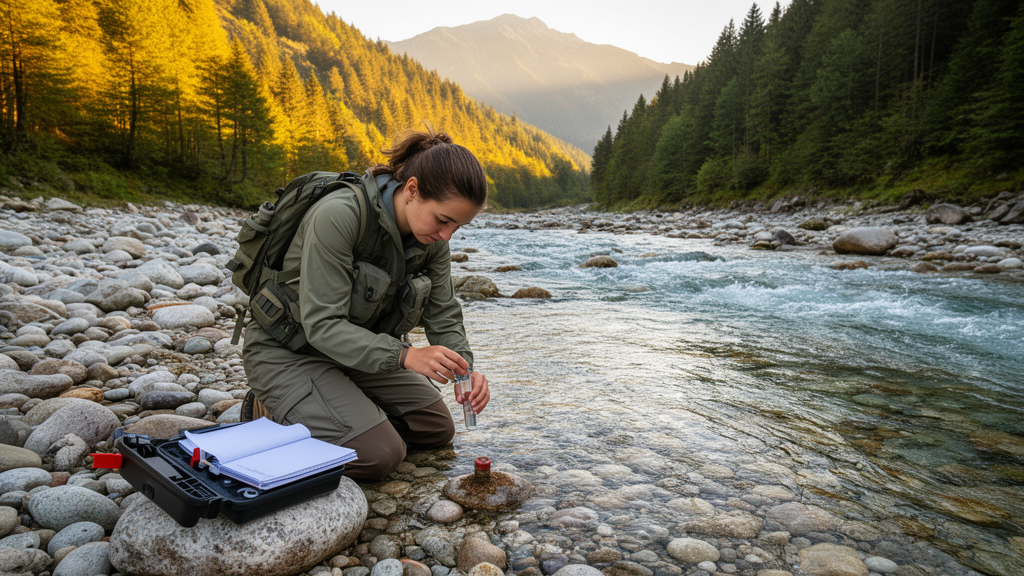
The researchers applied a systematic approach based on the analysis of chemical element content in river sediments. Sediments naturally absorb substances transported by rivers, making any anomaly in chemical concentration easy to detect. This allows the tracking of anomalies arising from either human activities or natural factors. The team collected twelve samples of river sediments using a standardised methodology: each sample weighed 500 grams with a grain size below 0.5 millimetres, taken from the upper layer of 0 to 5 centimetres of dried river thalwegs during the summer, when all intermittent rivers in the area dry out. Locations were selected through an analysis of spatial perspective and topographic accessibility, allowing the geochemical influence of Ada Tepe itself and of the tributaries feeding the main river to be interpreted.
The samples were analysed in the Geochemistry Laboratory of Sofia University. The sediments were dried, quartered, levigated in a porcelain cup, sifted through a 63-micrometre sieve, burned at 500 degrees Celsius and dissolved by a mixture of acids — perchloric acid, hydrofluoric acid and hydrochloric acid. Heavy metal content in the resulting chemical solution was measured by atomic-absorption spectrometry using a Perkin-Elmer 3030 instrument. The central quantitative tool was the coefficient of Clarke concentration, which compares the element concentration in the collected environmental samples with the Clarke value — the average content of a chemical element in the lithosphere. Values equal to 1 correspond to the Clarke concentration, values between 0 and 1 indicate dispersion, and any value higher than 1 signals concentration or enrichment.
The median values of heavy metals in the river sediments of the researched area, expressed in milligrams per kilogram, were 15 for copper, 72 for zinc, 17 for lead, 461 for manganese, 35 for nickel, 8 for cobalt and 60 for chromium. These figures place the Ada Tepe catchment firmly within the range of natural background territories. When compared with river sediments across Europe, most of the investigated chemical elements showed lower concentrations in the Ada Tepe area. Only nickel had a higher value than Europe’s reference: 35 milligrams per kilogram in the Ada Tepe area compared with 11 milligrams per kilogram in Europe. A similar comparison with natural background territories in Bulgaria — protected areas with minor human impact — showed only nickel exceeding the reference value of 28 milligrams per kilogram, and the scale of this excess was relatively tiny, demonstrating no anomaly.
The coefficient of Clarke concentration for nickel varied between 0.5 and 0.6 in the three comparable territories in Bulgaria, while in the rivers of Europe it was more dispersed, with smaller coefficient values of 0.2. The obtained data certify no geochemical anomalies for the territory, whether caused by natural factors or human impact. Previous results based on investigated plant tissues in the area, published by the same researchers, reached the same outcome. The investigated heavy metals did not contaminate the catchments in the Ada Tepe area by 2016.
A spatial analysis along the course of the Krumovitsa River, the main river in the catchment, clarified the differentiation of chemical elements. The sample collected before the Ada Tepe area showed an association of cobalt, copper, nickel and chromium, with only lead having a higher concentration — a Clarke concentration of 1.8. Four elements had significantly lower concentrations than the results where the Krumovitsa River passes near the foothill of Ada Tepe and downstream after the river flows through the town of Krumovgrad. Six elements — zinc, manganese, cobalt, copper, nickel and chromium — had lower concentrations downstream of Krumovgrad compared with the area near the foothill of Ada Tepe, proving that no technogenic geochemical anomaly exists in the river sediments caused by industrial or urban infrastructure.
One sample, collected where the Krumovitsa River passes near the foothill of Ada Tepe, showed increased concentrations of four elements — copper, zinc, nickel and chromium. This local anomaly is probably naturally determined and reflects the local geochemical influence of the ore-rich hill of Ada Tepe itself. The influence of Byuyuk Dere, one of the significant tributaries, explains the decrease of concentrations downstream, as the lower concentrations in the tributary sediments prove its role as a natural disperser. Local lithology is the primary natural factor determining the geochemical content of the river sediments, with different rock types predetermining the variation in the mechanical and chemical structure of the sediments. The precipitation rate of 760 millimetres per year, concentrated in autumn and winter, directly affects the accumulation, transportation and deposition of river sediments, while deforested landscapes enable active bedrock weathering and enforce lateral erosion, increasing the solid outflow in the rivers.
The researchers also compared their results with legally adopted norms. There are no legally adopted norms for recommended environmental concentrations of metals and metalloids in river sediments in the European Union, although such norms exist in the United States, where the Environmental Protection Agency institutionalises two levels of quality: the threshold environmental concentration, highlighting acceptable levels, and the predicted environmental concentration, raising awareness of possible negative effects on wildlife. The results show that five of the investigated elements — copper, zinc, manganese, cobalt and lead — do not exceed the threshold environmental concentrations. Nickel, at 35 milligrams per kilogram, and chromium, at 60 milligrams per kilogram, exceed the threshold environmental concentrations of 23 and 43 milligrams per kilogram respectively. However, none of the investigated chemical elements exceeds the predicted environmental concentration, which marks the level of possible harm to ecosystems.
The study concludes that the geochemical properties of the seven examined heavy metals within the local landscapes resemble a natural background territory with no traces of human impact. Local lithological specifics, rather than anthropogenic activity, determine the geochemical properties of the river sediments in the catchment. The research serves as a baseline for future studies on the mining impact on landscapes and ecosystems. The authors recommend extending the list of investigated chemical elements to encompass the full geochemical picture of the area, and stress that the effect of the ongoing mining activity at Ada Tepe must be a subject of regular independent environmental monitoring to ensure that the clean pre-mining record is preserved.
Subject of Research: Geochemistry
Article Title: Pre-monitoring geochemical research of the river sediments in the area of Ada Tepe gold mining site (Eastern Rhodopes)
Article References: Zhelev, D., & Penin, R. (2022). Pre-monitoring geochemical research of the river sediments in the area of Ada Tepe gold mining site (Eastern Rhodopes). BioRisk, 17, 379-387. https://doi.org/10.3897/biorisk.17.77466
Image Credits: AI Generated
Keywords: geochemistry, heavy metals, river sediments, gold mining, Ada Tepe, Bulgaria, environmental monitoring, pre-monitoring, geochemical, research, river, sediments
Cite Scienmag News
Violet Maxwell. (October 18, 2026). Gold Mine Baseline: Bulgarian River Sediments Show Clean Heavy Metal Record Before Ada Tepe Digging. Scienmag. https://scienmag.com/gold-mine-baseline-bulgarian-river-sediments-show-clean-heavy-metal-record-before-ada-tepe-digging/
Violet Maxwell. "Gold Mine Baseline: Bulgarian River Sediments Show Clean Heavy Metal Record Before Ada Tepe Digging." Scienmag, 18 October 2026, https://scienmag.com/gold-mine-baseline-bulgarian-river-sediments-show-clean-heavy-metal-record-before-ada-tepe-digging/. Accessed 18 October 2026.
Violet Maxwell. "Gold Mine Baseline: Bulgarian River Sediments Show Clean Heavy Metal Record Before Ada Tepe Digging." Scienmag. October 18, 2026. https://scienmag.com/gold-mine-baseline-bulgarian-river-sediments-show-clean-heavy-metal-record-before-ada-tepe-digging/


