


Panama has quietly become one of the most intensively surveyed countries on Earth for a group of insects most people have never noticed: caddisflies. A new benchmark study published in Neotropical Biology and Conservation reports that the country’s known Trichoptera fauna has more than doubled in under a decade, jumping from 257 species recorded between 1861 and 2015 to a staggering 535 species today, distributed across 15 families and 56 genera. The surge is not the result of a single spectacular discovery but of a sustained, methodical campaign by a small research group based in western Panama, and it offers a striking case study in how much biodiversity can remain hidden in a well-studied corner of the tropics when nobody looks closely.
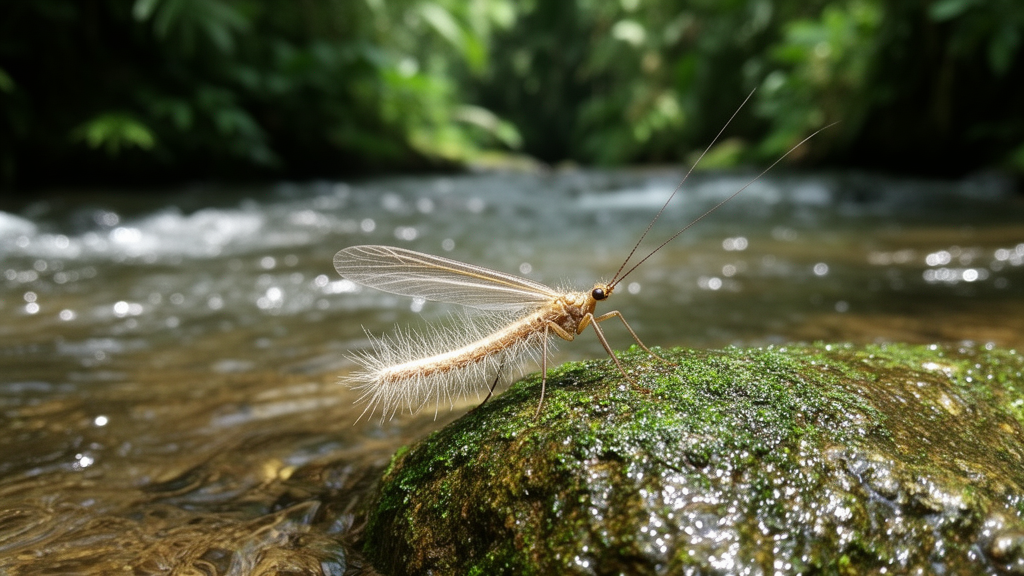
Caddisflies are aquatic insects whose larvae build silk cases and retreats in streams, making them important players in freshwater food webs and widely used indicators of water quality. Adults are moth-like and nocturnal, drawn to lights along streams throughout the tropics. Because their larvae live in flowing water and are sensitive to pollution, sedimentation, and changes in flow, caddisfly assemblages are among the standard biological tools for assessing the health of rivers and creeks. A country that does not know its caddisfly fauna, the authors argue, cannot fully interpret its own environmental monitoring data.
The new paper is the third in a series of benchmarks stretching back decades. The first, published in 1992, tallied 168 species in 39 genera and 13 families. By 2015, contributions from foreign specialists—most notably Oliver S. Flint, Jr. of the Smithsonian Institution, along with Joaquin Bueno-Soria, Ralph Holzenthal, Roger Blahnik, and Steve Harris—had pushed the total to 257 species in 45 genera. The first species ever recorded from Panama, the hydropsychid Smicridea bivittata, was described by Hagen in 1861 from the Panama Canal Zone, and for the following century only three more species were added. The real acceleration came after 2015, when a resident-led effort took over.
That effort centers on the Aquatic Invertebrate Research Group, or AIRG, formed in 2018 from employees and research associates of the Museo de Peces de Agua Dulce e Invertebrados at the Universidad Autónoma de Chiriquí in David. Between 2015 and 2023, the group added two families, 11 genera, and 278 species—more than the previous 154 years of work combined. Roughly 70 percent of the species described or recorded before 2015 have since been re-collected and confirmed, which the authors say attests to the historical accuracy of the older records and the continued presence of those species in Panama.
The methodology behind the surge is deliberately unglamorous. The team relies primarily on ultraviolet light traps, using fluorescent tubes or LED strips, supplemented wherever possible by Malaise traps set at the same sites. The combination of the two methods has consistently produced the richest species inventories. Equally important is sampling duration: monthly collections from December through June have proven roughly equivalent to sampling all year, while a single visit to a site yields far too little information to characterize the species assemblage present. Multiple months and multiple methods, the authors stress, are the price of a realistic picture of freshwater diversity.
The scale of the task is enormous. Panama’s narrow isthmus, bridging North and South America, contains 6,326 named creeks and 1,387 named rivers, plus tens of thousands of unnamed streams, organized into 52 defined water basins. The country’s complex geology—two continental blocks, the Chorotega and Choco, shaped by subduction, volcanism, and uplift of the Cocos Ridge—has produced steep altitudinal gradients and a patchwork of microclimates that favor speciation. Before 2015, most collecting had been confined to a handful of spots such as Barro Colorado Island, Miramar, and the Fortuna Forest Preserve. In the past eight years, the team has sampled more locations across more altitudes than in the previous 145 years combined, though entire basins remain unsurveyed.
The standout story is the family Hydroptilidae, the micro-caddisflies, many barely a few millimeters long. Before 2015, Panama had 154 hydroptilid species; the count now exceeds 250, with the genus Neotrichia alone leaping from three species to 45. Remarkably, Panama now leads all Latin American countries in hydroptilid diversity, surpassing far larger nations such as Mexico and Brazil. The authors expect Brazil, with its vast area and dedicated cadre of specialists, eventually to overtake Panama—but not yet. They also report 30 to 40 additional candidate new species already in hand, awaiting formal description, and one provisional species, Metrichia PA-1, left unnamed because its headless holotype made formal diagnosis too risky.
Biogeographically, Panama’s fauna is overwhelmingly Central American. The country shares 285 species with neighboring Costa Rica—about 53 percent of its fauna—including 91 species once thought to be Costa Rican endemics. Jaccard similarity analyses suggest the true affinity between the two countries may be even higher than measured, because incomplete inventories in other Central American nations depress the calculated values. The authors estimate that adequately surveyed Central American countries would each record a minimum of 200 to 250 caddisfly species, and they argue that most of the region’s apparent faunal differences simply reflect disparities in scientific effort rather than genuine biological divergence.
Perhaps the most consequential finding is what the accumulation curves do not show. Plots of new species and new country records over time remain essentially straight lines, with no sign of leveling toward an asymptote. Even as new records of the larger, more conspicuous macro-caddisflies have slowed, the micro-caddisflies show no such falloff. Based on current trends, material in hand, and non-parametric estimators such as Chao2, the authors project that Panama will ultimately prove to host 750 to 850 species, most of them hydroptilids. The fauna is also highly endemic: 170 species, roughly 32 percent, are known only from Panama.
The team is now deliberately slowing its collecting to process a backlog of samples, including a 2023 effort that sampled 27 locations monthly across three altitudinal zones. Their agenda for the future is clear: mapping the surficial and altitudinal distribution of every genus and species, associating adults with their poorly known larvae, and moving from pure inventory into ecology, life history, and long-term monitoring. They also flag a caution for biomonitoring—year-to-year variation in adult assemblages is still so poorly quantified that detecting genuine environmental impacts from adult caddisflies alone may be difficult, and larval identifications, currently reliable only to genus, trade precision for lower noise. What began as a checklist has become a foundation for understanding how one of the tropics’ most biodiverse freshwater systems actually works, one tiny insect at a time.
Subject of Research: Diversity and biogeography of caddisflies (Trichoptera) in Panama
Article Title: The Trichoptera of Panama XXVII. The third benchmark—a waypoint to the future
Article References: Armitage, B. J., Harris, S. C., Ríos González, T. A., Aguirre, Y. P., Blahnik, R. J., Thomson, R. E., & Arefina-Armitage, T. I. (2024). The Trichoptera of Panama XXVII. The third benchmark—a waypoint to the future. Neotropical Biology and Conservation, 19(2), 253-291. https://doi.org/10.3897/neotropical.19.e113487
Image Credits: AI Generated
DOI: 10.3897/neotropical.19.e113487
Keywords: caddisflies, Trichoptera, Panama, biodiversity, freshwater insects, Hydroptilidae, Neotropics, taxonomy, species inventory, aquatic invertebrates, biogeography, water quality
Cite Scienmag News
Gavin Prescott. (October 18, 2026). Caddisfly Explosion: Panama Doubles Its Insect Fauna in Just Eight Years. Scienmag. https://scienmag.com/caddisfly-explosion-panama-doubles-its-insect-fauna-in-just-eight-years/
Gavin Prescott. "Caddisfly Explosion: Panama Doubles Its Insect Fauna in Just Eight Years." Scienmag, 18 October 2026, https://scienmag.com/caddisfly-explosion-panama-doubles-its-insect-fauna-in-just-eight-years/. Accessed 18 October 2026.
Gavin Prescott. "Caddisfly Explosion: Panama Doubles Its Insect Fauna in Just Eight Years." Scienmag. October 18, 2026. https://scienmag.com/caddisfly-explosion-panama-doubles-its-insect-fauna-in-just-eight-years/


