


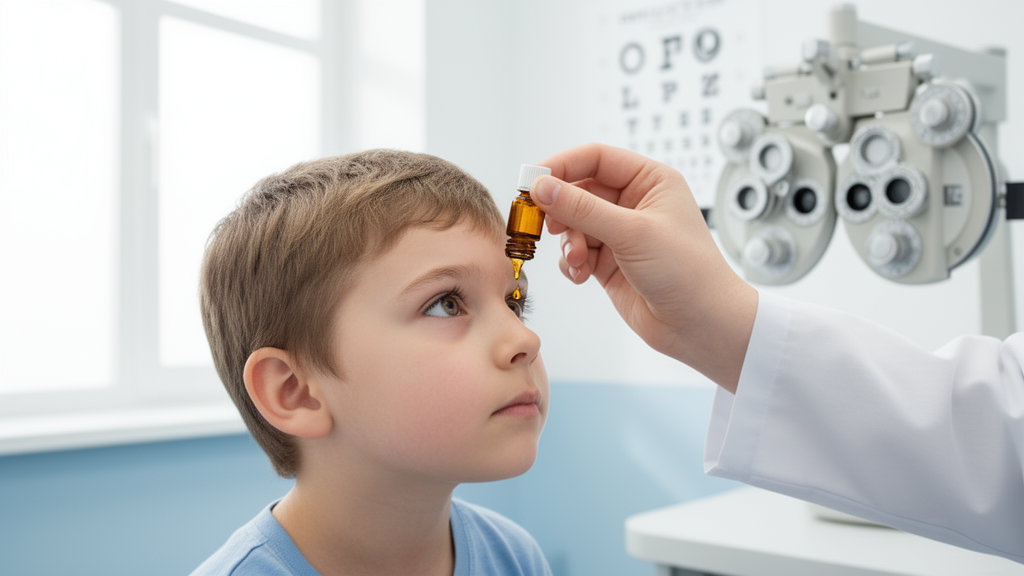
For millions of families watching a child’s prescription climb year after year, the question has never been whether to intervene, but how. A large clinical trial now offers one of the clearest answers yet for children at the most dangerous end of the spectrum. In a two-year, multicenter, double-blind randomized controlled trial conducted across Shanghai, researchers found that nightly atropine eye drops at a concentration of 0.10 percent significantly slowed the progression of high myopia in children aged 6 to 12, outperforming the weaker concentrations that have dominated clinical practice for the past decade. The study, published in Nature Communications, enrolled 219 children with myopia of at least −5.0 diopters and followed them for 24 months, providing the kind of long-term, head-to-head evidence that the field of myopia control has been waiting for.
The stakes in high myopia are far higher than thick spectacle lenses. When the eyeball elongates excessively, the retina and its supporting tissues are stretched and thinned, dramatically raising the lifetime risk of retinal detachment, myopic macular degeneration, glaucoma, and irreversible visual impairment. Unlike ordinary refractive error, which can simply be corrected with glasses or contact lenses, the structural changes of high myopia cannot be undone. That is why clinicians have increasingly focused not on correcting vision but on slowing the eye’s growth itself, and why the search for a safe, effective, and practical pharmacological treatment has become one of the most active areas in pediatric ophthalmology.
Atropine, a classic muscarinic receptor antagonist long used to dilate the pupil and paralyze the eye’s focusing muscle, emerged as an unlikely candidate for this mission. The landmark ATOM1 and ATOM2 trials in Singapore demonstrated that even very dilute solutions could slow myopia progression, with lower concentrations offering a more favorable trade-off between efficacy and side effects. The 0.01 percent formulation in particular spread rapidly through clinics worldwide, becoming a de facto standard despite lingering uncertainty about the optimal dose. What remained genuinely contested was whether stronger solutions, which plausibly suppress eye growth more powerfully, could be given to children without unacceptable visual disturbance or rebound effects, and whether the benefits seen in moderate myopia would extend to children whose eyes were already severely elongated.
The new trial was designed to answer exactly that question in the high myopia population. Between recruitment on July 4, 2021 and final follow-up on August 21, 2024, the research team, working through the Shanghai Eye Diseases Prevention and Treatment Center, Shanghai General Hospital, and Shanghai Ninth People’s Hospital, enrolled 219 children aged 6 to 12 with spherical equivalent refraction of at least −5.0 diopters. Participants were randomly assigned in a double-blind fashion to receive one of three concentrations of atropine eye drops, 0.01 percent, 0.04 percent, or 0.10 percent, instilled once nightly into both eyes for 24 months. Neither the families nor the clinicians assessing outcomes knew which concentration any child was receiving, eliminating the placebo expectations and observer biases that can distort unblinded studies. In total, 182 participants completed the full trial, and all 219 randomized cases were included in the analysis.
The primary outcome was the change in cycloplegic spherical equivalent, a standardized measure of refractive error taken after eye drops temporarily disable the eye’s accommodation, from baseline over 24 months. The results showed a clear concentration-dependent pattern. Children on 0.01 percent atropine progressed by a mean of −0.92 diopters over two years, those on 0.04 percent by −0.78 diopters, and those on 0.10 percent by only −0.56 diopters. In other words, the strongest dose cut the two-year progression by roughly 0.35 diopters compared with the weakest, a difference that reached statistical significance with a 95 percent confidence interval of 0.12 to 0.58 diopters. The intermediate 0.04 percent concentration, by contrast, did not differ significantly from 0.01 percent over the full 24-month period.
The one-year data add an important nuance to that picture. At the 12-month mark, both higher concentrations had already demonstrated significantly greater reductions in progression than 0.01 percent, by 0.16 diopters for 0.04 percent and 0.30 diopters for 0.10 percent. The intermediate dose’s advantage, visible early, apparently faded over the second year, while the strongest concentration’s benefit persisted. For clinicians, this temporal pattern matters: it suggests that dose selection is not simply a matter of picking the strongest tolerable option at any moment, but of considering how the treatment effect is sustained across the years during which a child’s eye is still growing. It also hints that the mechanisms driving myopia progression may respond differently to dose over time, a question that will likely fuel further mechanistic research.
Safety has always been the central argument against higher atropine concentrations, and the trial addressed it directly. Atropine dilates the pupil, letting in more light, and relaxes the focusing mechanism, and the most common adverse event reported was photophobia, or light sensitivity. Over the first 12 months, photophobia was reported by 9.0 percent of children on 0.01 percent, 10.6 percent on 0.04 percent, and 18.8 percent on 0.10 percent. Over the full 24 months, the figures were 7.8 percent, 8.1 percent, and 21.1 percent respectively. The gradient is real, with roughly one in five children on the strongest dose experiencing light sensitivity, but the investigators concluded that nightly use of 0.10 percent atropine for 24 months was both effective and safe in this age group. For most families, a manageable increase in light sensitivity, often addressed with hats or photochromic lenses, may be a reasonable price for meaningfully slower eye growth.
The trial’s design strengths deserve emphasis, because they distinguish it from much of the existing literature. It was randomized, double-blind, and placebo-controlled in structure across three active doses, multicenter in execution, and long enough at two years to capture sustained effects rather than short-term fluctuations. Cycloplegic refraction, the gold standard for measuring refractive error in children, was used for the primary endpoint, avoiding the overestimation of myopia that non-cycloplegic measurements can introduce. The trial is registered with ClinicalTrials.gov under identifier NCT04699357, and the funders, including the National Natural Science Foundation of China and several Shanghai municipal programs, had no role in the design, conduct, analysis, or publication decisions. The authors reported no competing interests.
What does this mean for the millions of children worldwide whose myopia is racing toward the high range? The global prevalence of myopia has been climbing for decades, particularly in East and Southeast Asia, and projections suggest that by mid-century roughly half of the world’s population may be myopic, with a substantial fraction falling into the high myopia category where sight-threatening complications concentrate. Interventions to date have included increased outdoor time, specialized spectacle and contact lens designs, orthokeratology, and low-dose atropine, often in combination. This trial does not settle every question, notably whether even higher concentrations might do better, how treatment should be tapered or stopped, or how atropine interacts with optical interventions, but it substantially strengthens the case that 0.10 percent is a rational starting point for children with high myopia rather than the weaker doses conventionally prescribed.
It also reframes a decade of clinical habit. The rapid global adoption of 0.01 percent atropine was driven more by caution than by comparative evidence, and this study suggests that caution may have cost children in the high myopia group a meaningful amount of protection. The concentration-dependent effect observed here, with 0.10 percent clearly superior over two years and 0.04 percent offering only transient benefit, gives ophthalmologists a firmer evidence base for individualizing treatment in the patients who need it most. As with any trial, replication in other populations and longer follow-up will be needed to confirm durability and monitor for late-emerging effects. But for now, the message from Shanghai is strikingly simple: for children whose eyes are already severely myopic, a nightly drop of stronger atropine can measurably slow the march toward a lifetime of elevated risk, safely, over the two years when it matters most.
Subject of Research: Atropine eye drop concentrations for controlling high myopia progression in children
Article Title: Different concentrations of atropine in children with high myopia: a 2-year multicenter double-blind, randomized controlled trial
Article References: Du, L., Liu, Z., Cheng, T., Yan, W., Ke, B., Yuan, Y., Li, X., Zhou, J., Chen, J., Wang, J., Pang, C. P., Zou, H., Gao, W., Xu, X., & He, X. (2026). Different concentrations of atropine in children with high myopia: a 2-year multicenter double-blind, randomized controlled trial. Nature Communications. https://doi.org/10.1038/s41467-026-77797-2
Image Credits: AI Generated
DOI: 10.1038/s41467-026-77797-2
Keywords: myopia, high myopia, atropine, randomized controlled trial, pediatric ophthalmology, refractive error, eye drops, photophobia, spherical equivalent, myopia control, Nature Communications, clinical trial
Cite Scienmag News
Ophelia Keating. (October 18, 2026). Stronger Atropine Eye Drops Slow Severe Nearsightedness in Children, Trial Finds. Scienmag. https://scienmag.com/stronger-atropine-eye-drops-slow-severe-nearsightedness-in-children-trial-finds/
Ophelia Keating. "Stronger Atropine Eye Drops Slow Severe Nearsightedness in Children, Trial Finds." Scienmag, 18 October 2026, https://scienmag.com/stronger-atropine-eye-drops-slow-severe-nearsightedness-in-children-trial-finds/. Accessed 18 October 2026.
Ophelia Keating. "Stronger Atropine Eye Drops Slow Severe Nearsightedness in Children, Trial Finds." Scienmag. October 18, 2026. https://scienmag.com/stronger-atropine-eye-drops-slow-severe-nearsightedness-in-children-trial-finds/


