


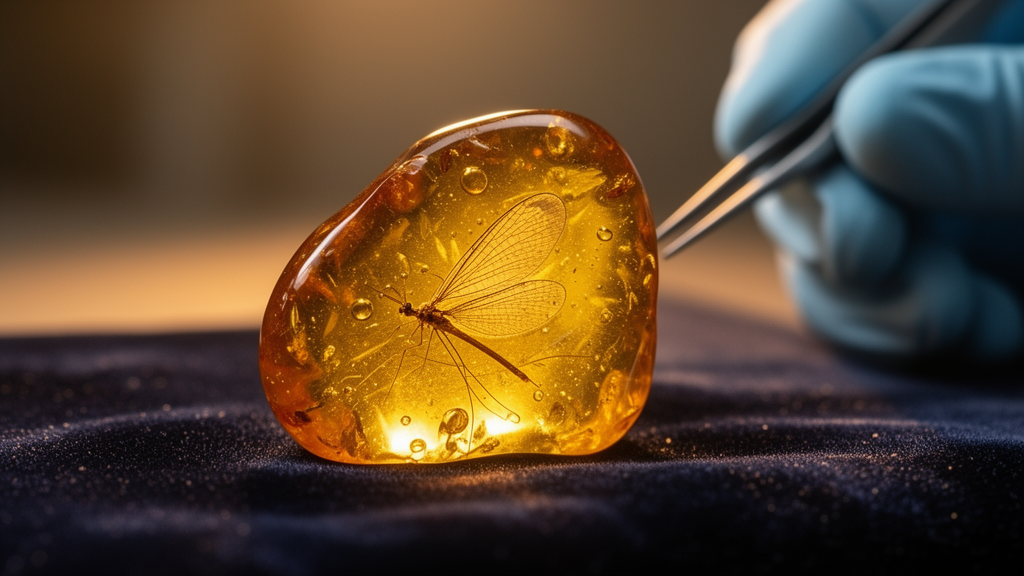
Deep inside a sliver of amber collected near Goldsboro, North Carolina, a mayfly has been waiting for roughly 83 million years. The insect, preserved as a female imago barely two millimeters long, has now been formally described as Petracloeon carolinensis gen. et sp. nov., a new genus and species within the mayfly family Baetidae. The discovery, published in the journal Fossil Record, marks the first mayfly ever recovered from the North Carolina amber deposit and the first unambiguous Baetidae fossil from the Cretaceous of the Americas. For a family that today accounts for roughly a quarter of all mayfly diversity worldwide, the fossil record has been astonishingly thin, and each new specimen carries disproportionate weight in reconstructing the group’s evolutionary history.
Baetidae are among the most successful mayfly families on the planet. They occur on nearly every significant landmass except Antarctica, New Zealand, and some oceanic islands, and they reach their greatest diversity and highest levels of generic endemism in tropical regions. Their larvae inhabit freshwater streams and lakes, where they play significant ecological roles as grazers and prey items. Yet despite this modern ubiquity, the family’s fossil record is extremely scarce. The oldest fossil attributed to Baetidae, referred to as Baetidae sp. 1, comes from Early Cretaceous Lebanese amber dated to approximately 129.4 to 125 million years ago, but its preservation is too poor to allow a detailed description. Additional Mesozoic records include Vetuformosa buckleyi from mid-Cretaceous Burmese amber, Palaeocloeon taimyricum from Late Cretaceous Taimyr amber in Northern Asia, and Myanmarella rossi, originally assigned to Prosopistomatidae and later transferred to Baetidae.
The new North Carolina specimen, catalogued as AMNH NC-VK261 in the American Museum of Natural History, was collected by V. E. Krynicki near the Neuse River Cut Off in Wayne County. According to earlier palynological dating by Mitra and Mickle, the type locality represents an outcrop of the Tar Heel Formation dated as early Campanian, approximately 83 million years ago. The amber itself has been embedded in a high-end glass conservation epoxy for protection. A second amber piece containing a partially preserved chironomid midge serves as a syninclusion, offering a glimpse of the insect community that shared the Cretaceous forest with the mayfly. Compared with extensively studied deposits such as Burmese amber from Northern Myanmar, the inclusions in North Carolina amber have received very little scientific attention, with only fossil ants and a phantom crane fly previously described from the deposit.
Morphological analysis of the holotype revealed a suite of diagnostic characters. The body measures approximately 1.9 millimeters, and the specimen is identified as female based on compound eyes that are not distinctly enlarged, forelegs that are not elongated, and the absence of male genitalia. The forewing, roughly equal in length to the body at 2 millimeters, displays a pronounced angle on its posterior margin between the veins CuA and CuP, an unusual feature in Baetidae where this portion of the wing margin is rounded in all extant genera. The hind wing is small, approximately 0.3 times the forewing length, with reduced venation and a small acute costal process positioned basally. The first principal longitudinal vein of the hind wing is sigmoidal, while the second is bifurcated, with an intercalary vein between its branches that is also distally bifurcated and followed by another simple intercalary vein. The tarsi are four-segmented with three movable segments and the basal segment fused with the tibia, and a tibio-patellar suture is present on all legs.
Attribution of the specimen to Baetidae rests on several key characters. The forewing MA2 vein is free, not connected with MA1, a condition that separates Baetidae not only from Siphlaenigmatidae but from all other mayfly families, which exhibit the MA vein bifurcated into MA1 and MA2. Single free marginal intercalary veins are present along the posterior margin of the forewing, well-distinguishable in the median sector of the left forewing, and such marginal intercalary veins are typical for Baetidae. The small hind wing with reduced venation and a basally situated costal process, along with the vestigial paracercus at the tip of the abdomen, further support the placement within the family. Characters associated with the broader group Tetramerotarsata, including the absence of the mesonotal suture, the presence of the sublateroscutal suture, and a CuP vein curved backward near its base, are also recognizable in the fossil, although recent molecular reconstructions suggest these similarities between Baetidae and Siphlaenigmatidae may reflect convergent evolution rather than shared ancestry.
The researchers also evaluated the specimen’s relationship to the Cretaceous subfamily Palaeocloeoninae, known from Burmese and Taimyr amber. Several characters argue against such an assignment. In Petracloeon carolinensis, the furcasternal protuberances on the mesothorax are widely separated, more closely resembling the condition in extant Baetidae, whereas Palaeocloeoninae is characterized by contiguous furcasternal protuberances. The tibio-patellar suture on the forelegs is present in the new fossil but absent in Palaeocloeoninae, and the antennal flagellum is much shorter, approximately twice the head length, compared with the very long flagella exceeding three times head length reported in Palaeocloeoninae females. Based on these character states, the authors declined to place the new genus within Palaeocloeoninae, instead suggesting an affinity with the clade Turbanoculata, which encompasses all extant Baetidae taxa.
Within Turbanoculata, the presence of the tibio-patellar suture in all legs points toward the group Anteropatellata. The hind wing venation, with its bifurcated longitudinal veins and intercalary veins, excludes assignment to Cloeonini, whose members have either no hind wings or slender hind wings with only simple, unforked longitudinal veins. The forewing pattern of single rather than double marginal intercalary veins rules out the clade Baetungulata, whose imagos universally display double intercalary veins. The venation pattern suggests a possible affinity with Baetovectata excluding Baetungulata, although the general shape of the forewing, particularly the pronounced posterior angle, may indicate a more basal position within the Baetidae lineage. Because the holotype is female, crucial characters of male genitalia and turbinate eyes cannot be verified, and the authors refrained from establishing any new higher taxon above the genus level.
The biogeographic implications are considerable. From the sparse fossil record, it is clear that Baetidae were already diversified during the Cretaceous, with nearly contemporaneous occurrences in Burmese amber, Taimyr amber, and now North America. Earlier hypotheses proposed either a South American primary centre of evolution or a Pangean origin for the family. Given that mayflies have short adult lifespans and depend on freshwater habitats, transoceanic dispersal likely played only a minor role in shaping their current distribution, although proven cases of such dispersal exist between Madagascar and continental Africa. It therefore seems reasonable to conclude that the origin of Baetidae predates the main continental breakup beginning in the Jurassic, an assumption consistent with recent phylogenies of Ephemeroptera that recover the family as one of the basal lineages.
The discovery also highlights how much remains to be learned from understudied amber deposits. While Burmese amber has been intensively investigated and has yielded numerous Baetidae specimens, the North Carolina amber has produced only a handful of described inclusions despite its considerable age. The new fossil represents the oldest known occurrence of the clade Turbanoculata, meaning it sits at or near the base of the lineage that gave rise to every living Baetidae species. Knowledge of the male imago, with its genitalia and turbinate eyes, could provide crucial insights to confirm the precise taxonomic position of Petracloeon within the family and resolve remaining uncertainties about its phylogenetic relationships.
For now, the tiny mayfly sealed in North Carolina amber stands as a quiet but powerful witness to the deep history of one of the world’s most diverse insect families. Its presence in the Cretaceous of North America significantly expands the known distribution range of Baetidae during that period and reinforces the picture of a family that was nearly global tens of millions of years before the continents assumed their modern configurations. As scientists turn fresh attention to the inclusions preserved in this underexplored deposit, more discoveries may follow, each one adding another piece to the puzzle of how mayflies conquered the freshwater habitats of the world.
Subject of Research: A new fossil mayfly species from Late Cretaceous amber in North Carolina, USA, described as Petracloeon carolinensis gen. et sp. nov., the first Baetidae from the Americas' Cretaceous.
Article Title: The first mayfly ( Ephemeroptera , Baetidae ) from Late Cretaceous amber of North Carolina, USA
Article References: Sroka, P., & Gattolliat, J.-L. (2025). The first mayfly (Ephemeroptera, Baetidae) from Late Cretaceous amber of North Carolina, USA. Fossil Record, 28(1), 125-132. https://doi.org/10.3897/fr.28.143974
Image Credits: AI Generated
DOI: 10.3897/fr.28.143974
Keywords: mayfly, Baetidae, Ephemeroptera, Cretaceous amber, North Carolina, fossil, Petracloeon carolinensis, paleontology, biogeography, amber inclusions, Late Cretaceous, insect evolution
Cite Scienmag News
Gavin Prescott. (October 18, 2026). Tiny mayfly in 83-million-year-old amber rewrites the story of a global insect family. Scienmag. https://scienmag.com/tiny-mayfly-in-83-million-year-old-amber-rewrites-the-story-of-a-global-insect-family/
Gavin Prescott. "Tiny mayfly in 83-million-year-old amber rewrites the story of a global insect family." Scienmag, 18 October 2026, https://scienmag.com/tiny-mayfly-in-83-million-year-old-amber-rewrites-the-story-of-a-global-insect-family/. Accessed 18 October 2026.
Gavin Prescott. "Tiny mayfly in 83-million-year-old amber rewrites the story of a global insect family." Scienmag. October 18, 2026. https://scienmag.com/tiny-mayfly-in-83-million-year-old-amber-rewrites-the-story-of-a-global-insect-family/


