


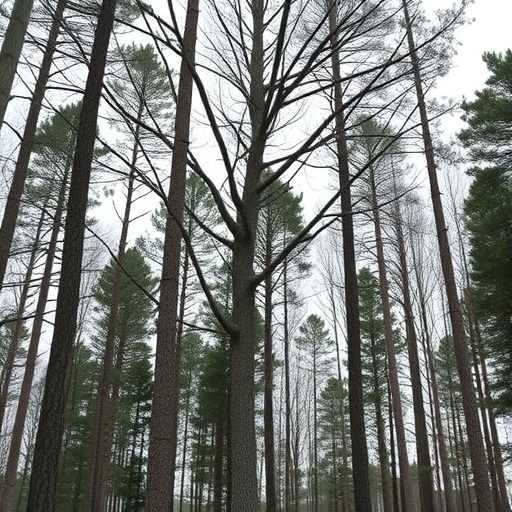
A comprehensive global study conducted by researchers from the University of Basel, Switzerland, has uncovered unexpected patterns in the shifting of alpine treelines across the world. Contrary to the prevailing assumption that treelines uniformly ascend in response to climate warming, the study reveals that while 42 percent of treelines have indeed moved upslope over the past two decades, a significant 25 percent have retreated downslope. This nuanced dynamic demonstrates that elevational shifts in treelines are governed by complex interactions between climate factors and human land use, rather than temperature alone.
For decades, the upward migration of treelines in mountain ecosystems has been commonly interpreted as an unambiguous signal of global warming. Trees, constrained by harsh climatic conditions at high altitudes, were expected to advance as temperatures rise. However, this comprehensive investigation, spanning satellite data analysis from 2000 to 2020, challenges this linear perspective by demonstrating a heterogeneous response of treeline boundaries to environmental drivers. It provides compelling evidence that temperature is only part of a multifaceted set of influences affecting treeline dynamics globally.
The researchers deployed advanced remote sensing techniques to distinctly characterize actual treeline movements and juxtapose these with potential treeline locations—where climatic conditions theoretically permit tree establishment. This comparison exposed discrepancies indicative of additional controlling factors beyond mere temperature shifts. The potential treeline correlates primarily with thermal constraints, whereas the realized treeline reflects ecological realities shaped by anthropogenic impacts and disturbance regimes.
Dr. Mathieu Gravey of the Austrian Academy of Sciences emphasizes the temporal scale of treeline dynamics. “The process unfolds gradually over decades, meaning the full extent of these ecological adjustments might span human lifetimes,” he notes. This highlights the importance of long-term monitoring to appreciate the slow but critical ecological transformations underway in alpine regions affected by climate change and land use modifications.
The study’s findings convey that temperature alone cannot explain the observed variability in treeline shifts. Human activities, particularly alterations in land use patterns such as grazing intensity, forest management, and fire incidence, exert profound control on the actual position and movement of treelines. For instance, in the European Alps, the abandonment of traditional high-elevation pastures allows natural forest succession to reclaim these areas, driving treelines higher irrespective of climatic constraints.
Prof. Dr. Sabine Rumpf from the University of Basel elaborates on the implications: “Common narratives attribute treeline shifts primarily to warming climates. Yet our data reveal that human land use trajectories critically shape treeline morphology. The interplay between retreating grazing, increasing forest regeneration, and climate warming creates complex ecological feedbacks.” This suggests that ecological responses to climate change cannot be fully understood without accounting for socio-environmental contexts.
Globally, the degree to which a region has been historically exploited and altered by human land use strongly modulates present treeline dynamics. The study quantifies that in numerous regions, the influence of land use change rivals or exceeds that of temperature change. Such findings necessitate integrating socioeconomic factors alongside climatic variables to accurately model and predict alpine ecosystem trajectories.
Natural disturbances also contribute substantially to treeline variability. The study highlights that 38 percent of observed downward treeline shifts correlate with wildfire events. Dr. Tianchen Liang, lead author, notes that while fires are typically seen as natural disturbance agents, their frequency and severity are increasingly intertwined with anthropogenic pressures and climate-driven changes. This entanglement further complicates separating natural versus human-induced ecological processes impacting treelines.
Treelines thus emerge as more than climatic thermometers; they reflect a complex tapestry of ecological, climatic, and anthropogenic influences. This complexity challenges simplistic interpretations and calls for nuanced, interdisciplinary approaches to understanding mountain ecosystem responses to global change. Moreover, as visual and tangible indicators of environmental transformation, treelines provide an accessible medium for illustrating the often opaque consequences of human decisions on natural landscapes.
According to the researchers, interpreting treeline shifts correctly is paramount for climate change science and policy. Treelines exemplify the multifaceted nature of global environmental change, embodying direct human land use effects alongside indirect climatic impacts. This dual role underscores the imperative for conservation and land management policies that consider both climate mitigation and sustainable land stewardship to preserve alpine biodiversity and ecosystem services.
The study also stresses the communicative power of treelines as ecological signals. Whereas many global changes remain abstract and detached from everyday human experience, shifts in treeline boundaries are visually striking and intuitively understandable, bridging the gap between scientific evidence and public perception. Historical and contemporary photographic comparisons starkly illustrate landscape transformations, thereby offering a tangible narrative of environmental change.
In sum, the global analysis of treeline shifts over the past two decades reveals that the patterns of alpine forest boundaries are far from uniform and driven by a confluence of warming temperatures, land use changes, and disturbance events. These findings prompt a reevaluation of how treelines are used as sentinel indicators of climate change impacts and highlight the critical need to consider anthropogenic land use as a central driver shaping mountain ecosystems’ future.
The comprehensive insights stemming from this internationally collaborative research not only refine our ecological understanding but also enhance the ability of stakeholders—from scientists to policymakers—to navigate the challenges of sustainable mountain landscape management in an era of accelerating global change.
Web References:
DOI link to article
Cite Scienmag News
Gavin Prescott. (April 9, 2026). Why Treelines Don’t Just Shift Upward as the Climate Warms. Scienmag. https://scienmag.com/why-treelines-dont-just-shift-upward-as-the-climate-warms/
Gavin Prescott. "Why Treelines Don’t Just Shift Upward as the Climate Warms." Scienmag, 9 April 2026, https://scienmag.com/why-treelines-dont-just-shift-upward-as-the-climate-warms/. Accessed 3 September 2026.
Gavin Prescott. "Why Treelines Don’t Just Shift Upward as the Climate Warms." Scienmag. April 9, 2026. https://scienmag.com/why-treelines-dont-just-shift-upward-as-the-climate-warms/


