


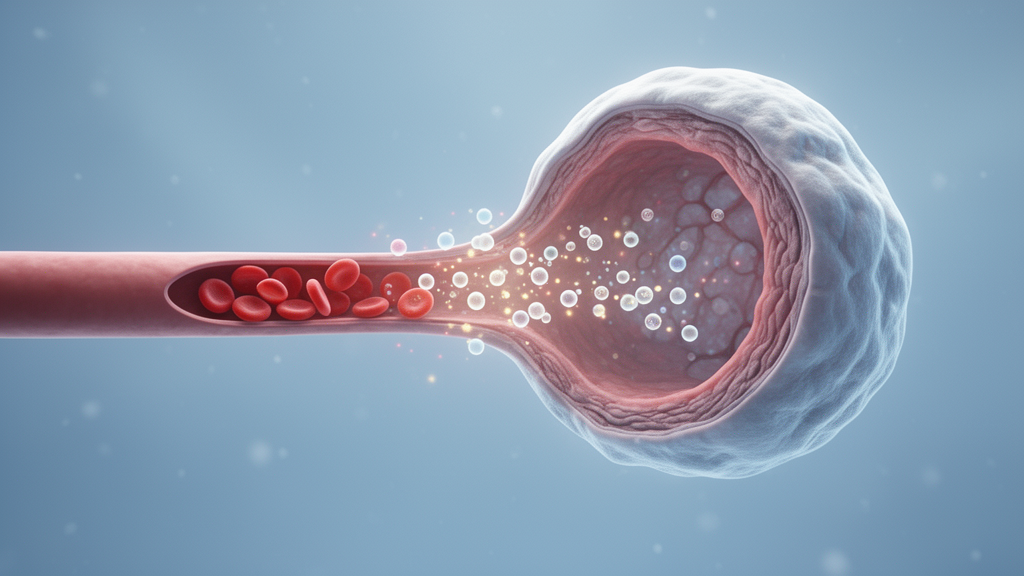
On the summit of Mount Everest, a fit young adult who can consume roughly four to five liters of oxygen per minute at sea level manages barely one liter per minute in the thin air of the highest point on Earth. That is just enough oxygen to sustain a moderately paced walk on level ground, equivalent to about 60 watts of external power. A new Perspective article by Peter D. Wagner of the University of California, San Diego, published in Frontiers in Physiology, dissects why this collapse happens and reaches a provocative conclusion: the dominant culprits are not the heart or the lungs’ pumping capacity, but the physics of oxygen diffusion itself.
The starting point is straightforward physics. As barometric pressure falls with altitude, the partial pressure of inspired oxygen, known as PIO2, falls with it. On the Everest summit, where barometric pressure is around 253 millimeters of mercury, inspired PO2 is only about 43 millimeters of mercury. This directly reduces alveolar and arterial oxygen levels and therefore the amount of oxygen delivered to working muscles. Yet, according to Wagner’s analysis of data from the landmark Operation Everest II chamber study and the American Medical Research Expedition to Everest, this physical consequence of low pressure explains only about half of the total reduction in maximal oxygen uptake. The remaining half comes from barriers within the body’s oxygen transport chain.
Wagner frames the problem using a five-step model of oxygen transport: pulmonary ventilation, alveolar-capillary diffusion, convective blood transport from lungs to muscle, diffusion from muscle microvessels to mitochondria, and finally mitochondrial respiration through oxidative phosphorylation. Each step can be described by a mass conservation equation, since no oxygen is lost as it passes through the chain. Crucially, the first and third steps are convective processes governed by oxygen concentration, while the second and fourth are diffusive processes governed by oxygen partial pressure. This distinction becomes the key to understanding what goes wrong at altitude.
The five equations are not independent. Variables such as cardiac output, hemoglobin concentration, and the slope of the oxygen-hemoglobin dissociation curve appear in multiple equations, meaning that each component of the system influences the others. Cardiac output offers the clearest example of this interdependence. Raising cardiac output increases convective oxygen delivery from lungs to muscles, but it also shortens the time red cells spend in lung and muscle capillaries, which can worsen diffusive equilibration and partly offset the benefit. Because of these interactions, Wagner argues, there is no single limiting factor for maximal oxygen uptake at any altitude; all steps contribute, and modest changes in any one variable produce only small effects, while large decreases in any one variable have significant negative consequences.
The experimental data come primarily from Operation Everest II, a simulated ascent conducted in an altitude chamber with invasive arterial and pulmonary arterial blood sampling. At the Everest summit equivalent, maximal cardiac output fell from 24 liters per minute at sea level to 16 liters per minute, and arterial PO2 measured just 28 millimeters of mercury against an alveolar PO2 of 35. Wagner and colleagues asked a hypothetical question: what would maximal oxygen uptake have been if the three main transport barriers were removed? Eliminating the alveolar-arterial PO2 difference would have raised arterial oxygen saturation from 53 percent to about 67 percent, a 26 percent gain. Restoring cardiac output to sea level values would have increased blood flow and delivery by 50 percent. And driving venous PO2 to zero, eliminating muscle diffusion limitation, would have raised the arterio-venous oxygen difference by 39 percent.
Multiplying these gains together, maximal oxygen uptake at the Everest summit equivalent would have been about 2.6 times higher than the observed 1.18 liters per minute, reaching roughly 3.1 liters per minute. In other words, the fall in inspired oxygen pressure alone accounts for about half the loss, and the three barriers of lung diffusion limitation, reduced maximal cardiac output, and incomplete muscle oxygen extraction account for the rest in roughly similar proportions. The striking implication is that even at the top of the world, the body leaves a large reserve of potential oxygen uptake untapped because of transport bottlenecks.
Why is diffusion so uniquely vulnerable to altitude? The answer lies in the shape of the oxygen-hemoglobin dissociation curve. At sea level, arterial PO2 during exercise sits on the flat upper portion of the curve, where the slope is low, around 0.2 milliliters of oxygen per deciliter of blood per millimeter of mercury. At the Everest summit equivalent, with arterial PO2 near 28 and mixed venous PO2 around 14 millimeters of mercury, gas exchange occurs on the steepest part of the curve. Add the polycythemia that develops with acclimatization, which steepens the curve further, and the effective slope approaches 0.6, roughly three times the sea level value. Because the diffusion equations depend on this slope, the result is substantial diffusion limitation in both lungs and muscles. Meanwhile, the driving gradients themselves shrink: the difference between alveolar and capillary PO2, and the difference between blood and mitochondria, both narrow as altitude increases.
By contrast, the evidence against the convective steps is compelling. Maximal ventilation is well maintained at altitude, and in Operation Everest II it was actually higher at the summit equivalent, 184 liters per minute, than at sea level, 124 liters per minute, driving arterial PCO2 down to about 10 millimeters of mercury. As for the heart, multidisciplinary measurements during Operation Everest II showed no impairment: venous return curves were normal, electrocardiography revealed no myocardial ischemia, and echocardiography even suggested enhanced left ventricular function. The reduction in peak cardiac output therefore cannot be attributed to a failing heart, and Wagner argues on theoretical grounds that restoring cardiac output to sea level values would likely confer only modest benefit, because the shortened capillary transit time would worsen diffusion limitation in lungs and muscles, offsetting the gains in convective delivery.
Supporting this reasoning, experiments in which the elevated hemoglobin concentration of acclimatized subjects was acutely reduced back to sea level values, using isovolumic blood removal, did not lower maximal oxygen uptake beyond values measured before the intervention. Conversely, the polycythemia of altitude, which restores total arterial oxygen delivery toward sea level values, has only a small effect on maximal uptake. Since blood flow and the dissociation curve slope appear together as a product in both the convective and diffusive equations, Wagner infers that manipulating blood flow alone would similarly have little effect. He acknowledges, however, that this hypothesis cannot be definitively confirmed until a study is devised that experimentally restores maximal cardiac output at altitude to sea level norms, a challenge that remains open.
The analysis also flags unresolved questions about mitochondria and individual variation. Hyperoxic gas breathing restores maximal oxygen uptake to sea level values in acclimatized subjects at altitude, confirming that mitochondrial capacity is not the limiting factor in healthy fit adults. Yet limited biopsy data suggest altitude may alter mitochondrial properties: high-altitude deer mice show increased mitochondrial oxygen affinity, while humans spending weeks above 5,000 meters at Everest Base Camp showed deactivation of mitochondrial biogenesis, alongside the inexorable muscle mass loss common above that altitude. Wagner notes that findings below 5,000 meters may not apply above it, and that clarifying mitochondrial responses across this threshold is an important research goal. He further observes that fitter individuals lose more maximal oxygen uptake at altitude, that males may lose more than females though evidence is mixed, and that older people with lower baseline values may see smaller absolute reductions. Small muscle mass exercise, such as one-legged cycling at 5,200 meters, can restore oxygen delivery and uptake to sea level values, possibly because lower cardiac output prolongs lung gas exchange time and eases diffusion limitation. The overall picture that emerges is one of a tightly integrated system in which the ever-shrinking diffusion gradients of extreme hypoxia, amplified by the steepening of the oxygen-hemoglobin dissociation curve, quietly impose the heaviest penalty on human performance at the roof of the world.
Subject of Research: Mechanisms reducing maximal oxygen uptake in hypoxia and at high altitude
Article Title: “Physiological and pathological responses to hypoxia and high altitude, volume IV.” Mechanisms of reduction in V̇O2max in hypoxia/at altitude
Article References: Wagner, P. D. (2026). “Physiological and pathological responses to hypoxia and high altitude, volume IV.” Mechanisms of reduction in V̇O2max in hypoxia/at altitude. Frontiers in Physiology, 17, 1970453. https://doi.org/10.3389/fphys.2026.1970453
Image Credits: AI Generated
DOI: 10.3389/fphys.2026.1970453
Keywords: hypoxia, high altitude, VO2max, oxygen diffusion, cardiac output, Everest, exercise physiology, hemoglobin, mitochondria, oxygen transport, Physiological, pathological
Cite Scienmag News
Drew Townsend. (October 26, 2026). Why Oxygen Uptake Collapses at Altitude: Diffusion, Not the Heart, Emerges as the Main Barrier. Scienmag. https://scienmag.com/why-oxygen-uptake-collapses-at-altitude-diffusion-not-the-heart-emerges-as-the-main-barrier/
Drew Townsend. "Why Oxygen Uptake Collapses at Altitude: Diffusion, Not the Heart, Emerges as the Main Barrier." Scienmag, 26 October 2026, https://scienmag.com/why-oxygen-uptake-collapses-at-altitude-diffusion-not-the-heart-emerges-as-the-main-barrier/. Accessed 26 October 2026.
Drew Townsend. "Why Oxygen Uptake Collapses at Altitude: Diffusion, Not the Heart, Emerges as the Main Barrier." Scienmag. October 26, 2026. https://scienmag.com/why-oxygen-uptake-collapses-at-altitude-diffusion-not-the-heart-emerges-as-the-main-barrier/


