


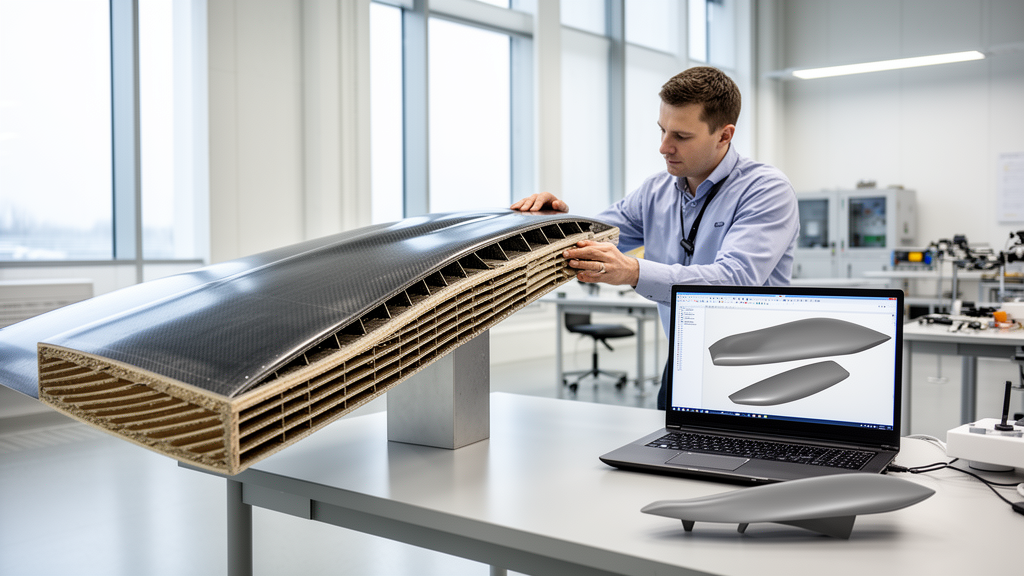
Engineers at the German Aerospace Center (DLR) have presented a computational workflow that can fully size the structure of a trailing-edge high-lift device, such as a flaperon, in just two to three minutes on a standard office laptop. The tool, described in a recent study, combines parametric aircraft geometry definitions, an efficient beam-element solver, and automated laminate sizing so that hundreds of structural design concepts can be compared during the earliest phases of aircraft development, when architectural freedom is greatest and costly decisions are still reversible. A complete parametric study, sweeping dozens of support and spar configurations, took between four and twelve hours of computation.
The work targets a pressing challenge for next-generation single-aisle aircraft, which aim for higher fuel efficiency, lower emissions, and reduced operating costs. High-aspect-ratio wings are a key aerodynamic enabler in this context, cutting induced drag and improving cruise performance, but their slender outboard geometry leaves control-surface profile heights as low as 5 to 10 centimeters. Conventional composite flap designs, sometimes called skeleton architectures, consist of ribs, spars, stiffened skins, and closing elements riveted together, as seen on an A321 composite flap.
Their high part counts offer tolerance flexibility but demand significant assembly effort. At projected production rates of up to 100 aircraft per month for future single-aisle platforms, that assembly work risks becoming a bottleneck, and the reduced profile heights of high-aspect-ratio wings make access and integration even harder. The new workflow closes that gap by linking three components.
First, flap geometries are defined in CPACS, the Common Parametric Aircraft Configuration Schema, a standardized XML-based format that describes the outer mold line, internal spars and shells, materials, and external loads in one consistent file. Second, the defined geometry is idealized as a one-dimensional beam using the PreDoCS solver, previously validated against commercial finite-element software. An analytical thin-walled cross-sectional analysis yields a seven-by-seven sectional stiffness matrix covering axial, bending, shear, torsional, and warping behavior, from which a global Timoshenko beam model is assembled and solved.
Third, the recovered sectional forces and shear flows feed into lightworks, DLR's in-house sizing framework, which applies a fully stressed design approach. The CPACS models used in the study are publicly available in an open-source repository. The sizing loop iteratively updates laminate thicknesses until strain and buckling criteria are satisfied with minimal weight, using a global safety factor of 1.5 for buckling and strain criteria and a maximum allowable tip deflection of 10 millimeters.
Buckling contributions enter the thickness-scaling factor with an exponent of one third to linearize their cubic influence on deflection, while strain contributions act linearly, and a global deflection constraint is enforced only after three iterations to preserve local sizing behavior. Loads come from two sources: nominal aerodynamic NTM load sets, comprising normal force, tangential force, and torsional moment derived from computational fluid dynamics and distributed spanwise in proportion to local chord, and off-nominal kinematic failure scenarios in which actuation continues despite a failed actuator, forcing one flap track to carry the full moment. Boundary conditions at the tracks restrain all translations while leaving rotation about the chordwise axis free, reflecting the spherical bearings that connect the kinematics to the flap.
To demonstrate the method, the researchers ran trade studies on two geometrically distinct flaperons of the DLR-F25 high-aspect-ratio wing research configuration: a slender outboard device, Flaperon-3, spanning 3.644 meters with section heights of only 7 to 12 centimeters, and a bulkier inboard device, Flaperon-1, spanning 1.756 meters with section heights near 20 centimeters. A common rule of thumb places both kinematic supports and spars at the quartiles, 25 and 75 percent, of span and chord. The team tested whether that convention holds for high-aspect-ratio geometries by sweeping support positions across 81 spanwise combinations, with the inboard support restricted to the inner half of the span and the outboard support to the outer half, and reinforcement layouts across 228 spar configurations.
Loads were applied across 31 nodes, and each structural component was subdivided into 20 spanwise design regions allowing discrete thickness variation. The results show that geometry strongly shapes the design space. For the slender Flaperon-3, deflection profiles along the span exhibited a characteristic U-shape whose orientation depended directly on the relative placement of the support stations, with configurations placing supports very close together or very far apart capped near the 10-millimeter deflection limit and driven by aerodynamic loading.
The optimal support stations fell at roughly 20 to 25 percent and 75 to 80 percent of span, with the discrete combination of 20 and 75 percent yielding the lowest mass of 19.74 kilograms, close to but slightly better than the conventional quartile layout at 19.93 kilograms. Notably, any configuration with supports separated by about 60 percent of the span kept mass near 20 kilograms, revealing a broad band of competitive solutions beyond the textbook rule. With supports fixed at 20 and 75 percent of span, the lightest reinforcement for Flaperon-3 was a conventional two-spar layout at 30 and 65 percent chord, weighing 16.63 kilograms, a 15 percent saving relative to the quartile spar placement.
Laminate thickness concentrated around the kinematic supports, and because upward bending under aerodynamic loading left the lower skin less buckling-critical, it was sized marginally thinner than the upper skin. Independent of reinforcement concept, the optimum front and rear spar positions consistently occurred near 30 and 60 percent chord, with smooth, convex mass contours indicating stable structural trends. Adding a third spar improved skin buckling resistance yet increased total mass because the spar itself, even at minimum allowable thickness, outweighed the laminate savings.
The omega concept, whose spars are tilted by 10 to 30 degrees to simplify manufacturing and improve bracket accessibility in the tight outboard structure, proved two to seven percent heavier than the optimal straight two-spar solution. By quantifying that penalty explicitly, the workflow lets designers weigh structural efficiency against production benefits on a common mechanical basis rather than relying on empirical guesses. The bulky inboard Flaperon-1 behaved quite differently: its shorter span and larger section height made it far less sensitive to support placement, with a wide range of locations, roughly 20 to 40 percent inboard and 60 to 80 percent outboard, producing comparable mass.
The deflection constraint never became active for Flaperon-1; every design was driven solely by the kinematic failure load case. Optimal spar positions again clustered near 30 and 60 percent chord, suggesting that once support stations are fixed, internal reinforcement behavior is largely geometry-independent, whereas support placement itself is the dominant, geometry-specific lever on structural mass. The authors caution that the flaperons were analyzed independently of the wing, consistent with a preliminary-design objective, so wing-flap interaction may shift absolute load levels and resulting masses even though the identified geometric sensitivities are expected to persist.
The fully stressed design approach may also be suboptimal for structures with pronounced parallel load paths, though the underlying lightworks framework supports gradient-based thickness optimization and directional stiffness tailoring via lamination parameters for later refinement. Future work could extend the approach to configurations with additional support stations, alternative stiffening concepts, and refined criteria beyond the current panel-based buckling treatment of leading and trailing edges. Even so, the ability to screen a single concept in minutes and complete a full parametric study in hours offers early-phase teams a fast, mechanically consistent way to challenge inherited design rules and identify favorable design regions before geometry freezes.
Subject of Research: Rapid structural sizing and trade studies of trailing-edge high-lift devices for high-aspect-ratio aircraft wings
Article Title: Rapid evaluation of structural concepts in preliminary design of trailing-edge high-lift devices
Article References: Manikandan, R., Zerbst, D., Kappel, E., Tönjes, L., Werthen, E., Dähne, S., & Hühne, C. (2026). Rapid evaluation of structural concepts in preliminary design of trailing-edge high-lift devices. Results in Engineering, 32, Article 113675. https://doi.org/10.1016/j.rineng.2026.113675
Image Credits: AI Generated
DOI: 10.1016/j.rineng.2026.113675
Keywords: aircraft design, high-lift devices, flaperon, composite structures, beam modeling, structural sizing, DLR, CPACS, high-aspect-ratio wings, preliminary design, manufacturability, trade studies
Cite Scienmag News
Denise Maddox. (October 26, 2026). New Workflow Sizes Aircraft Flap Structures in Minutes to Guide Early Wing Design. Scienmag. https://scienmag.com/new-workflow-sizes-aircraft-flap-structures-in-minutes-to-guide-early-wing-design/
Denise Maddox. "New Workflow Sizes Aircraft Flap Structures in Minutes to Guide Early Wing Design." Scienmag, 26 October 2026, https://scienmag.com/new-workflow-sizes-aircraft-flap-structures-in-minutes-to-guide-early-wing-design/. Accessed 26 October 2026.
Denise Maddox. "New Workflow Sizes Aircraft Flap Structures in Minutes to Guide Early Wing Design." Scienmag. October 26, 2026. https://scienmag.com/new-workflow-sizes-aircraft-flap-structures-in-minutes-to-guide-early-wing-design/


