

Monday, October 26, 2026
Science
No Result
View All Result
  • Login
  • HOME
  • SCIENCE NEWS
  • CONTACT US
  • HOME
  • SCIENCE NEWS
  • CONTACT US
No Result
View All Result
Scienmag
No Result
View All Result
Home Science News Technology and Engineering

Light-Controlled Adhesive Interface Lets Neural Implants Stick Firmly and Detach on Demand

October 26, 2026
in Technology and Engineering
Cassandra Pierce
By Cassandra Pierce Scienmag Editorial Profile - Systems Neuroscience
Reading Time: 3 mins read
0
Light-Controlled Adhesive Interface Lets Neural Implants Stick Firmly and Detach on Demand

Light-Controlled Adhesive Interface Lets Neural Implants Stick Firmly and Detach on Demand

65
SHARES
587
VIEWS
Share on FacebookShare on Twitter
ADVERTISEMENT

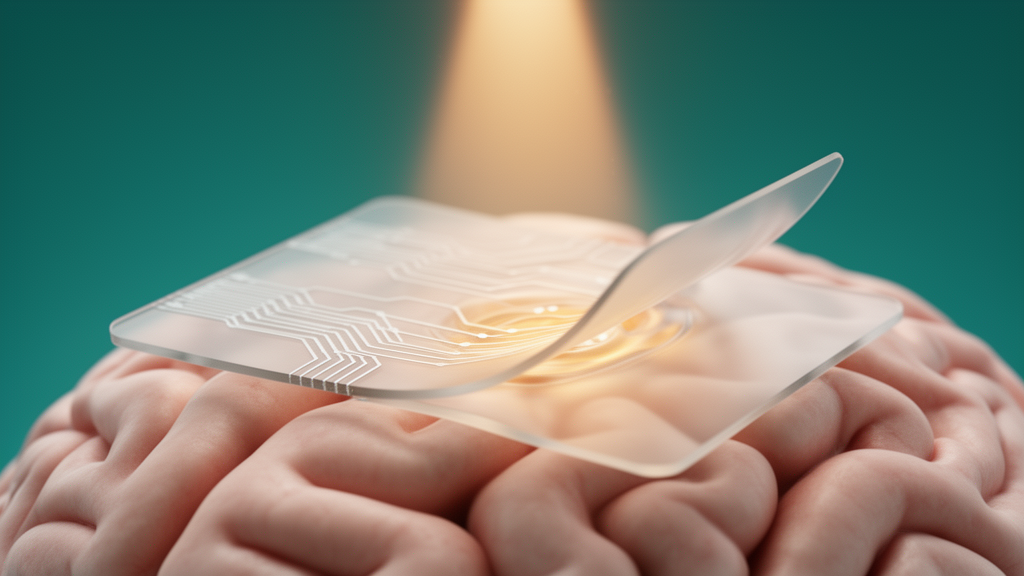
Implantable neural electronics face a persistent materials dilemma: electrodes must grip tissue tightly enough to record clean signals over weeks or months, yet any device that may eventually need to be repositioned or retrieved risks tearing delicate neural tissue if its adhesion is permanent. A team reporting in npj Flexible Electronics has now built a photo-programmable biointerface designed to resolve this tension, pairing strong, stable bonding with on-demand release triggered by ultraviolet light.

The core of the system is a self-healing matrix the researchers call bPDMS@Fe, constructed from a carboxyl-functionalized polydimethylsiloxane network dynamically crosslinked by coordination bonds between iron ions and carboxylate groups. Because these Fe3+-carboxylate coordination bonds are reversible, the material can re-form connections after damage, giving it self-healing behavior, while remaining chemically responsive to external stimuli. According to the study, the resulting electrode adheres robustly to a range of substrates and to biological tissues, and its adhesion can be weakened on demand through UV illumination, allowing controlled debonding without mechanical force.

The team demonstrated the interface first in a peripheral setting: the material supported stable epidermal electrocardiogram recordings under various conditions, showing that the adhesive layer maintains reliable electrical contact with skin even as the body moves. This surface-level application served as a testbed for the adhesion and signal-fidelity properties before the same materials strategy was scaled down and made implantable.

Translated into an implantable format, the biointerface became a nine-channel cortical electrode array. In freely moving mice, the array delivered stable local field potential recordings and enabled spatiotemporal mapping of seizure-associated neural activity, capturing how abnormal activity propagates across the cortical surface over time. Stable long-term contact between electrode and cortex is critical for such chronic recordings, since even small shifts in positioning degrade signal quality, and the adhesive dynamic interface is intended to maintain that contact throughout the monitoring period.

The authors position the work as establishing a dynamic adhesive strategy, a new materials design paradigm for neural bioelectronic interfaces aimed at next-generation chronic electrophysiological monitoring devices. The design logic is that the same reversible coordination chemistry that grants self-healing also provides a remote-control release mechanism: light exposure weakens the bonding network, so a device can be removed or reconfigured deliberately rather than surgically forcing a permanently bonded implant away from tissue.

As with any early-stage materials demonstration, the findings so far come from the specific systems tested: epidermal ECG in the reported conditions and cortical recording in mice. The study was published as open-access peer-reviewed research in npj Flexible Electronics on 26 October 2026, with the team led by Zili Li, Binbin Hu, Quansheng He and colleagues including Yousheng Shu and Miao Tang. Whether the UV-triggered debonding and chronic recording performance translate to larger animals and clinical timelines remains to be established by future work, but the demonstration marks a concrete step toward neural interfaces that are simultaneously durable in place and retrievable by design.

Subject of Research: Light-programmable adhesive biomaterial interfaces for flexible neural bioelectronics and chronic electrophysiology

Article Title: Light-regulated biomaterial interfaces enable flexible neural bioelectronics with stable adhesion and on-demand detachment for chronic electrophysiology

Article References: Li, Z., Hu, B., He, Q., Wang, Z., Sun, L., Yang, H., Zhang, X., Guo, H., Shu, Y., & Tang, M. (2026). Light-regulated biomaterial interfaces enable flexible neural bioelectronics with stable adhesion and on-demand detachment for chronic electrophysiology. npj Flexible Electronics. https://doi.org/10.1038/s41528-026-00659-w

Image Credits: AI Generated

DOI: 10.1038/s41528-026-00659-w

Keywords: neural interfaces, biomaterials, flexible electronics, photo-programmable adhesion, self-healing polymer, Fe3+-carboxylate coordination, cortical electrodes, local field potentials, seizure mapping, chronic electrophysiology, npj Flexible Electronics, Light-regulated

Cite Scienmag News

Cassandra Pierce. (October 26, 2026). Light-Controlled Adhesive Interface Lets Neural Implants Stick Firmly and Detach on Demand. Scienmag. https://scienmag.com/light-controlled-adhesive-interface-lets-neural-implants-stick-firmly-and-detach-on-demand/


Cassandra Pierce. "Light-Controlled Adhesive Interface Lets Neural Implants Stick Firmly and Detach on Demand." Scienmag, 26 October 2026, https://scienmag.com/light-controlled-adhesive-interface-lets-neural-implants-stick-firmly-and-detach-on-demand/. Accessed 26 October 2026.

Cassandra Pierce. "Light-Controlled Adhesive Interface Lets Neural Implants Stick Firmly and Detach on Demand." Scienmag. October 26, 2026. https://scienmag.com/light-controlled-adhesive-interface-lets-neural-implants-stick-firmly-and-detach-on-demand/

Tags: advanced materials for neural tissue compatibilitybioelectronic interface with controllable adhesionbiomaterialschronic electrophysiologycortical electrodesdynamic crosslinked polydimethylsiloxane for biointerfacesFe3+-carboxylate coordinationflexible electronicsflexible electronics for neural tissue recordingLight-regulatedlight-triggered biointerface for neural deviceslocal field potentialsneural implant adhesion controlneural interfacesnpj Flexible Electronicson-demand neural device retrievalphoto-programmable adhesionphoto-programmable tissue adhesivereversible bioadhesive for neural implantsseizure mappingself-healing electrode materials for neural interfacesself-healing polymerstable neural-electrode contact with movementUV-responsive neural electrode detachment
Share26Tweet16
Previous Post

Fern sieve cells shrank over geological time, cutting sugar-transport capacity

Next Post

Chip-Based Electrophoresis Spots SARS-CoV-2 Antigen in Under 30 Seconds

Related Posts

Trust-aware sharding could secure blockchain for 5G vehicular networks
Technology and Engineering

Trust-aware sharding could secure blockchain for 5G vehicular networks

October 26, 2026
Robots Learn to See, Feel and Hear at Once as Multimodal Perception Advances
Science News

Robots Learn to See, Feel and Hear at Once as Multimodal Perception Advances

October 26, 2026
Covariance Alignment Boosts Cross-Program Student Performance Prediction, Study Finds
Technology and Engineering

Covariance Alignment Boosts Cross-Program Student Performance Prediction, Study Finds

October 26, 2026
Bigger Cities Build Lighter: Global Study Finds Built Mass Grows Slower Than Population
Technology and Engineering

Bigger Cities Build Lighter: Global Study Finds Built Mass Grows Slower Than Population

October 26, 2026
Softening Hard Masks: New Correction Method Tames Overconfident AI Labels
Technology and Engineering

Softening Hard Masks: New Correction Method Tames Overconfident AI Labels

October 26, 2026
New dataset and protein language models sharpen T cell receptor binding prediction
Technology and Engineering

New dataset and protein language models sharpen T cell receptor binding prediction

October 26, 2026
Next Post
Chip-Based Electrophoresis Spots SARS-CoV-2 Antigen in Under 30 Seconds

Chip-Based Electrophoresis Spots SARS-CoV-2 Antigen in Under 30 Seconds

  • Mothers who receive childcare support from maternal grandparents show more optimized

    Mothers who receive childcare support from maternal grandparents show more parental warmth, finds NTU Singapore study

    27656 shares
    Share 11059 Tweet 6912
  • University of Seville Breaks 120-Year-Old Mystery, Revises a Key Einstein Concept

    1061 shares
    Share 424 Tweet 265
  • Bee body mass, pathogens and local climate influence heat tolerance

    682 shares
    Share 273 Tweet 171
  • Researchers record first-ever images and data of a shark experiencing a boat strike

    546 shares
    Share 218 Tweet 137
  • Groundbreaking Clinical Trial Reveals Lubiprostone Enhances Kidney Function

    531 shares
    Share 212 Tweet 133
Science

Embark on a thrilling journey of discovery with Scienmag.com—your ultimate source for cutting-edge breakthroughs. Immerse yourself in a world where curiosity knows no limits and tomorrow’s possibilities become today’s reality!

RECENT NEWS

  • Cheap IoT sensors track lower gas levels in Chlorella-fed hen pens
  • Trust-aware sharding could secure blockchain for 5G vehicular networks
  • French lagoon harbors a genetic lifeline for the collapsing Mediterranean fan mussel
  • Chip-Based Electrophoresis Spots SARS-CoV-2 Antigen in Under 30 Seconds

Categories

  • Agriculture
  • Anthropology
  • Archaeology
  • Athmospheric
  • Biology
  • Biotechnology
  • Blog
  • Bussines
  • Cancer
  • Chemistry
  • Climate
  • Earth Science
  • Editorial Policy
  • Marine
  • Mathematics
  • Medicine
  • Pediatry
  • Policy
  • Psychology & Psychiatry
  • Science Education
  • Science News
  • Social Science
  • Space
  • Technology and Engineering

Subscribe to Blog via Email

Enter your email address to subscribe to this blog and receive notifications of new posts by email.

Join 5,151 other subscribers

© 2025 Scienmag - Science Magazine

Welcome Back!

Login to your account below

Forgotten Password?

Retrieve your password

Please enter your username or email address to reset your password.

Log In
No Result
View All Result
  • HOME
  • SCIENCE NEWS
  • CONTACT US

© 2025 Scienmag - Science Magazine

Discover more from Science

Subscribe now to keep reading and get access to the full archive.

Continue reading