


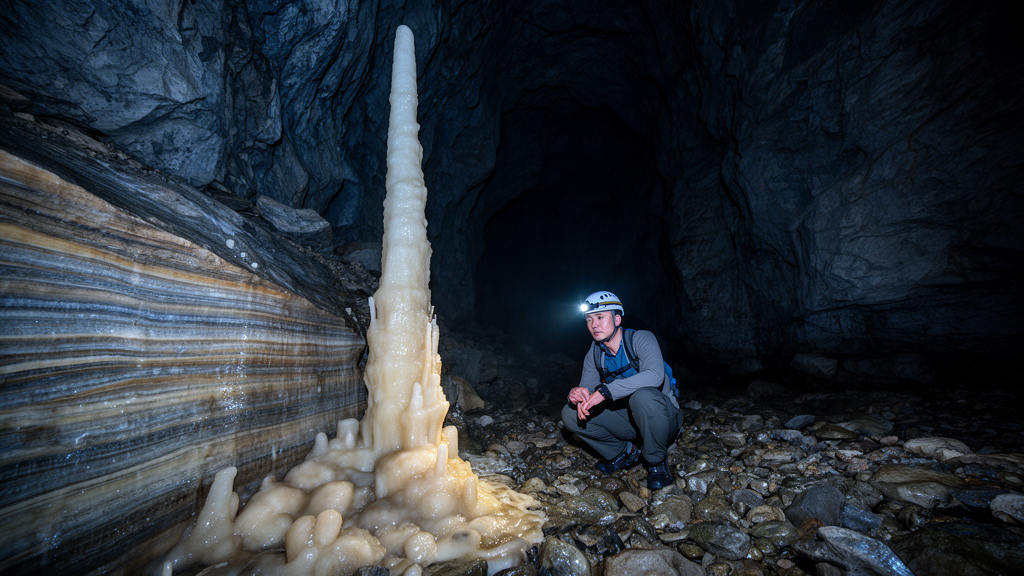
Deep beneath the mountains of South Korea, stalagmites have been quietly recording the climate of East Asia for hundreds of thousands of years. Yet these stone archives have long puzzled scientists. While cave records from China swing dramatically in step with the slow wobbles of Earth’s orbit, Korean stalagmites show almost no such response. Now, a study published in the journal Climate of the Past by Nitesh Sinha of the Center for Climate Physics at the Institute for Basic Science in Busan, together with Axel Timmermann, Sun-Seon Lee, Kyoung-Nam Jo, Jasper A. Wassenburg, Daniel M. Cleary, and Kyung-Sook Yun, offers a compelling explanation: over the Korean Peninsula, the isotopic fingerprints of moisture from the ocean and from the land cancel each other out, muting the climate signal that would otherwise be written into the rock.
The puzzle centers on a geochemical measurement known as the stable oxygen isotope ratio, written as δ18O. When water evaporates from the ocean, lighter isotopes of oxygen rise more readily into the vapor, and as that vapor travels and rains out along its path, the remaining moisture becomes progressively depleted in the heavy isotope oxygen-18. Stalagmites lock this isotopic signature into their calcite as they grow, because the drip water that feeds them ultimately comes from precipitation. In China, cave records stretching back more than 600,000 years show a pronounced cyclicity of roughly 21,700 years, matching the precession cycle, the slow change in the orientation of Earth’s rotational axis that shifts where and when the Northern Hemisphere receives its most intense summer sunlight. Chinese stalagmite δ18O values rise and fall by about 4 per mil across these cycles, a signal that researchers have long interpreted as a record of changing monsoon strength.
Precession matters because it modulates Northern Hemisphere summer insolation, which in turn drives the great heat engines of the Asian monsoon. When summer perihelion brings Earth closest to the Sun during the boreal summer, landmasses heat more intensely, pressure gradients steepen, and moist air surges inland from the tropical oceans. The East Asian Summer Monsoon, with its characteristic Meiyu-Baiu rainband over China and Japan and its Korean counterpart, the Changma front, is governed by the position of the subtropical front, which forms where the Westerly jet interacts with the Western North Pacific Subtropical High. A recent modeling study by Wen and colleagues identified a striking consequence of this orbital forcing: a grand dipole pattern in which precipitation and isotope signals over South Asia move in opposition to those over Japan, with the Korean Peninsula sitting almost exactly on the nodal line between the two lobes.
That theoretical prediction is precisely what the new study set out to test with real data. The team assembled oxygen isotope records from two Korean stalagmites, one from Gwaneum Cave and a previously unpublished record from Eden Cave, which together grew intermittently across several segments of the past 550,000 years. The records are well constrained by uranium-series dating, and their growth fabrics indicate that the calcite precipitated under conditions close to isotopic equilibrium, meaning the signals preserved in the stone faithfully reflect the water that formed them. Crucially, the weak covariation between the carbon and oxygen isotope records in both stalagmites suggests that kinetic effects, which can distort isotope signals during rapid degassing, are not the dominant control. The absence of a precessional cycle in the Korean oxygen isotope profiles is therefore a genuine climate signal, not a cave artifact.
To understand why the signal is so weak, the researchers turned to the isotope-enabled Community Earth System Model, iCESM1.2, a fully coupled climate model that tracks the isotopes of oxygen and hydrogen in water as it moves through the atmosphere, land, and ocean. They ran a transient simulation covering the past 130,000 years of orbital forcing, compressed by a factor of 100 so that 130,000 years of astronomical history unfolded over just 1,300 model years, an acceleration justified because the atmospheric processes of interest adjust far faster than the precessional cycle itself. They also performed equilibrium time-slice experiments under extreme precession conditions with amplified eccentricity, compared results with an ultra-high-resolution simulation of the last interglacial and the subsequent cold stage, and cross-checked their precipitation patterns against a separate three-million-year transient simulation.
The simulations reproduced the observed geography of the monsoon response with remarkable fidelity. The leading mode of annual precipitation variability over eastern China, Korea, and Japan forms a north-south dipole that tracks summer insolation at 30 degrees north, and Korea sits squarely on its nodal line. Even more tellingly, the leading mode of precipitation δ18O forms an east-west dipole: during Northern Hemisphere summer perihelion, western Asia becomes isotopically depleted while eastern Asia becomes enriched, and the Korean Peninsula again lies in the zone of transition where the two signals oppose and largely annihilate each other. The model shows no distinct precessional cyclicity in Korean precipitation isotopes, exactly matching the silence of the stalagmites.
The mechanism behind this cancellation emerged from a series of water-tagging experiments, in which the model tracked moisture from fourteen source regions to see how each contributed to Korean rainfall under high and low precession. During summer perihelion, the Western North Pacific Subtropical High strengthens and shifts northwestward, pumping additional moisture from the subtropical North Pacific toward Korea, contributing about 0.40 millimeters per day, while East Asian land sources add another 0.11 millimeters per day. At the same time, however, moisture deliveries from the northern North Pacific and the equatorial Indian Ocean decline, offsetting much of the gain. The isotopic story follows the same logic: subtropical Pacific and East Asian land moisture arrive isotopically enriched, while Indian Ocean and South Asian moisture arrives depleted, and the two effects nearly cancel. On annual timescales the compensation is even more complete, leaving a net shift of less than a tenth of a per mil, far too small to register in the cave record.
Perhaps the most exciting implication of the study is that the muted oxygen isotope signal does not mean the Korean Peninsula was climatically frozen through half a million years of orbital change. The team showed that deuterium excess, a secondary isotope parameter defined as the difference between the hydrogen isotope ratio and eight times the oxygen isotope ratio, still carries a strong precessional signal over Korea. Deuterium excess reflects conditions at the moisture source, particularly the relative humidity during evaporation, because hydrogen isotopes diffuse more readily than oxygen isotopes when water evaporates under dry, windy conditions. In the simulations, surface relative humidity over the southeast Indian Ocean and the northwest Pacific oscillates by 3 to 4 percent on precessional timescales, in antiphase between the two basins, and these changes propagate faithfully into the deuterium excess of precipitation falling over Korea, which is low when summer insolation is high and high when it is low.
Because deuterium excess can be recovered from ancient water trapped as fluid inclusions within speleothem calcite, the authors propose that such reconstructions from East Asian caves could provide a powerful new constraint on the drivers of the regional monsoon system, even in places where oxygen isotopes alone are uninformative. They also point to oxygen-17 excess, measurable directly from calcite and insensitive to temperature, as a promising complementary proxy where fluid inclusions are not preserved. A multi-proxy framework combining oxygen isotopes, deuterium excess, carbon isotopes, trace elements, and growth rates, integrated with marine and lacustrine archives, could finally reconcile the apparently conflicting hydroclimate records scattered across Asia.
The study also surfaced an unexpected curiosity: simulated Korean precipitation displays a semi-precessional rhythm, with a period of roughly 11,000 years, visible during certain marine isotope stages. The researchers suggest this may arise from combination tones, a nonlinear interaction in which precessional-scale winds multiply with precessional-scale changes in atmospheric moisture, though they caution that the mechanism remains unresolved and warrants further investigation. What is already clear is that the Korean Peninsula, far from being a boring corner of the Asian monsoon system, is a natural laboratory where competing moisture streams meet and cancel, and where the right proxy, read carefully, can still reveal the heartbeat of orbital-scale climate change pulsing beneath an apparently still surface.
Subject of Research: Orbital-scale monsoon variability and speleothem oxygen isotope records on the Korean Peninsula
Article Title: Muted orbital-scale monsoon variability over the Korean Peninsula
Article References: Muted orbital-scale monsoon variability over the Korean Peninsula. (n.d.). https://doi.org/10.5194/cp-22-1711-2026
Image Credits: AI Generated
Keywords: Korean Peninsula, speleothems, oxygen isotopes, East Asian Summer Monsoon, precession, paleoclimate, deuterium excess, moisture sources, Western North Pacific Subtropical High, iCESM, stalagmites, hydroclimate
Cite Scienmag News
Sloane Callahan. (October 9, 2026). Why Korea’s Caves Stay Silent While Asian Monsoons Swing: A 550,000-Year Isotope Mystery Solved. Scienmag. https://scienmag.com/why-koreas-caves-stay-silent-while-asian-monsoons-swing-a-550000-year-isotope-mystery-solved/
Sloane Callahan. "Why Korea’s Caves Stay Silent While Asian Monsoons Swing: A 550,000-Year Isotope Mystery Solved." Scienmag, 9 October 2026, https://scienmag.com/why-koreas-caves-stay-silent-while-asian-monsoons-swing-a-550000-year-isotope-mystery-solved/. Accessed 9 October 2026.
Sloane Callahan. "Why Korea’s Caves Stay Silent While Asian Monsoons Swing: A 550,000-Year Isotope Mystery Solved." Scienmag. October 9, 2026. https://scienmag.com/why-koreas-caves-stay-silent-while-asian-monsoons-swing-a-550000-year-isotope-mystery-solved/


