


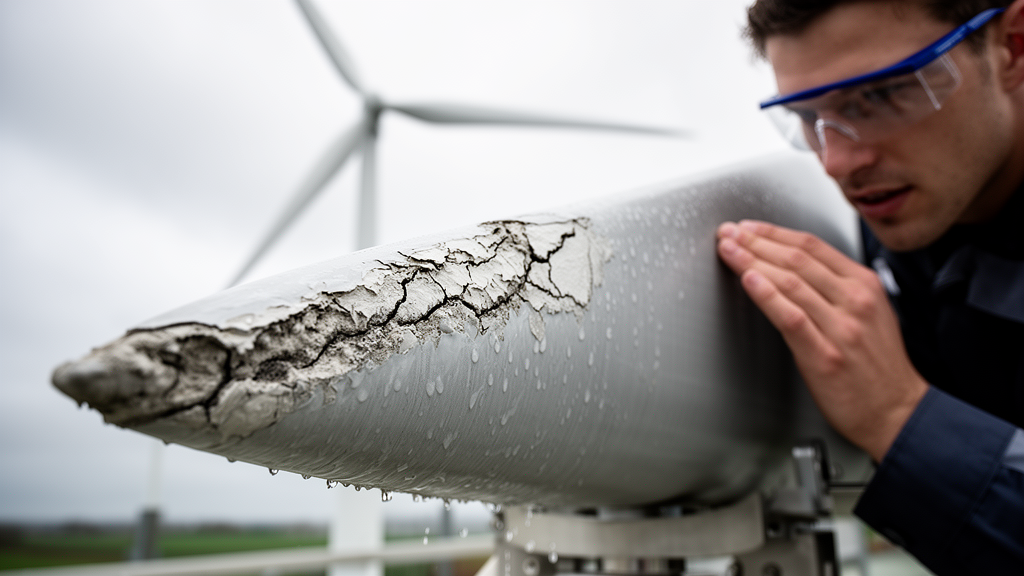
Every time a raindrop strikes the leading edge of a spinning wind turbine blade, it delivers a microscopic hammer blow. At tip speeds approaching several hundred kilometers per hour, water droplets behave less like liquid and more like high-velocity projectiles, generating transient stress waves that race through the protective polymer coating in microseconds. Over millions of such impacts, the material at the blade’s leading edge begins to disintegrate, a phenomenon known as leading-edge erosion that costs the wind industry dearly in lost energy production and repairs. Now, researchers at the Technical University of Denmark have introduced a fundamentally new way of understanding and measuring this damage, one that could reshape how protective materials are designed, tested, and certified.
Jakob Ilsted Bech and Jamie Engelhardt Simon, writing in the journal Wind Energy Science, argue that the dominant failure mode in modern leading-edge protection systems is not the gradual, uniform wearing-away that conventional models assume, but rather fatigue cracking: the initiation and growth of discrete cracks driven by the cyclic pulse loading of successive droplet impacts. Their X-ray computed tomography images of rain-eroded samples reveal locally occurring cracks surrounded by virtually undamaged material, a signature that looks far more like classical fatigue fracture than like progressive surface loss. For soft, tough, visco-elastic elastomers, the polyurethanes and similar polymers increasingly used to shield blade tips, this distinction matters enormously, because the old stress-based damage models simply do not capture how these materials fail.
The physics of a droplet impact is violent and fast. Numerical studies predict local strains of up to 80 percent and strain rates between 1,000 and 1,000,000 per second during the microseconds of contact. The resulting stress patterns depend on impact velocity, droplet size, and the hyper-visco-elastic properties of the surface. Classic experiments dating back to Bowden and Brunton in 1961 showed that a single high-speed water jet can fracture a polymer, and the crack patterns differ by material type: hard elastic polymers develop ring-shaped surface cracks that propagate conically into the depth, while soft rubbers nucleate cracks inside the bulk, beneath the impact center, which then spread in star-shaped patterns. On a real blade, where droplets strike at random positions, cracks may initiate at randomly distributed defects and inhomogeneities, making the damage harder to predict but no less governed by the laws of fracture mechanics.
Bech and Simon’s central contribution is to bring the established tools of experimental fracture mechanics to bear on this problem for the first time. The key quantity is the tearing energy, T, the energy per unit area released as a crack advances, a concept that traces back to Rivlin and Thomas’s foundational 1953 work on rubber rupture. To measure it, the researchers employed a plane strain tensile test with two slits, often called the pure shear test, in which a thin polymer sheet is clamped at its edges and pre-cut cracks grow under cyclic loading. Because the geometry produces a uniform plane-strain zone between the crack tips and a stress-free zone behind them, the tearing energy can be computed from a remarkably simple energy balance. Their novel analysis technique tracks the evolution of strain energy with crack length throughout the test, comparing the work required to stretch the specimen at successive cycle intervals, so that the energy released per unit of new crack area emerges directly from the measured load-displacement loops.
Testing soft elastomer sheets posed its own engineering challenge. Rubber-like materials are notoriously difficult to grip because they contract in the thickness direction under tension and slip out of conventional flat-jaw grips. The team designed a new test fixture with partially circular grip faces, a 90-degree concave cylinder that wraps around the specimen and compresses it progressively, maintaining grip even at high strains. A prototype was 3D printed in PLA plastic and mounted in an electro-pulse test machine, with specimens cut from sheet material into rectangles of 80 by 46 millimeters. A digital camera recorded the crack tips at peak displacement throughout each test, allowing crack lengths to be tracked by image analysis with a resolution of about 0.02 millimeters per pixel.
Crucially, the loading scheme was designed to mimic the rhythm of rain. Each cycle consists of a short sinusoidal displacement pulse followed by a dwell time before the next pulse, representing the interval between successive droplet impacts. Two dwell times were tested, 0.1 and 1 second, chosen from computed impact frequencies for realistic rain fields, although the researchers note that characteristic impact periods in the field can range from 1 to 100 seconds. This dwell-time dependence turned out to be one of the most revealing aspects of the study, because the material exhibits pronounced visco-elastic behavior, including the Mullins effect, a cyclic stress softening in which stiffness and energy uptake decline over repeated cycles before stabilizing.
The softening behavior was dramatic. With a dwell time of 0.1 seconds, the maximum load in an uncracked specimen fell from about 221 newtons in the first cycle to 126 newtons by cycle 2,000, and the strain energy dropped from 0.28 to 0.15 joules. After a 10-minute recovery period, the same specimen tested with a 1-second dwell time nearly regained its initial state, reaching 215 newtons and 0.27 joules before softening again to 171 newtons and 0.22 joules. With a 10-second dwell time, the material almost fully recovered between cycles, ending at 211 newtons and 0.27 joules after 2,000 cycles. Shorter dwell times also required more cycles to reach stable, repeatable stress-strain loops, meaning that any meaningful crack growth measurement demands a run-in period of potentially several hundred cycles before the material settles into a steady state.
When the crack growth rate per cycle was plotted against maximum strain, the results appeared dwell-time dependent: cracks grew faster at the longer 1-second dwell time, and the strain threshold between slow and fast growth differed by roughly 27 percent between the two regimes. Longer dwell times allow greater recovery between pulses, so the material resumes each cycle at higher stiffness and can absorb more strain energy for a given peak strain, delivering a larger tearing energy to the crack tip. But here lies the study’s most elegant finding: when the same data were plotted against tearing energy rather than strain, the curves for both dwell times collapsed onto a single master curve, differing by only about 10 percent in threshold. Above the threshold, the data follow a power law relating growth rate to tearing energy with an exponent of about 2.2. Tearing energy, not strain, is the governing parameter, independent of how fast the impacts arrive, at least for the dwell times tested.
The measured crack growth rates spanned a striking range. Below a tearing energy threshold estimated at approximately 2,100 joules per square meter, with a standard deviation of about 200, cracks grew at only 3 to 6 nanometers per cycle, effectively negligible. Above the threshold, rates jumped to between 0.6 and 10 micrometers per cycle, three orders of magnitude faster. Some tests revealed intriguing anomalies: one crack sat dormant for nearly 570,000 cycles before abruptly accelerating, suggesting the threshold had been marginally crossed; another crack paused at an apparent tough inhomogeneity before finding a path around it and resuming its original rate. These observations reinforce the picture of a sharp fatigue limit, analogous to the mechanical fatigue limit long established for rubber, below which a component could theoretically endure impacts indefinitely.
The implications reach well beyond the laboratory. The authors propose that crack growth resistance could become a key parameter in material standards, in the systematic development of new protective coatings, and even in operational strategy. In so-called erosion-safe operation, the tearing energy threshold could serve as a curtailment criterion, with rotor speed limited during extreme precipitation so that the energy delivered to cracks stays below the propagation threshold, a function of protection material properties and meteorological conditions such as droplet size and liquid water content. The fracture mechanics approach also offers a mechanistic basis for evaluating materials before costly whirling-arm rain erosion testing, and the authors call for future work on ultra-high strain rates, possibly using low temperatures and time-temperature superposition to mimic impact conditions, and on rain erosion tests with controlled defects to link laboratory fracture data directly to field performance. If successful, this paradigm shift could finally give the wind industry a rigorous, physics-based route to eliminating one of its most persistent and expensive failure modes.
Subject of Research: Fatigue crack growth characterization of elastomeric leading-edge protection materials for wind turbine blades using experimental fracture mechanics
Article Title: Fatigue crack growth in elastomers for leading-edge erosion protection of wind turbine blades
Article References: Bech, J. I., & Simon, J. E. (2026). Fatigue crack growth in elastomers for leading-edge erosion protection of wind turbine blades. Wind Energy Science, 11(10), 3803-3821. https://doi.org/10.5194/wes-11-3803-2026
Image Credits: AI Generated
Keywords: wind energy, leading-edge erosion, fatigue crack growth, elastomers, fracture mechanics, tearing energy, polyurethane, rain erosion, Mullins effect, wind turbine blades, materials testing, visco-elasticity
Cite Scienmag News
Faith Mcneil. (October 9, 2026). How Fatigue Cracks Eat Wind Turbine Blades: A New Fracture Mechanics Test Could Transform Erosion Protection. Scienmag. https://scienmag.com/how-fatigue-cracks-eat-wind-turbine-blades-a-new-fracture-mechanics-test-could-transform-erosion-protection/
Faith Mcneil. "How Fatigue Cracks Eat Wind Turbine Blades: A New Fracture Mechanics Test Could Transform Erosion Protection." Scienmag, 9 October 2026, https://scienmag.com/how-fatigue-cracks-eat-wind-turbine-blades-a-new-fracture-mechanics-test-could-transform-erosion-protection/. Accessed 9 October 2026.
Faith Mcneil. "How Fatigue Cracks Eat Wind Turbine Blades: A New Fracture Mechanics Test Could Transform Erosion Protection." Scienmag. October 9, 2026. https://scienmag.com/how-fatigue-cracks-eat-wind-turbine-blades-a-new-fracture-mechanics-test-could-transform-erosion-protection/


