


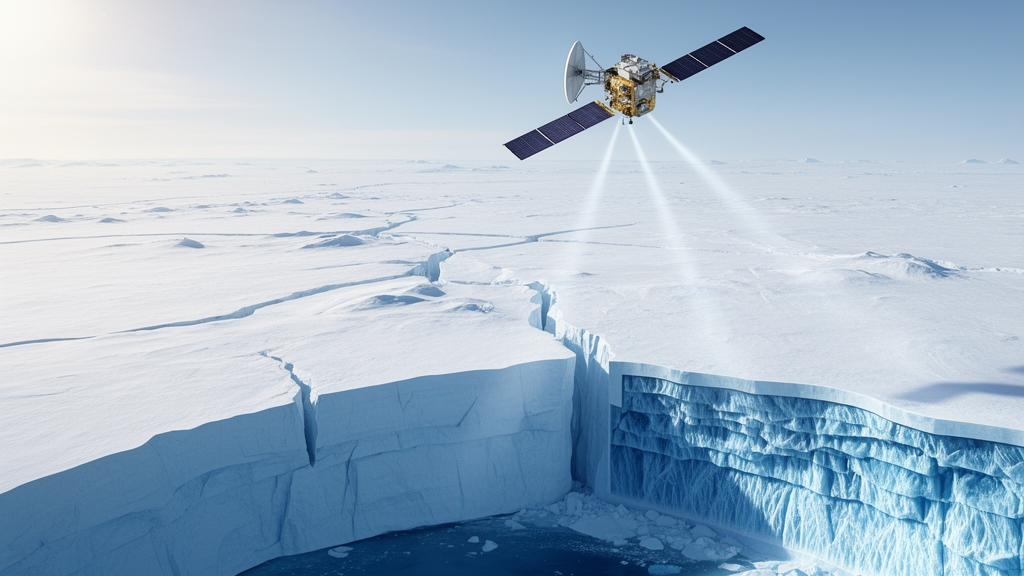
Deep beneath the windswept surfaces of Antarctic ice shelves, a hidden architecture of snow grains and trapped air quietly determines whether these floating giants will survive a warming century. Now, a team of researchers at Delft University of Technology, Utrecht University, and KU Leuven has found a way to read that architecture from orbit. By combining fifteen years of radar measurements from the Advanced Scatterometer, known as ASCAT, with a sophisticated firn densification model and a microwave radiative transfer model, they have produced the first ice-shelf-wide, year-by-year estimates of an effective firn grain-size parameter across Antarctica. The work, published in the journal Earth Observation, offers a new diagnostic window onto the firn layer that regulates meltwater storage and, ultimately, ice shelf stability.
The firn layer is the transitional zone between fresh snowfall and solid glacial ice, a porous blanket that can extend tens of meters deep. Its pore space acts as a sponge: in healthy, air-rich firn, summer meltwater percolates downward and refreezes or is stored internally, sparing the ice shelf surface from ponding. But when sustained melt and compaction deplete that pore space, the firn becomes ice-saturated, infiltration is blocked, and meltwater pools on the surface. Those ponds deepen fractures in a process called hydrofracturing, which has triggered the catastrophic collapse of ice shelves such as Larsen A and Larsen B on the Antarctic Peninsula. Tracking how much air remains in the firn, and how the snow grains that control its permeability evolve over time, is therefore central to predicting which shelves are most at risk.
The problem has always been that grain size, one of the key microstructural variables, is poorly represented in firn densification models. The Utrecht Firn Densification Model, IMAU-FDM, simulates the vertical evolution of firn layers with high resolution, capturing density, temperature, and firn air content. But its grain-size evolution is parameterized with simplified assumptions that do not explicitly account for refreezing-driven grain growth, a serious limitation in regions where melt-refreeze cycles repeatedly restructure the snowpack. In-situ measurements are sparse and concentrated in dry, non-melt regions, leaving vast stretches of the continent effectively unvalidated. The Delft-led team set out to fill that gap using satellite radar, which penetrates several meters into the firn and responds directly to its microstructure.
ASCAT, flying aboard the EUMETSAT Metop satellites, transmits C-band microwave pulses at 5.255 GHz and measures the energy scattered back from the snowpack. At this wavelength, the radar return is strongly modulated by the size and arrangement of ice grains in the upper roughly twenty meters of firn. The researchers used vertically polarized backscatter data processed by Brigham Young University, normalized to a forty-degree incidence angle, and focused on winter means from June through August for each year between 2007 and 2021. Restricting the analysis to winter minimizes the confounding influence of transient liquid water and short-lived seasonal effects, isolating a more stable signal tied to firn microstructure. Grid cells affected by major calving events were excluded to keep the record consistent.
The heart of the method is a coupling between two models. IMAU-FDM, forced by three-hourly output from the RACMO2.3p2 regional climate model, prescribes the physical state of the firn: layer thickness, density, temperature, and liquid water content. That stratigraphy is then fed into the Snow Microwave Radiative Transfer model, SMRT, which simulates how the C-band signal scatters through the layered snowpack. Within this framework, grain size is treated as the single unknown. The team optimized one annual, column-wide correlation length for each twenty-seven-kilometer grid cell, minimizing the mismatch between simulated and observed backscatter using a bounded L-BFGS-B algorithm, and then converted the result into an effective grain-size parameter. The computation, run across roughly two thousand grid cells on the DelftBlue supercomputer, yields a fifteen-year record of ASCAT-conditioned firn microstructure spanning the continent’s ice shelves.
The retrieved parameter is deliberately described as effective rather than absolute. Because a single annual scalar is fitted to a single annual observation, the inversion cannot resolve vertical or sub-seasonal variations in microstructure, and the result should be read as an observationally constrained measure within the adopted modeling framework rather than a direct measurement of individual grains. Even so, the record reveals striking spatial patterns. In dry, high-firn-air-content regions such as the Ross and Filchner-Ronne ice shelves, the optimized values closely match the IMAU-FDM estimates, both indicating small grains below roughly half a millimeter. In melt-affected East Antarctica and the Antarctic Peninsula, the satellite-constrained values are substantially larger than the model predicts, pointing to coarsening that the model’s refreezing scheme, which caps refreeze-driven growth at 0.25 millimeters, fails to capture.
The most dramatic discrepancies appear where firn is most depleted. Near the grounding line of the Amery Ice Shelf, where the firn column becomes ice-saturated within about two meters of the surface, the model’s grain-size estimates exceed the satellite-conditioned values by up to eight millimeters, likely because the model lets grains grow without an upper bound across the shelf’s very old firn-ice transition age of one to 1.5 thousand years. On Larsen-C, where the transition is far younger, the pattern reverses and the model underestimates grain size. A limited plausibility check against in-situ grain-size measurements near Dumont d’Urville in Adélie Land found that the retrieved value of 0.56 millimeters sat closer to the field-observed means of 0.55 and 0.43 millimeters than the unadjusted model estimate of one millimeter, though the authors caution that differences in season and scale make this a consistency check rather than a strict validation.
Sensitivity experiments illuminated where the radar signal is most informative. Simulated backscatter rises steeply as grain size grows from near zero to about one millimeter, then plateaus, and the observed ASCAT values at most sites fall on that steep limb, where even small errors in modeled grain radius translate into multi-decibel biases. A two-dimensional sensitivity analysis showed that at intermediate densities, roughly 200 to 700 kilograms per cubic meter, backscatter is dominated by grain size, while at the extremes of very high or very low firn air content the signal is governed mainly by density and saturation state. A variance-partitioning analysis confirmed the regime dependence: on dry shelves like Ross and Filchner-Ronne, interannual backscatter variability projects primarily onto grain size, whereas in depleted regions such as Amery, George-VI, and Larsen-C, it is firn air content that dominates the signal.
The team also tested the robustness of the retrieval on a high-firn-air-content benchmark on the Ross Ice Shelf, perturbing the prescribed density profile, vertical layer aggregation, idealized ice lenses, and the backscatter target itself. The retrieval proved comparatively insensitive to moderate porosity changes and vertical discretization, shifting by less than one percent, while idealized dense layers and interannual profile variability produced changes of a few percent. The largest response came from surface-related backscatter offsets of half a decibel, which moved the retrieved parameter by roughly five percent, a reminder that unmodeled near-surface processes such as wind-formed sastrugi, roughness, and snowdrift remain an important source of uncertainty even in the most favorable firn regimes.
Perhaps the most forward-looking result is a proof of concept for reading firn air content directly from backscatter. Because grain-size variability scatters the relationship between radar return and firn air content into a broad band, the team statistically standardized grain size using a fitted power-law relationship, collapsing the data onto a cleaner inverted U-shaped curve: backscatter is low in deeply porous firn, peaks at intermediate air content, and drops sharply as firn becomes ice-saturated. Converting that curve into an operational retrieval will require calibration, independent priors to resolve the ambiguity between dry and depleted low-backscatter states, and better treatment of surface scattering. But as warming intensifies surface melt across Antarctica, the framework gives glaciologists something they have lacked: a scalable, physically grounded way to monitor the hidden grain structure of the firn, and with it, an early-warning signal for the shelves that buffer the ice sheet from the ocean.
Subject of Research: Satellite radar inversion of effective firn grain size and firn air content across Antarctic ice shelves
Article Title: Inferring effective firn grain size across Antarctic ice shelves from ASCAT observations
Article References: Shukla, S., Wouters, B., Veldhuijsen, S., de Roda Husman, S., Li, W., & Lhermitte, S. (2026). Inferring effective firn grain size across Antarctic ice shelves from ASCAT observations. Earth Observation, 1(1), 15-41. https://doi.org/10.5194/eo-1-15-2026
Image Credits: AI Generated
DOI: 10.5194/eo-1-15-2026
Keywords: Antarctic ice shelves, firn, grain size, firn air content, ASCAT, radar backscatter, remote sensing, firn densification model, radiative transfer, hydrofracturing, meltwater retention, ice shelf stability
Cite Scienmag News
Denise Maddox. (October 9, 2026). Satellite Radar Reveals Hidden Grain Structure of Antarctic Ice Shelves. Scienmag. https://scienmag.com/satellite-radar-reveals-hidden-grain-structure-of-antarctic-ice-shelves/
Denise Maddox. "Satellite Radar Reveals Hidden Grain Structure of Antarctic Ice Shelves." Scienmag, 9 October 2026, https://scienmag.com/satellite-radar-reveals-hidden-grain-structure-of-antarctic-ice-shelves/. Accessed 9 October 2026.
Denise Maddox. "Satellite Radar Reveals Hidden Grain Structure of Antarctic Ice Shelves." Scienmag. October 9, 2026. https://scienmag.com/satellite-radar-reveals-hidden-grain-structure-of-antarctic-ice-shelves/


