


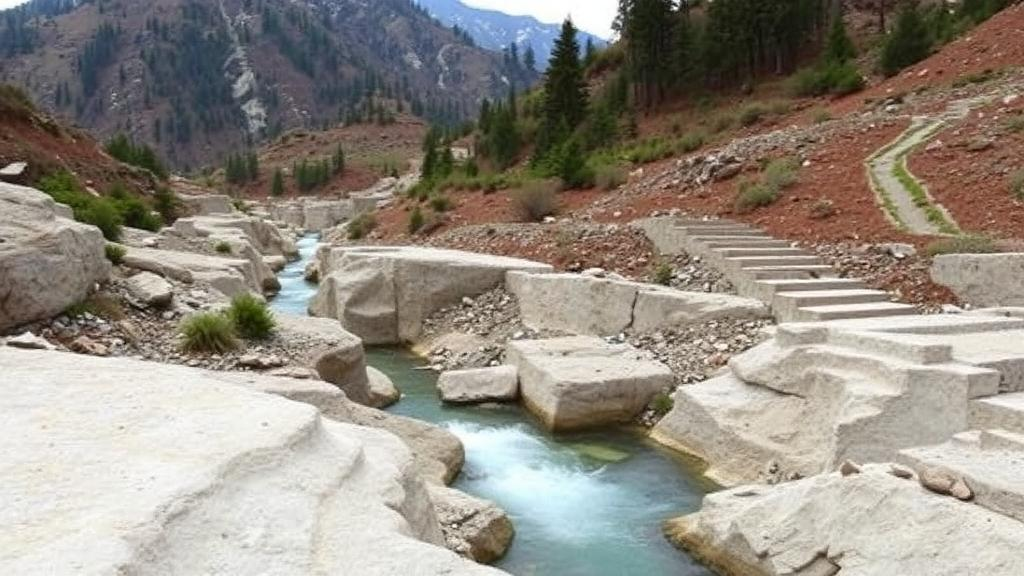
In the Middle Hills of Nepal, the water that sustains entire villages does not arrive through pipes or reservoirs. It emerges from the ground at natural springs, concentrated points where groundwater finds its way to the surface through fractured rock. These springs are the only source of freshwater for communities scattered across this densely populated mountain belt, and for years residents have watched many of them weaken or vanish altogether. A new study published in Hydrogeology Journal by Moti Lal Rijal and Suman Panthee of Tribhuvan University offers one of the most detailed explanations yet of why some springs flow strongly while others fail, and the answer lies not in a single factor but in the interplay between rock type, geological structures and the orientation of mountain slopes.
The research team focused on a 198 square kilometre portion of the Jyagdi River watershed, an area underlain by a demanding suite of metamorphic and sedimentary rocks including slate, phyllite, dolomite, quartzite and limestone. Each of these lithologies stores and transmits water differently. Slates and phyllites, formed under intense pressure during the Himalayan collision, are fine-grained and relatively impermeable except where fractures cut through them. Dolomites and limestones can dissolve slowly along joints and bedding planes, creating secondary porosity, while quartzites tend to be brittle and heavily fractured. Understanding how water moves through this heterogeneous stack is the central challenge for anyone hoping to restore a failing spring, because the recharge zone at the surface may be disconnected from the point of emergence in ways that are far from obvious.
To build that understanding, the researchers conducted two field campaigns: one after the monsoon, when aquifers are at their fullest, and one during the dry season, when only the most reliable groundwater sources remain active. During these surveys they compiled an inventory of 239 perennial springs, measuring discharge at each site and recording the local geology, slope aspect and structural features. Comparing post-monsoon and dry-season measurements allowed the team to characterise seasonal variability in flow, a critical indicator of how much storage each spring’s feeding aquifer possesses. Springs that maintain strong dry-season discharge are drawing from larger or better-connected groundwater reservoirs, whereas those that dwindle rapidly are tapping small, quickly drained storage.
The analytical approach combined geological mapping, topographic data and lineaments, which are linear features visible in the landscape that often trace faults, fractures and joint zones in the underlying bedrock. Lineaments matter enormously in hard-rock hydrogeology because in terrain like the Himalayan Middle Hills, the primary porosity of the rock is negligible; nearly all groundwater movement occurs through networks of fractures. Where these fracture zones intersect permeable lithologies and favourable slope configurations, water can infiltrate during the monsoon, percolate through the fractured rock mass and re-emerge downslope as spring discharge months later.
The study’s most striking finding concerns geometry. Most of the 239 springs documented occur on south-facing slopes, and, crucially, at locations where the bedrock dips toward the north. This combination is not a coincidence. In the folded and faulted terrain of the Nepal Himalaya, rock layers tilted away from a slope can act like tilted shingles, directing infiltrating rainwater downward and along the bedding planes toward the opposite side of the ridge. A south-facing slope underlain by north-dipping strata therefore receives water that has travelled through a substantial thickness of fractured rock, emerging where the flow path intersects the ground surface. The researchers also found that springs with the highest discharge tended to sit on these same south-facing slopes, confirming that aspect and structural dip together exert a first-order control on spring productivity.
This geometric insight has direct practical consequences for spring revival, an increasingly urgent task across the Hindu Kush Himalaya. The standard restoration technique is the springshed approach, in which hydrogeologists delineate the recharge zone above a spring using a conceptual geological model and then target that zone with interventions such as recharge pits, trenching, vegetation management and protection of infiltration areas. Programs of this kind have been implemented in the Indian Himalayan region, including the well-known Dhara Vikas initiative in Sikkim, and in various Nepali watersheds. The logic is sound: if you cannot increase the water reaching the aquifer, you cannot increase the water leaving it at the spring.
But the Jyagdi study suggests that in the structurally chaotic Himalayan terrain, a springshed approach alone can mislead. If bedrock dips northward away from a south-facing spring, the true recharge area may not sit directly uphill of the emergence at all; it may lie on the opposite flank of the ridge, or along a fracture corridor that crosses the topography at an oblique angle. Treating the land immediately above a dying spring would then be an exercise in futility. For this reason, Rijal and Panthee conclude that a landscape approach, one that integrates lithology, lineaments and slope aspect across the entire terrain rather than delineating a single recharge polygon, proved more effective in their study area than the conventional springshed method.
The implications extend well into water policy. The Middle Hills function as what the authors describe as water towers for the Nepal Himalaya, storing monsoon precipitation in fractured-rock aquifers and releasing it gradually through the dry season. As climate change alters the timing and intensity of the monsoon and as changing land use reduces infiltration, this natural storage-and-release system is under strain. Previous studies cited in the paper have documented widespread spring decline across Nepal’s mid-hills and the Indian Himalaya, with consequences for agriculture, drinking water security and the water-energy-agriculture nexus that governs rural livelihoods. Earthquakes, too, have been shown to disrupt spring behaviour in the Sikkim Himalaya, underscoring how sensitive these fracture-controlled systems are to any perturbation of the rock mass.
What makes the new work valuable is its insistence that spring revival must begin with reading the landscape correctly. Before any trench is dug or any recharge structure is built, the sequence of questions should be: what rock is here, which way does it dip, where do the fracture zones run, and which slope aspects concentrate groundwater emergence? The 239-spring inventory from the Jyagdi watershed demonstrates that these questions have answerable, mappable answers even in terrain where borehole data are scarce and aquifers are hidden deep within deformed rock. Remote sensing and geological fieldwork together can identify the structural corridors along which recharge water actually travels, allowing interventions to be placed where they will do the most good.
For the millions of people in the Middle Hills who depend on springs for every litre of water they drink, cook with and irrigate, the study offers a measure of hope grounded in geology rather than optimism. The springs are not failing randomly; they follow rules written in the orientation of slate beds and the traces of ancient faults. By mapping those rules across the Himalayan Middle Hills, hydrogeologists can help ensure that the region’s water towers remain resilient, and that the springs now drying on Nepal’s hillsides have a genuine chance of flowing again.
Subject of Research: Geological and geomorphological controls on spring discharge in the Nepal Himalaya
Article Title: Ascertaining controls on spring discharge: Implications for the revival of drying springs in the Middle Hills region of Nepal
Article References: Rijal, M. L., & Panthee, S. (2026). Ascertaining controls on spring discharge: Implications for the revival of drying springs in the Middle Hills region of Nepal. Hydrogeology Journal. https://doi.org/10.1007/s10040-026-03161-9
Image Credits: AI Generated
DOI: 10.1007/s10040-026-03161-9
Keywords: springs, hydrogeology, Nepal, Himalaya, Middle Hills, spring discharge, lineaments, fractured rock aquifers, springshed management, groundwater recharge, water security, Jyagdi watershed
Cite Scienmag News
Violet Maxwell. (September 30, 2026). Why Himalayan Springs Dry Up: New Study Maps the Hidden Geology of Nepal’s Vanishing Water. Scienmag. https://scienmag.com/why-himalayan-springs-dry-up-new-study-maps-the-hidden-geology-of-nepals-vanishing-water/
Violet Maxwell. "Why Himalayan Springs Dry Up: New Study Maps the Hidden Geology of Nepal’s Vanishing Water." Scienmag, 30 September 2026, https://scienmag.com/why-himalayan-springs-dry-up-new-study-maps-the-hidden-geology-of-nepals-vanishing-water/. Accessed 17 October 2026.
Violet Maxwell. "Why Himalayan Springs Dry Up: New Study Maps the Hidden Geology of Nepal’s Vanishing Water." Scienmag. September 30, 2026. https://scienmag.com/why-himalayan-springs-dry-up-new-study-maps-the-hidden-geology-of-nepals-vanishing-water/


