


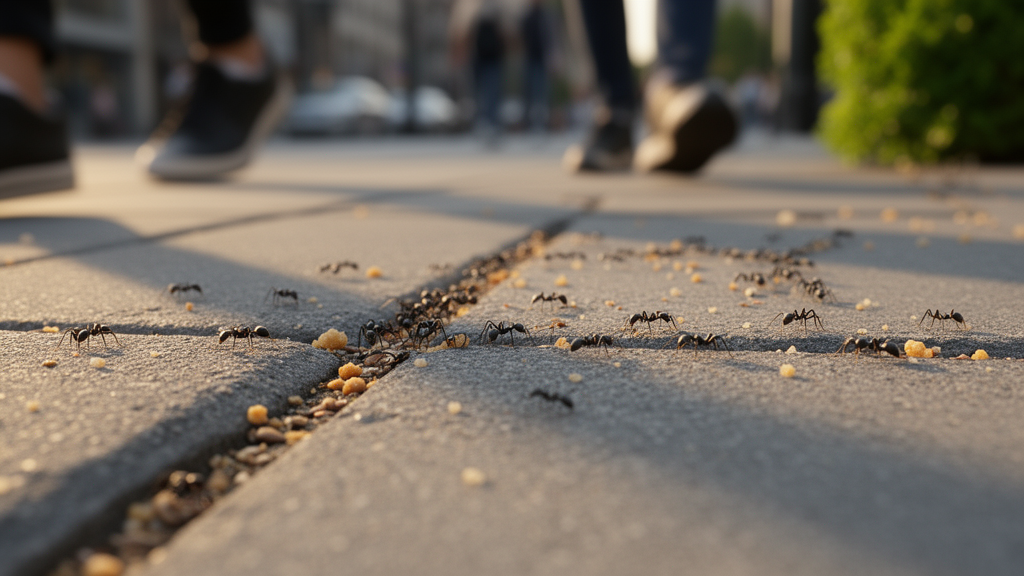
Ants are among the most successful animals on Earth, and nowhere is their quiet dominance more evident than in our cities. Now, a team of Brazilian researchers has launched UrbanAnts, a free web application that brings together scattered records of ant diversity from urban environments into a single, publicly accessible database. Described in the Food and Ecological Systems Modelling Journal, the platform is the first initiative of its kind dedicated exclusively to cataloguing the ants that share our streets, parks, buildings and backyards, and it invites everyone from professional myrmecologists to curious citizens to help build it.
The motivation behind UrbanAnts stems from a growing crisis in biodiversity documentation. Natural ecosystems worldwide are being battered by climate change, habitat fragmentation, pollution and the overexploitation of natural resources, pressures that are further compounded by invasive species and intensifying land use. As these anthropogenic processes accelerate, monitoring biodiversity becomes ever more difficult, particularly because a significant portion of global species diversity remains unknown to science. Many species risk vanishing before they are ever discovered and described, producing irreversible losses for both research and ecosystems. Urban areas sit at the sharp end of this problem, since the species living there are especially exposed to the negative effects of landscape transformation.
Databases have long served as fundamental tools for documenting, monitoring and conserving biological diversity, but the information scientists need is often unavailable or fragmented across multiple incompatible sources. For ants specifically, researchers have accumulated hundreds or even thousands of records for various species across different ecosystems, yet these records are not always stored in accessible databases. Several major resources already exist, including the Global Ant Biodiversity Informatics Project, which links species distribution records to antmaps.org; GlobalAnts, which compiles functional traits with georeferenced abundance data; AntWeb, the largest online repository of high-resolution ant images and specimen records; AntCat, a comprehensive worldwide catalogue of ant taxonomy; and the Atlantic Ants dataset covering the Atlantic Forest. What has been missing, the authors argue, is any dedicated resource for the ants of urban environments, particularly those co-existing with humans inside buildings and their surroundings.
Urban ants are a fascinating and distinctive ecological group. Many of the best-known urban species are characterised as unicolonial and polygynous, meaning they form sprawling colonies with multiple queens, and their long-lived queens often abandon the traditional nuptial flights that most ants rely on for dispersal. Their nests tend to be poorly structured and their workers small, as seen in the little fire ant (Wasmannia auropunctata), the longhorn crazy ant (Paratrechina longicornis) and the Argentine ant (Linepithema humile), all notorious invaders showing high interspecific aggression and migratory tendencies. Yet not every city-dwelling ant fits this profile. Native species also take refuge in urban green areas as their natural habitats disappear, and exotic species exploit urbanisation to disperse and establish themselves in these same spaces, making cities a dynamic frontier where local and global ant faunas collide.
Technically, UrbanAnts was built with the Shiny framework, a tool for constructing interactive web applications in the R programming language, and its data are managed through a relational SQLite database that ensures efficient retrieval, querying and maintenance. The application follows a panel-based design with a header, a sidebar menu and a main content area, and both the platform and its content are openly accessible under a Creative Commons Attribution licence (CC BY 4.0), meaning anyone can use and redistribute the data provided the database and contributing datasets are properly cited. The interface is currently available in Brazilian Portuguese to serve local volunteers, students and researchers, though the team plans a bilingual Portuguese-English version, and in the meantime modern browsers can translate the content automatically.
The app’s feature set is designed to make exploring ant data intuitive even for non-specialists. An Area Map displays the geographic locations of every area covered by the database, while two parallel species tables present all occurrence records in different formats. The UrbanAnts model table offers comprehensive details for each record, including precise location, collection method, collector, date, caste or life stage such as major worker, minor worker, queen or immature, abundance and the data source. The Darwin Core model table contains the same information but structured according to an internationally recognised standard for biodiversity data sharing, which guarantees compatibility with global systems and enhances reuse by researchers, environmental managers, educators and policy-makers.
Visualisation tools turn the raw tables into accessible ecological insight. Bar graphs quantify ant diversity at the subfamily, genus and species levels for each area, and beneath the species chart the app computes standard biodiversity metrics including species abundance, species richness, the Shannon diversity index, Pielou’s evenness and Margalef’s richness index. A dedicated Ant Diversity by Area feature lets users analyse distributions across taxonomic levels and identify the most common and rarest species, comparing all areas in the database or focusing on those of particular interest. For the simply curious, a Meet the Ants section describes the behaviour, feeding habits and ecological importance of urban species, while a Library provides free access to specialised books and articles and a Highlights and Updates tab tracks news and events in myrmecology.
The database’s initial backbone comes from the first author’s doctoral research on ant diversity in São Paulo, Brazil’s largest metropolis and one of the most populous cities in the world. Preliminary data were collected from eight parks across the city: Parque Alfredo Volpi, Parque Anhanguera, Parque Previdência, Parque do Carmo, Parque Ecológico Chico Mendes, Parque Ibirapuera, Parque Jardim da Luz and Parque Tenente Siqueira Campos, known as Trianon. These records document country, state, locality, latitude and longitude, collection date and method, collector identity, subfamily, genus and species, along with counts of major and minor workers, queens, males, immatures and overall abundance. In total, the database launched with 10,346 data entries encompassing 85,859 individual occurrence records, a substantial foundation for a platform that aspires to global reach.
Collaboration sits at the heart of the project’s long-term vision. Through the Collaborate with UrbanAnts feature, researchers studying ants in urban areas and members of the general public alike are invited to contribute, with a standardised submission table available for direct download and clear instructions guiding data entry. Citizen-science participants can also submit photographs, descriptions and observations through a form, and every submission passes through a dedicated moderation team that reviews and organises records to ensure quality standards. As contributions grow, the team intends to expand this network of validators, and expert myrmecologists will rigorously verify species identifications, examining physical museum specimens where possible, reviewing photographs and videos and consulting the literature before records are published with full attribution to their contributors.
The ambitions extend well beyond São Paulo’s parks. The team plans to compile records from every region of Brazil across an unusually broad sweep of urban settings, including residential, commercial, industrial, hospital, institutional, recreational, cultural, natural, historical, port and tourist areas. Partnerships with research institutions and educational organisations are expected to yield new tools such as mobile apps, plugins and integrations with other biodiversity databases, while the geographic scope will widen from Brazil to the entire world, supported by an English-language interface. The researchers frame UrbanAnts not only as a scientific resource but as a policy instrument, one that can support conservation, sustainable management and species control in urbanised areas, and as a means of raising public awareness of urban biodiversity, a realm of life that is often overlooked. In a country hosting some of the highest ant biodiversity on the planet, giving citizens and scientists a shared window onto the ants at their doorstep may prove to be a genuinely transformative act of ecological citizenship.
Subject of Research: A web application and database for exploring and collecting ant diversity data in urban environments
Article Title: UrbanAnts: An R Shiny app for exploring ant diversity data in urban environments
Article References: Gonçalves, D. C. D. O., Silva, N. S. D., Prado, L. P. D., & Morini, M. S. D. C. (2025). UrbanAnts: An R Shiny app for exploring ant diversity data in urban environments. Food and Ecological Systems Modelling Journal, 6, Article e155397. https://doi.org/10.3897/fmj.6.155397
Image Credits: AI Generated
DOI: 10.3897/fmj.6.155397
Keywords: UrbanAnts, ants, urban biodiversity, R Shiny, citizen science, biodiversity database, myrmecology, São Paulo, SQLite, Darwin Core, species diversity, conservation
Cite Scienmag News
Margaret Porter. (October 17, 2026). UrbanAnts: New R Shiny App Maps the Secret Lives of City Ants. Scienmag. https://scienmag.com/urbanants-new-r-shiny-app-maps-the-secret-lives-of-city-ants/
Margaret Porter. "UrbanAnts: New R Shiny App Maps the Secret Lives of City Ants." Scienmag, 17 October 2026, https://scienmag.com/urbanants-new-r-shiny-app-maps-the-secret-lives-of-city-ants/. Accessed 17 October 2026.
Margaret Porter. "UrbanAnts: New R Shiny App Maps the Secret Lives of City Ants." Scienmag. October 17, 2026. https://scienmag.com/urbanants-new-r-shiny-app-maps-the-secret-lives-of-city-ants/


