


Every cell in your body carries the same genome, yet a liver cell and a neuron look nothing alike because they read different genes. Single-cell RNA sequencing, or scRNA-seq, exploits this fact to profile gene activity cell by cell, offering researchers an unprecedented window into cellular diversity. But the technology produces data that are notoriously messy: expression matrices are sparse, riddled with noise, and distorted by dropout events in which genes that are genuinely active appear silent. Sorting thousands of cells into meaningful groups without labels is one of computational biology’s hardest unsupervised problems, and a new deep learning framework published in BMC Genomics claims a substantial step forward.
The method, called scDAEC, was developed by Yue Zhu, Chen Chen, Yue Liu, Yanlei Kang and Zhong Li at Huzhou Normal University, together with Hancan Zhu of Shaoxing University. It is an unsupervised clustering framework built on a dual-autoencoder architecture, meaning it trains two different autoencoders in parallel and fuses what each one learns. According to the authors, existing deep clustering models tend to emphasize either gene-expression reconstruction or cell–cell structural learning, which limits their ability to jointly handle expression sparsity while preserving the topology of how cells relate to one another. scDAEC was designed to do both at once.
The first autoencoder is a denoising autoencoder based on an adaptive zero-inflated negative binomial model, abbreviated ZINB. This statistical choice is deliberate. scRNA-seq count data contain many zeros, some of which reflect true biological silence and others of which are artifacts of incomplete sequencing. The zero-inflated negative binomial distribution explicitly models this uncertainty, combining a count component that captures overdispersed gene expression with a zero-inflation component that accounts for excess zeros. By training the denoising autoencoder with an adaptive ZINB loss, the network learns to reconstruct clean gene-expression profiles from corrupted inputs, producing denoised embeddings that retain biologically meaningful variation while suppressing technical noise.
The second autoencoder is a graph autoencoder, or GAE, which approaches the data from a completely different angle. Rather than treating each cell as an isolated vector of gene counts, the graph autoencoder learns from the structure of relationships among cells. A cell–cell graph encodes which cells are similar to which others, and the GAE learns topology-aware representations that preserve this cellular neighborhood structure. This matters because cells of the same type occupy connected regions in the high-dimensional expression space, and capturing that connectivity helps the model keep genuinely related cells together even when individual expression measurements are unreliable.
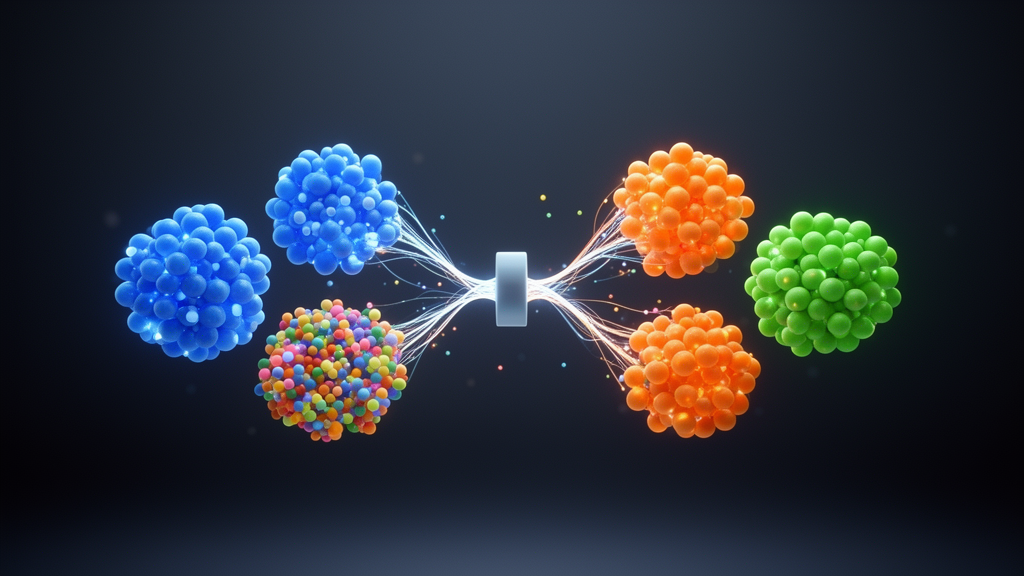
The innovation that ties the two branches together is a module the authors call dynamic combined multi-head attention, or DCMHA. Multi-head attention, the mechanism popularized by transformer architectures, allows a model to weigh different parts of its input with different importance when making decisions. In scDAEC, the DCMHA module integrates the denoised gene-expression embeddings from the ZINB-based branch with the graph-based embeddings from the GAE branch, dynamically combining the two views for clustering optimization. The dynamic aspect means the fusion weights are not fixed; the model adjusts how much it trusts expression information versus structural information as training proceeds, allowing the two representations to reinforce each other rather than compete.
Once the fused representation is learned, scDAEC optimizes clusters end to end, jointly refining the embeddings and the cluster assignments in a single training loop. This joint optimization is what distinguishes deep clustering from the classical pipeline of dimensionality reduction followed by a separate clustering algorithm such as k-means. In the classical approach, errors introduced during dimensionality reduction propagate unchecked into the clustering step. In scDAEC, the clustering objective feeds back into the representation learning, so the embeddings are shaped specifically to make cell groups separable.
The authors evaluated scDAEC on 13 real scRNA-seq datasets and compared it with representative competing methods. Performance was measured with two standard clustering metrics. The Adjusted Rand Index, or ARI, quantifies how well a clustering agrees with a reference grouping while correcting for chance agreement, and the Normalized Mutual Information, or NMI, measures how much information one clustering shares with another. Based on dataset-level mean results, scDAEC achieved overall mean ARI and NMI values of 0.864 and 0.859 respectively. Compared with the strongest competing methods, the framework improved average ARI by 10.79 percent and average NMI by 10.96 percent, margins the authors describe as reflecting improved clustering accuracy and more stable performance across datasets.
Stability is a point worth emphasizing. Deep clustering methods can be sensitive to initialization and hyperparameter choices, and a method that excels on one dataset but fails on another offers limited practical value. The consistent gains across 13 heterogeneous datasets suggest that the dual-view design, which grounds the model in both expression statistics and cellular topology, generalizes better than single-view alternatives. The adaptive ZINB loss also means the denoising branch does not rely on a fixed noise model; it adapts to the statistical character of each dataset it encounters.
The implications reach beyond benchmark scores. Accurate unsupervised clustering is the foundation for downstream single-cell analyses, including identifying rare cell populations, tracing developmental trajectories, and comparing healthy and diseased tissue. When clustering misassigns cells, rare populations can vanish into larger groups and disease signatures can be diluted. A framework that recovers cell groups more faithfully could sharpen every analysis built on top of it, from atlas construction to drug-response studies.
The work was supported by the National Natural Science Foundation of China under grants U24A20249 and 12171434, and by the Science and Technology Plan Project of Huzhou City under grant 2022GZ51. The study was published open access, and the source code is publicly available on GitHub, allowing other researchers to apply scDAEC to their own data or extend the architecture. As single-cell sequencing continues to scale to millions of cells, methods that can jointly denoise expression data and learn cellular structure are likely to become essential tools for turning raw transcriptomic noise into biological insight.
Subject of Research: Deep learning method scDAEC improves unsupervised clustering of single-cell RNA sequencing data
Article Title: scDAEC: deep clustering of single-cell data based on dual autoencoder
Article References: Zhu, Y., Chen, C., Liu, Y., Kang, Y., Zhu, H., & Li, Z. (2026). scDAEC: deep clustering of single-cell data based on dual autoencoder. BMC Genomics. https://doi.org/10.1186/s12864-026-13261-1
Image Credits: AI Generated
DOI: 10.1186/s12864-026-13261-1
Keywords: single-cell sequencing, deep learning, clustering, autoencoder, genomics, scRNA-seq, scDAEC, deep, single-cell, data, based, dual
Cite Scienmag News
Juliet Wilcox. (October 17, 2026). Dual autoencoder framework sharpens single-cell clustering accuracy. Scienmag. https://scienmag.com/dual-autoencoder-framework-sharpens-single-cell-clustering-accuracy/
Juliet Wilcox. "Dual autoencoder framework sharpens single-cell clustering accuracy." Scienmag, 17 October 2026, https://scienmag.com/dual-autoencoder-framework-sharpens-single-cell-clustering-accuracy/. Accessed 17 October 2026.
Juliet Wilcox. "Dual autoencoder framework sharpens single-cell clustering accuracy." Scienmag. October 17, 2026. https://scienmag.com/dual-autoencoder-framework-sharpens-single-cell-clustering-accuracy/


