


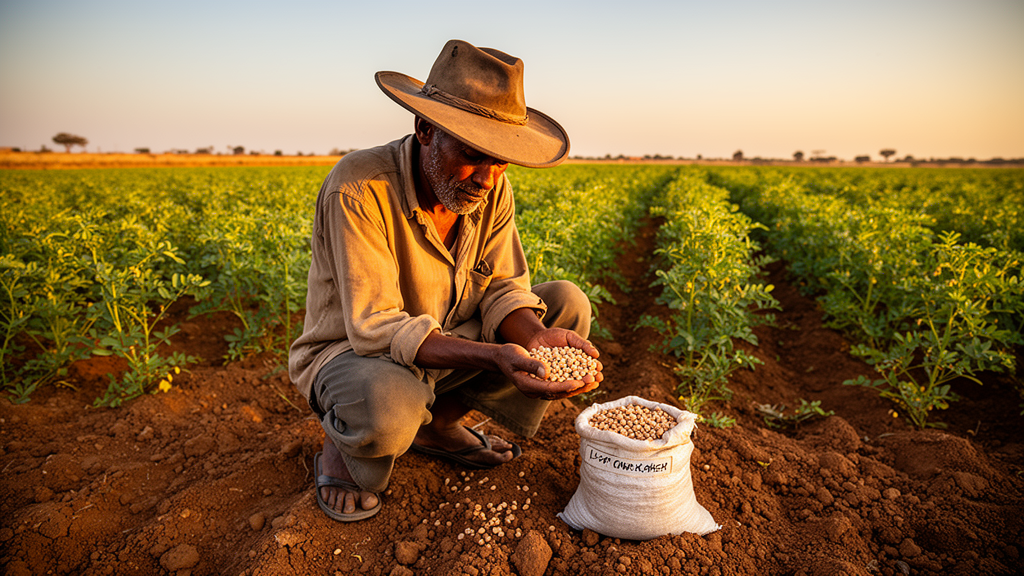
In the highlands of central Ethiopia, chickpea is far more than a crop. It is a rotational partner for cereals that rebuilds soil fertility on the Vertisols dominating the region, a protein source for families who cannot afford animal products, a cash earner through local and export markets, and a feed reserve for livestock in areas where grazing land has vanished under population pressure. Nearly 1.2 million smallholder farmers grow it. Yet the national average yield stands at a mere 1.8 tons per hectare, and official estimates suggest that less than one percent of Ethiopia’s chickpea area was planted with certified seed in a recent season, compared with 46 percent coverage for maize. A new study published in Innovations in Agriculture asks a deceptively simple question: what actually drives smallholder farmers to buy certified chickpea seeds, and what holds them back?
The research gap the study addresses is subtle but consequential. Previous Ethiopian work has concentrated on the adoption of improved chickpea varieties, treating the farmer’s relationship with new seed technology as a yes-or-no proposition. But adoption and demand are not the same thing. A farmer may adopt an improved variety once and then recycle seed for years, or may want certified seed but be unable to afford it or find it. Understanding the demand side, the researchers argue, is essential for building a seed system that matches supply to what farms actually need, rather than one plagued by shortages, excess inventory, delivery delays and quality failures.
To untangle this, the team surveyed 186 randomly selected farm households in the Gimbichu, Becho, Lume and Adea districts of the Eastern and South Western Shewa Zones of Oromia during the 2022 crop season. These zones rank among Ethiopia’s highest-potential chickpea areas. The researchers used a multistage sampling approach, first selecting zones purposively for production potential, then randomly drawing four districts, nine kebeles, and finally the households themselves. Data were coded in SPSS and analyzed in STATA, with descriptive statistics establishing the socioeconomic landscape before econometric modeling began.
The analytical centerpiece was Cragg’s double hurdle model, chosen for a technical reason that matters for interpretation. Many households buy zero certified seed, and a naive regression on such data produces biased, inconsistent estimates. The Tobit model can handle censored data but forces the participation decision and the purchase quantity to be governed by the same factors. The double hurdle model relaxes that restriction: the first hurdle is a probit-style participation decision, the second is the intensity of purchase, and each can be driven by different variables. The model’s error terms proved uncorrelated, meaning the decision to buy and the amount bought are genuinely independent choices, a finding that itself carries policy weight because interventions can be tailored separately to each hurdle.
The descriptive results sketch a stark picture of exclusion. Certified seed purchasers held an average of 1.65 hectares of farmland against 0.83 hectares for non-purchasers, owned 9.4 tropical livestock units versus 6.2, and had nearly ten years of experience growing certified chickpea compared with 4.5 years for non-buyers. Only 39.3 percent of surveyed farmers purchased certified seed at all, and 75 percent voiced worries about limited accessibility, while 85.9 percent expressed dissatisfaction with exorbitant prices. Meanwhile, 66.4 percent received no extension advice on the significance of certified seed, and 65.3 percent had no formal training on chickpea production, suggesting that the knowledge infrastructure around the crop is as thin as the seed supply itself.
The econometric estimates then identify which factors move each hurdle. Participation in certified seed purchase rose significantly with household size, education of the household head, age, chickpea farmland size, cooperative membership and access to extension advice, and fell with seed price and distance to the extension office. Each additional household member raised the probability of participation by 0.066, each hectare of farmland by 0.019, and each year of education by a substantial margin, while every one Birr increase in seed price cut the probability of purchase by 0.008. The age effect is telling: older household heads, who have accumulated more resources and experience, were more likely to buy certified seed than younger counterparts.
The second hurdle, the quantity purchased, responded to a partly different set of levers. Household size, education, land size, livestock holdings and cooperative membership all increased the kilograms of certified seed bought, while price again depressed it sharply, with each one Birr increase reducing quantity by 2.92 kilograms. The land effect was especially strong, adding 1.92 kilograms of seed per additional hectare. Livestock holdings matter because they function as a liquid asset in crop-livestock farming systems, allowing households to convert animal wealth into seed purchases. Notably, training on certified chickpea seed showed no significant effect on either hurdle, hinting that the training that does exist may be poorly targeted or too infrequent to change behavior.
Cooperative membership emerged as one of the most powerful and consistent factors across both hurdles, raising participation probability by 0.15 and quantity by 0.046 kilograms. The mechanism is straightforward: cooperatives pool capital, secure bulk discounts through collective bargaining, guarantee seed quality and authenticity, distribute technical assistance and agronomic advice, and connect members to output markets and price information. Most certified seed purchasers, 75.2 percent, were cooperative members. Farmers also revealed their varietal preferences: Arerti, Ejire and Habru dominated, with Arerti cultivated by 14 percent of sampled farmers and achieving on-farm productivity of roughly 23.2 quintals per hectare, well above the national average but still below the research station potential of 2.5 to 3.0 tons per hectare.
The demand trend over three years adds nuance. Certified seed use climbed steadily from 2020, with non-users falling from 87.1 percent to 75 percent of the sample, but the pace of replacement is glacial, taking up to eight years, largely because few superior varieties exist relative to those already in use and because price remains prohibitive. Farmers reported that certified seeds supplied to them sometimes showed low adaptability, disease susceptibility and late delivery, reinforcing the case for continuous monitoring and evaluation of seed suppliers. The study concludes that boosting crop productivity for resource-limited farmers requires improving farmer skills, guaranteeing certified seed availability through collaborative efforts, and implementing seed price subsidies, alongside strengthening local seed producer cooperatives and prioritizing inclusive extension services that reach beyond model farmers to the smallholders who need them most.
Subject of Research: Determinants of demand for certified chickpea seeds among smallholder farmers in Oromia, Ethiopia
Article Title: Estimating the demand for certified chickpea seeds among smallholder farmers in the Eastern and South Western Shewa Zones of Oromia, Ethiopia
Article References: Gemechu, A., & Gemechu, B. (2024). Estimating the demand for certified chickpea seeds among smallholder farmers in the Eastern and South Western Shewa Zones of Oromia, Ethiopia. Innovations in Agriculture, 7, 1-12. https://doi.org/10.3897/ia.2024.124511
Image Credits: AI Generated
Keywords: chickpea, certified seed, smallholder farmers, Ethiopia, seed demand, double hurdle model, agricultural extension, seed cooperatives, Estimating, demand, certified, seeds
Cite Scienmag News
Alan Morgan. (October 17, 2026). Why Ethiopia’s smallholder farmers still shun certified chickpea seeds. Scienmag. https://scienmag.com/why-ethiopias-smallholder-farmers-still-shun-certified-chickpea-seeds/
Alan Morgan. "Why Ethiopia’s smallholder farmers still shun certified chickpea seeds." Scienmag, 17 October 2026, https://scienmag.com/why-ethiopias-smallholder-farmers-still-shun-certified-chickpea-seeds/. Accessed 17 October 2026.
Alan Morgan. "Why Ethiopia’s smallholder farmers still shun certified chickpea seeds." Scienmag. October 17, 2026. https://scienmag.com/why-ethiopias-smallholder-farmers-still-shun-certified-chickpea-seeds/


