


Deep in the montane broadleaf forests of Sichuan and Yunnan provinces, Chinese researchers have encountered a moth so visually arresting that it looks less like a silkworm relative and more like a black-and-white pierid butterfly. The insect, now formally described as Rondotia melanoleuca sp. nov. in the journal Nota Lepidopterologica, began its scientific life not as an adult specimen pinned in a drawer but as a batch of vivid yellow caterpillars dotted with black spots, collected in the wild and raised to adulthood in captivity. What emerged from those cocoons was a wing pattern entirely unlike anything else known in the family Bombycidae, the group that includes the domesticated silkworm and its wild relatives.
The genus Rondotia has long been familiar to sericulture, but for an unwelcome reason. Its type species, Rondotia menciana, described by Moore in 1885 and named in honor of the French sericulturist Natalis Rondot, is a recognized pest of mulberry plantations across the Far East. Because of its economic impact, the biology and even the genomics of this white mulberry caterpillar have been studied in considerable detail in China. The other two accepted members of the genus have fared less well in the literature: Rondotia diaphana, originally described from Myanmar by Hampson in 1893, has since been reported from China, India, Thailand, and Vietnam, while Rondotia lineata, a highland flyer restricted to the eastern edge of the Qinghai-Tibet Plateau, has rarely been mentioned since Leech established it in 1898. A recent taxonomic review concluded that these three species are closely related and monophyletic, sharing similar wing patterns and venation.
The new species breaks that pattern of uniformity in spectacular fashion. Adult males carry heads largely cloaked in black scales, offset by an off-white frontoclypeal area, black compound eyes, and bipectinate antennae. Their semitransparent forewings and hindwings, roughly 2.2 and 1.8 centimeters long respectively in the holotype, are arranged so that every wing vein sits inside a gray-black scaly stripe, with additional dark bands across the postbasal, median, and marginal regions, while the remaining surfaces carry a light dusting of white scales. The result is a moth with crisp white patches framed between black vertical stripes and black veins, a configuration the authors note allows identification from all other bombycids without any dissection of genital structures. Females resemble males closely but are larger, with forewings around 2.4 centimeters and hindwings near 1.9 centimeters, and their wings appear narrower, longer, and paler.
The story of the discovery began on 2 May 2022, when ten mature caterpillars were collected from a Morus species at the type locality near Dafengding in Leshan, Sichuan Province, at approximately 1,500 meters elevation. The larvae were sent to co-author Cao in Beijing and reared successfully in captivity on the white mulberry, Morus alba. They spanned their cocoons between 5 and 9 May 2022, and the adults that would become the holotype and paratypes emerged between 14 and 18 May of that year. A separate observation added an intriguing ecological wrinkle: co-author Liu found a single individual on Camptotheca acuminata, a member of the Nyssaceae, in Fugong County, Yunnan, at 1,221 meters on 28 May 2023. Brought indoors, that larva refused to continue feeding on either the original plant or mulberry, and it ultimately starved to death, hinting at a specialized and still poorly understood larval diet.
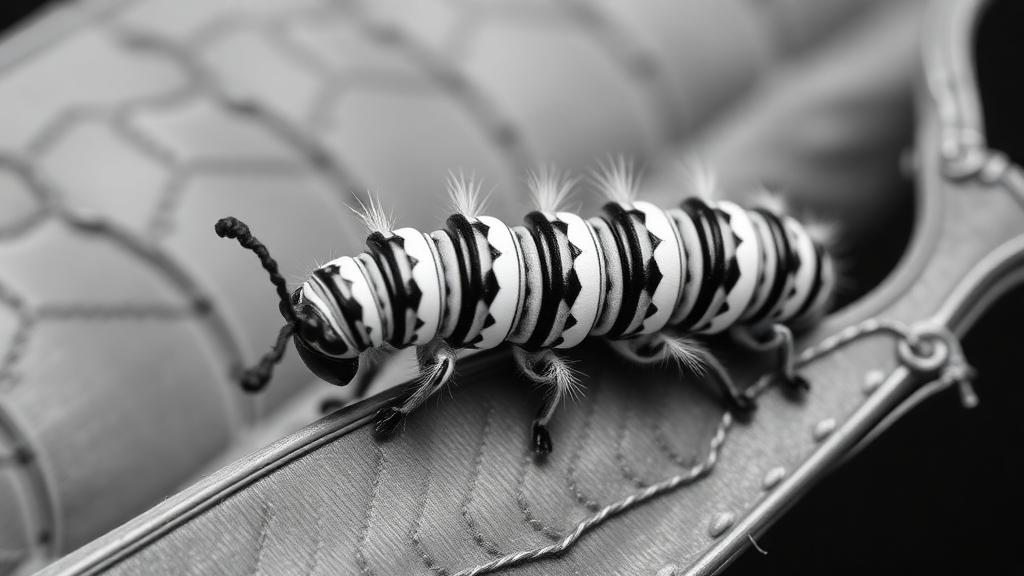
The immature stages themselves are striking. The mature larva has a dark gray head capsule, sometimes dusted with sparse yellow powder, with a yellowish adfrontal area and pale yellow labrum. Its body integument from the first thoracic to the tenth abdominal segment is mostly vivid yellow, transversely decorated with black dotted stripes, and the second thoracic segment forms the most swollen dorsal region. A strongly developed black caudal horn rises from the mid-dorsal line of the eighth abdominal segment; at rest it points toward the posterosuperior side, but when the caterpillar is frightened or crawling it swings back and forth from anterior to posterior at unstable frequencies and speeds. The cocoons are white ellipsoids about twice as long as wide, with a wrinkled, irregular outer fiber layer that appears loose and perforated in horizontal section, enclosing a pupal chamber whose inner surface is comparatively smooth.
To place the new moth within its family, the researchers generated molecular data alongside their morphological work. They extracted DNA from a paratype using cryogenic grinding and silicon matrix adsorption, amplified a partial sequence of the mitochondrial cytochrome c oxidase subunit I gene, 1,235 base pairs long, with the primer pair LYQ3/LYQ4, and sequenced it on an ABI 3730XL platform, depositing the result in GenBank under accession OR051027. This new sequence was aligned with COI data extracted from the complete mitochondrial genomes of other bombycids, including Rotunda rotundapex, Bombyx huttoni, Bombyx mandarina, the domestic silkworm Bombyx mori, Rondotia menciana, and Ocinara albicollis, together with a partial COI sequence of R. diaphana and an outgroup sequence from the saturniid Saturnia pyretorum. Alignment was performed with MAFFT V7, and a maximum-likelihood tree was inferred with IQ-TREE 2 under the best-fitting model TIM2+F+G4, with nodal support assessed by ultrafast bootstrapping.
The phylogenetic result was unambiguous. Rondotia melanoleuca emerged as sister to a clade formed by R. menciana and R. diaphana, with a support value of 99 percent. Given the very high morphological similarity that R. lineata shares with those two species, the authors reason that the new species is likely sister to all other known members of the genus. That placement agrees neatly with the moth’s morphological uniqueness, which stands in sharp contrast to the relative uniformity of every other Rondotia described to date. The broader generic relationships recovered in the topology are also consistent with earlier published analyses.
Formal diagnosis rests on both external and genital characters. Where previously described Rondotia species show a forewing with the outer margin concave below the apex and a projection at the end of the third median vein, an uncus divided into three lobes, and a valval apex bearing one large and one small tooth, the new species displays a straighter forewing termen, a biforked uncus, and a rounded dorsodistal edge of the valva. The male genitalia are otherwise distinctive in their own right: tegumen and vinculum are fused into a narrowly elliptical ring with a very short saccus, the deeply bilobed uncus is sclerotized laterally and membranous medially, a pair of strongly developed cambered sclerites derived from the gnathos connects to the uncus by lateral membrane, and the thin, long, straight phallus terminates in a pointed tip with a slightly helical opening. The eighth abdominal sternum is caudally digitiform and carries dorsolateral bristles.
Behavioral observations in captivity added further texture, even though they stopped short of full life-cycle completion. The adults were active during the day, and in their resting posture they typically held the forewings with their costal margins horizontal, perpendicular to the body, while the anal angles of the hindwings were widely separated. No successful pairing occurred under captive conditions, yet unfertilized females still laid eggs, covering them with black scales scraped from the midventral areas of their abdomens. The researchers also noted a subtle optical phenomenon: the dorsal epicuticle of the membranous wing areas appeared slightly iridescent in living moths, a quality that proved difficult to detect in dead, dry specimens, suggesting that field observations of live insects may reveal traits invisible in museum collections.
Currently, Rondotia melanoleuca is known only from mid-elevation localities in Leshan and Fugong, but the authors suspect it may be more widely distributed across the montane broadleaf forests of Sichuan and Yunnan. Because similar environments extend southward, they presume the species may also occur on the northern Indochina Peninsula, in Myanmar, Laos, and Vietnam. The species name melanoleuca, a feminine adjective in modern Latin meaning black and white, carries a pleasing coincidence: the Sichuanese giant panda bears the very same specific epithet. The authors also point out that the moth superficially resembles the pierid butterfly genus Aporia, and they argue that future ecological studies will be needed to determine whether a mimetic relationship exists between the new silkworm and other Lepidoptera. Whether that resemblance reflects genuine mimicry or mere coincidence, the discovery underscores how much diversity still hides in the forests of southwest China, waiting for a handful of yellow, black-spotted caterpillars to give it away.
Subject of Research: Description and molecular phylogenetic placement of a new wild-mulberry silkworm species, Rondotia melanoleuca, from southwest China
Article Title: Rondotia melanoleuca sp. nov., a new wild-mulberry silkworm from China ( Lepidoptera , Bombycidae )
Article References: Liu, Z., & Cao, X. (2024). Rondotia melanoleuca sp. nov., a new wild-mulberry silkworm from China (Lepidoptera, Bombycidae). Nota Lepidopterologica, 47, 49-56. https://doi.org/10.3897/nl.47.109920
Image Credits: AI Generated
DOI: 10.3897/nl.47.109920
Keywords: Rondotia melanoleuca, new species, Bombycidae, Lepidoptera, COI phylogeny, Sichuan, Yunnan, mulberry silkworm, taxonomy, China, wild silkworm, molecular systematics
Cite Scienmag News
Gavin Prescott. (October 17, 2026). Black-and-White Wild Silkworm Discovered in China Rewrites Rondotia Family Tree. Scienmag. https://scienmag.com/black-and-white-wild-silkworm-discovered-in-china-rewrites-rondotia-family-tree/
Gavin Prescott. "Black-and-White Wild Silkworm Discovered in China Rewrites Rondotia Family Tree." Scienmag, 17 October 2026, https://scienmag.com/black-and-white-wild-silkworm-discovered-in-china-rewrites-rondotia-family-tree/. Accessed 17 October 2026.
Gavin Prescott. "Black-and-White Wild Silkworm Discovered in China Rewrites Rondotia Family Tree." Scienmag. October 17, 2026. https://scienmag.com/black-and-white-wild-silkworm-discovered-in-china-rewrites-rondotia-family-tree/


