


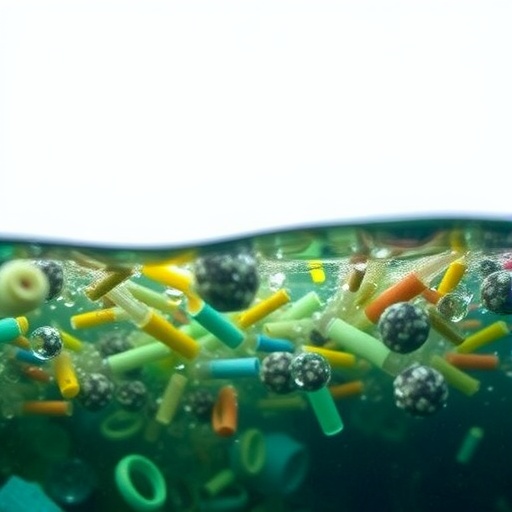
In recent years, the proliferation of microplastics within the world’s aquatic environments has raised significant concern among scientists, policymakers, and environmentalists alike. These tiny particles, often smaller than five millimeters in diameter, infiltrate marine ecosystems and potentially disrupt the natural functioning of food webs, biogeochemical cycles, and ultimately human health. One key question that has fascinated researchers is the role of biofouling—the colonization of plastic surfaces by microorganisms and microbial communities—in facilitating the vertical transport of microplastic particles through water columns. A groundbreaking study conducted by Benner and Passow published in Microplastics & Nanoplastics (2024) fundamentally challenges previous assumptions about this relationship, demonstrating that biofouling may not, in fact, contribute to vertical transport of small microplastic to the extent once thought.
Biofouling has long been posited as a mechanism by which small microplastic particles gain density and sink from surface waters to deeper ocean layers. Microorganisms, from bacteria to algae, colonize submerged surfaces and form biofilms that may cause changes in buoyancy, ostensibly aiding particle descent. This conceptual framework has been central to models predicting the fate and transport of plastic pollutants in marine systems. However, Benner and Passow’s meticulous experiments and analytical insights reveal that this process is far more complex and less impactful on vertical transport of microplastics, particularly for particles of the smallest sizes.
At the heart of their investigation was an experimental design that allowed assessment of biofouling effects on microplastic particles of various sizes within controlled aquatic microcosms. The researchers utilized cutting-edge imaging techniques to monitor microbial colonization, along with density and sinking velocity measurements over time. By focusing on plastics smaller than 100 micrometers, they directly addressed a critical gap in previous studies that primarily emphasized larger microplastics. Their results demonstrated that while biofilm growth is indeed evident, the associated increase in particle density is insufficient to overcome the intrinsic buoyant properties of small microplastics, limiting their ability to sink.
This evidence disrupts a prevailing narrative in marine pollution science. Facilitation of vertical transport through biofouling had often been considered to be a crucial pathway by which microplastics removed from surface waters enter deep ocean sediments or are otherwise sequestered in deeper layers. The findings from Benner and Passow suggest instead that other factors may be more important in vertical microplastic transport, such as aggregation with organic matter or downward movement via biological vectors like zooplankton. These alternative mechanisms must be reevaluated to improve the accuracy of ecological risk assessments and pollutant fate models.
The study provides a nuanced understanding of the physical and biological interactions governing microplastic dynamics. It highlights that simply accumulating microorganisms on microplastics is not enough to guarantee their descent. Instead, the density increment caused by biofilms is marginal relative to the overall particle buoyancy, particularly for smaller sized plastic debris. This discovery underscores the necessity for marine scientists to consider the balance of forces—buoyancy, drag, and aggregation—in developing predictive models of microplastic transport.
One of the fascinating aspects illuminated by Benner and Passow’s research is the temporal scale on which biofouling occurs and its possible ecological consequences. Their data show biofilm accumulation can take place within days to weeks in ocean-like conditions; however, this buildup remains relatively thin and patchy and does not translate into meaningful density changes needed for sinking. The implications are profound: rather than facilitating rapid sedimentation of microplastics, biofouling might instead enhance surface residence time, potentially increasing exposure to sunlight, UV radiation, and photodegradation processes.
From a methodological perspective, the study leverages advanced microscopy and chemical analyses to characterize biofilms at a microbial and molecular level. Employing fluorescent markers and DNA sequencing, the authors decipher the community composition on microplastic surfaces. They reveal a predominance of bacteria and microalgae species known for forming sparse biofilms rather than dense, heavy mats that might contribute significantly to sinking. This biological insight dovetails elegantly with the physical measurements, collectively portraying a multi-dimensional view of biofouling impact.
Furthermore, the revelations from this work have implications beyond environmental science, extending into marine policy and plastic pollution management strategies. If biofouling does not drive vertical transport as strongly as believed, current models predicting microplastic accumulation zones and sediment contamination might require recalibration. Enhanced understanding of microplastic residence times in surface waters informs risk assessments concerning ingestion by surface-dwelling marine organisms and potential trophic transfer through marine food webs.
The differentiation between microplastic sizes in the observed effects also stresses the importance of focusing future research on size-dependent mechanisms. While larger microplastics might still sink due to biofouling or aggregation, small microplastics exhibit notable resistance to sinking despite biofilm presence. This size-related behavior may affect their distribution, ecological impacts, and potential for atmospheric transport, implications that resonate strongly given the widespread dispersal of microplastics globally.
Benner and Passow’s findings also open new avenues for probing the role of natural environmental variables influencing biofouling efficacy. Factors such as water temperature, nutrient concentrations, and microbial community diversity could modulate biofilm formation rates and density, potentially shifting the balance under different oceanographic contexts. Their work highlights the need for further in situ studies assessing these variables in diverse marine ecosystems to corroborate laboratory findings.
Another significant dimension explored through this study is the interaction between microplastics and sinking organic particles, or marine snow. While biofouling alone may not suffice to cause sinking, its presence on microplastic surfaces may facilitate adhesion to organic aggregates, indirectly contributing to particle descent. This mechanism suggests a more complex interplay where biofouling acts as a facilitator of microplastic incorporation into larger, denser particles rather than a direct driver of vertical transport.
The ongoing refinement of our understanding of microplastic behavior in marine environments also demands interdisciplinary approaches, combining microbiology, oceanography, materials science, and environmental chemistry. Studies like that of Benner and Passow exemplify such integration, yielding high-resolution insights into microplastic fate that inform both fundamental science and applied environmental stewardship. Their critical revision of biofouling’s role provokes a reconsideration of established theoretical frameworks, emphasizing empirical validations using modern experimental methodologies.
Cumulatively, this research challenges assumptions and underscores the complexities inherent in marine microplastic dynamics. It has immediate implications for conservation biology, particularly regarding how microplastics impact lower trophic levels and the broader marine ecosystem services upon which humans depend. By tempering expectations about biofouling-driven sinking, the study calls for a renewed focus on alternative transport pathways and degradation mechanisms.
In conclusion, the innovative research conducted by Benner and Passow represents a pivotal step forward in understanding microplastic pollution in marine environments. It redefines the ecological role of biofouling in vertical microplastic transport, emphasizing that small microplastic particles largely resist sinking even as microbial biofilms develop. This revelation challenges prevailing assumptions that have informed predictive models and environmental policies and sets the stage for more targeted studies exploring a diverse suite of physical, chemical, and biological factors influencing microplastic fate. As scientists continue to unravel the complexities of plastic pollution, such nuanced, data-driven analyses will be crucial for developing effective mitigation strategies and safeguarding ocean health for future generations.
Cite Scienmag News
Denise Maddox. (August 4, 2025). Why Biofouling Fails to Move Microplastics Vertically. Scienmag. https://scienmag.com/why-biofouling-fails-to-move-microplastics-vertically/
Denise Maddox. "Why Biofouling Fails to Move Microplastics Vertically." Scienmag, 4 August 2025, https://scienmag.com/why-biofouling-fails-to-move-microplastics-vertically/. Accessed 4 September 2026.
Denise Maddox. "Why Biofouling Fails to Move Microplastics Vertically." Scienmag. August 4, 2025. https://scienmag.com/why-biofouling-fails-to-move-microplastics-vertically/


