


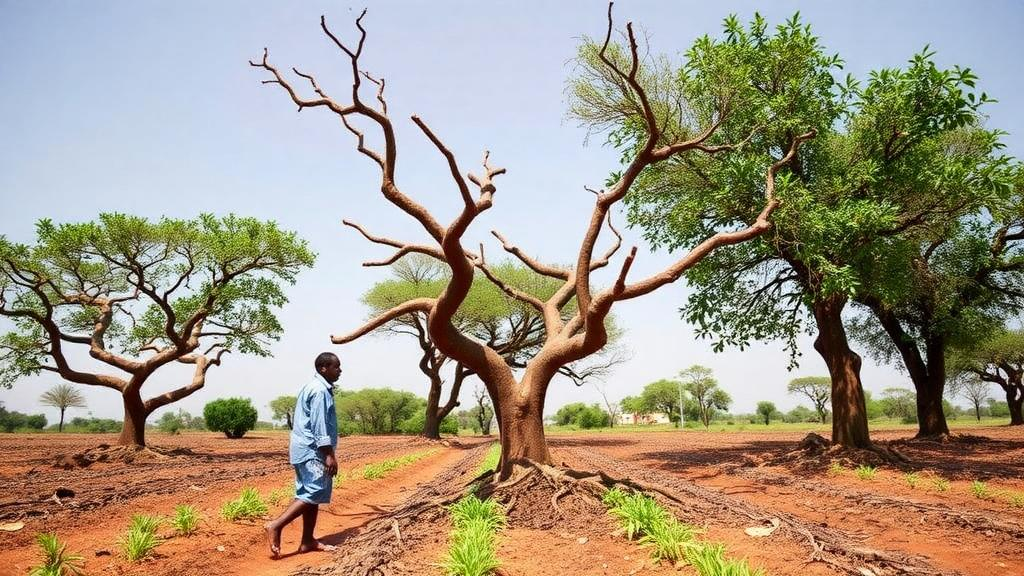
In the highlands of northwest Ethiopia, the fate of the landscape’s trees and shrubs rests almost entirely in the hands of smallholder farmers. A new study from Enemay District, published in Discover Sustainability, reveals a sobering picture: nearly eight in ten farmers surveyed believe that woody species conservation in their area is in decline, and the practices they adopt to protect trees are shaped less by environmental ideals than by a web of socioeconomic realities, from gender and age to access to credit and the distance they must walk to reach their fields. The research, conducted by Kiros Getachew Belachew and Berhanu Tadesse Beyene of Debre Markos University, offers one of the most detailed portraits to date of how rural households in the Ethiopian Highlands perceive and manage the woody vegetation on which their livelihoods depend.
Woody species, the trees and shrubs that dot farmlands, home gardens, and communal hillsides, perform functions far beyond their appearance. They stabilize soils against erosion on steep slopes, regulate local water cycles, provide fodder for livestock during dry seasons, supply fuelwood and construction material, and harbor the biodiversity that underpins resilient agricultural ecosystems. In a country where deforestation and land degradation have progressed relentlessly over recent decades, understanding why farmers conserve or clear these species is not an academic question. It is central to any credible strategy for restoring degraded landscapes and sustaining rural incomes. Yet, as the authors note, detailed information on farmers’ perceptions and the factors driving conservation behavior has been strikingly scarce for Enemay District.
To fill that gap, the researchers designed a study combining quantitative rigor with qualitative depth. Between January and June 2022, they surveyed 235 households selected through systematic random sampling from three kebeles, the smallest administrative units in Ethiopia, chosen purposively to represent the district’s agroecological diversity. Semi-structured questionnaires formed the backbone of the data collection, but the team also walked the fields with farmers, conducted focus group discussions, and interviewed key informants, including elders and local experts, to capture nuances that numbers alone cannot convey. Quantitative responses were analyzed with descriptive statistics and binary logistic regression, a statistical technique that estimates how each factor changes the odds of a farmer adopting conservation practices, while qualitative material was examined thematically.
The headline finding is stark. When asked about the current state of woody species conservation in their locality, 77.8 percent of respondents expressed negative perceptions, signaling a widespread belief that trees and shrubs are being lost or inadequately protected. This pessimism matters because perceptions often precede action: farmers who believe that woody vegetation is disappearing may either redouble their planting efforts or, conversely, conclude that individual action is futile. The study does not merely document this sentiment; it probes what lies beneath it, linking negative assessments to observable pressures such as agricultural expansion, fuelwood harvesting, and free grazing, dynamics familiar across much of the Ethiopian Highlands where farmland intensification competes directly with woody cover.
What are farmers actually doing on the ground? The most frequently reported conservation practice was plantation establishment, cited by 15.7 percent of respondents, followed closely by home garden agroforestry at 15.3 percent. Enforcement of community conservation laws, a customary mechanism by which local rules penalize unauthorized tree cutting, was reported by 11.5 percent, while parkland agroforestry, the deliberate retention of scattered trees within cropland, accounted for 9.4 percent. The relatively low percentages are telling. Even the most common practices are adopted by only a small minority of households, suggesting that conservation in Enemay remains an exception rather than a norm. Home gardens and parklands, both traditional agroforestry systems, nonetheless emerge as the principal arenas where farmers and woody species coexist productively.
The analytical core of the study lies in its logistic regression results, which identify the variables that significantly influence whether farmers engage in conservation practices. Eight factors emerged as statistically significant at the five percent level: gender, age, education level, farming experience, access to extension services, access to credit, occupation type, and the distance of farmland from the homestead. Each of these tells a story. Gender differences may reflect the gendered division of labor and control over land and tree resources in rural Ethiopia. Age and farming experience plausibly shape both ecological knowledge and long-term planning horizons. Education can enhance awareness of the benefits trees provide, while occupation type determines how central farming, and therefore on-farm woody resources, are to a household’s livelihood.
Two institutional variables deserve particular attention because they are the levers most amenable to policy intervention. Access to extension services, meaning contact with government agricultural advisors who can disseminate technical knowledge about tree planting and management, significantly increased the likelihood of conservation practice. Access to credit mattered as well, presumably because planting and protecting trees requires upfront labor and inputs while the benefits, whether fruit, fodder, or timber, accrue years later. Households with financial breathing room can afford to invest in a resource whose payoff is delayed. Farmland distance, meanwhile, captures a simple logistical truth: fields far from the homestead receive less daily attention, making it harder to establish seedlings, protect them from livestock, and monitor them over time.
The implications of these findings extend well beyond a single district. If gender, education, extension contact, and credit access systematically shape who conserves trees, then conservation programs designed around blanket prescriptions are likely to miss their targets. The authors argue that improving farmers’ awareness of the value of woody species, strengthening locally relevant extension services, and addressing the socioeconomic constraints that limit household investment in trees could together transform conservation outcomes. In practical terms, this means extension systems that speak to the specific species and farming systems of the highlands, credit products tailored to the long gestation period of tree-based investments, and attention to the particular barriers faced by women farmers, who may lack the land tenure or labor access needed to plant and protect trees.
The study also underscores the value of community-level institutions. The enforcement of community conservation laws, reported by more than one in ten respondents, represents an indigenous governance mechanism in which social norms and local sanctions regulate tree harvesting. Such customary arrangements can be remarkably effective and cost-efficient, but they are vulnerable to erosion as communities modernize and as formal and informal authority structures shift. Integrating these local institutions with formal conservation policy, rather than replacing them, may offer a path toward scaling up woody species protection across the Amhara region and beyond.
Ultimately, the research from Enemay District delivers a message that resonates far beyond Ethiopia: the survival of trees in agricultural landscapes is decided not by foresters or policymakers but by thousands of individual farming households making daily decisions under constraint. Where those constraints bind tightly, through poverty, inattention from extension agents, or fields too distant to tend, woody species decline. Where they are loosened, through knowledge, finance, and supportive institutions, farmers become the most effective conservationists of all. As restoration initiatives across Africa set ambitious targets for tree cover, this study is a reminder that the roots of success lie in the socioeconomic soil of the farms themselves.
Subject of Research: Farmers' perceptions and socioeconomic determinants of woody species conservation in Enemay District, northwest Ethiopia
Article Title: Factors influencing farmers’ perceptions and practices in woody species conservation in Enemay District, Northwest Ethiopia
Article References: Belachew, K. G., & Beyene, B. T. (2026). Factors influencing farmers’ perceptions and practices in woody species conservation in Enemay District, Northwest Ethiopia. Discover Sustainability. https://doi.org/10.1007/s43621-026-04352-w
Image Credits: AI Generated
DOI: 10.1007/s43621-026-04352-w
Keywords: agroforestry, woody species, conservation, Ethiopia, farmers' perceptions, logistic regression, extension services, home gardens, parkland agroforestry, sustainable land use, rural livelihoods, highlands
Cite Scienmag News
Violet Maxwell. (October 2, 2026). Who Plants, Who Cuts? Farmers Hold the Key to Ethiopia’s Vanishing Trees. Scienmag. https://scienmag.com/who-plants-who-cuts-farmers-hold-the-key-to-ethiopias-vanishing-trees/
Violet Maxwell. "Who Plants, Who Cuts? Farmers Hold the Key to Ethiopia’s Vanishing Trees." Scienmag, 2 October 2026, https://scienmag.com/who-plants-who-cuts-farmers-hold-the-key-to-ethiopias-vanishing-trees/. Accessed 4 October 2026.
Violet Maxwell. "Who Plants, Who Cuts? Farmers Hold the Key to Ethiopia’s Vanishing Trees." Scienmag. October 2, 2026. https://scienmag.com/who-plants-who-cuts-farmers-hold-the-key-to-ethiopias-vanishing-trees/


