


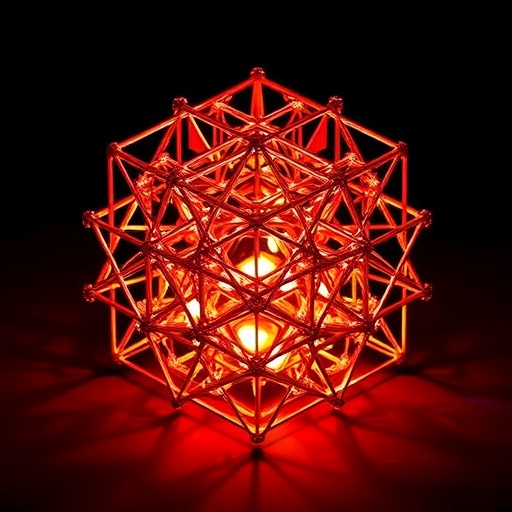
In recent years, metamaterials—artificially engineered structures composed of periodic or quasi-periodic elements at scales smaller than the wavelength of incident electromagnetic waves—have revolutionized the field of electromagnetic wave manipulation. These materials possess unusual properties not found in natural substances, enabling groundbreaking applications ranging from cloaking devices to superlenses. However, traditional metamaterials often remain static and lack adaptability to real-time environmental changes, limiting their utility in dynamic and multifunctional systems. Addressing this critical shortfall, a pioneering research team led by Professor Wang has introduced an innovative class of mechanically reconfigurable metamaterials, known as Magic Cube Metamaterials (MCMs), that leverage three-dimensional geometric architectures to achieve unparalleled tunability and functionality.
The cornerstone of this breakthrough lies in the integration of a 3D magic cube configuration—a volumetric, permutation-based spatial structure—with metamaterial elements bonded to its sub-blocks. This arrangement exploits the cube’s inherent symmetrical and modular properties, enabling independent control over the position and orientation of metamaterial particles embedded on each sub-block. This spatial permutation mechanism, markedly different from conventional planar or two-dimensional mechanical tuning schemes, dramatically expands the degrees of freedom by which electromagnetic responses can be modulated. As a result, MCMs exhibit multidimensional reconfigurability, enabling precise and dynamic control of wavefront properties, polarization sensitivity, and phase responses.
Unlike prior mechanical tuning systems which often suffer from limited reconfigurability and low information capacity, MCMs can independently tune reflective phase responses across six distinct levels through three-dimensional permutations of the meta-particles. This capability allows for complex electromagnetic wave manipulations including but not limited to the realization of reconfigurable achromatic metalenses and multifunctional beam generators that operate efficiently across multiple frequency bands. The modular magic cube supercell design forms a plinth array arranged in a square lattice, facilitating the creation of large-scale metamaterial surfaces with customizable electromagnetic properties adaptable to diverse applications.
The researchers underscore that mechanical tunability, while typically less responsive than electrical modulation in terms of speed and sensitivity, boasts significant advantages in industrial scalability and resilience to harsh operational conditions. These benefits stem from the simplicity of the mechanical design and the inherent load-bearing capacity of the cubic architecture. Moreover, the full polarization incident electromagnetic waves can be dynamically manipulated by physically reorienting the MCM structure, offering a dimension of control that electrical tuning methods rarely achieve.
To validate the practical functionality of MCMs, the team developed two proof-of-concept prototypes that demonstrate the remarkable versatility and adaptability of this new metamaterial design. The first prototype is a reconfigurable achromatic metalens capable of focusing electromagnetic waves without chromatic aberrations across a wide frequency range. This advancement holds profound implications for imaging systems, telecommunications, and sensing technologies where aberration-free performance is essential. The second prototype functions as a tunable multifunctional beam generator, capable of switching between distinct beam patterns and manipulation modes on demand. This switchability introduces a new paradigm in beam steering and shaping that can dynamically adapt to changing environmental or operational requirements.
From a theoretical perspective, the researchers harnessed principles from geometric transformation mathematics to decode and design the permutations within the magic cube structure, aligning these transformations with physically realizable electromagnetic functionalities. This mathematical framework enables precise anticipation of electromagnetic responses resulting from specific geometric rearrangements, effectively bridging the gap between abstract mathematical constructs and tangible physical implementations.
Furthermore, the MCM design facilitates real-time visual mapping of the permutation states owing to the transparent substrate materials used in the meta-particle construction. This optical transparency opens avenues for direct feedback and monitoring during operation, addressing a critical challenge in existing mechanical metamaterial technologies where feedback mechanisms are often inadequate or absent. The ability to visually track permutation states enhances the interactivity and control fidelity of the system, augmenting its applicability in human-machine interface environments and adaptive electromagnetic interference mitigation.
The collective ingenuity of the magic cube architecture also significantly surpasses classical origami or kirigami-based frameworks that have been previously employed for mechanical metamaterials. By exploiting the three-dimensional volumetric permutations of the magic cube, the information capacity and configurational freedom are raised to unprecedented levels, ushering in a new design paradigm for programmable metamaterials. This evolution from traditional two-dimensional folding schemes to volumetric permutations represents a quantum leap in achievable metamaterial performance and adaptability.
Looking toward future prospects, the research team envisions an integrated development path in which MCM technology transitions from laboratory demonstrations to widespread real-world applications through three strategic pillars: mechatronic hybridization, intelligent system integration, and spectrum compatibility. The fusion of mechanical actuation with electronic control systems aims to enable more sophisticated, automated, and responsive metamaterial platforms. Coupling these with advanced data processing and machine learning algorithms promises intelligent metamaterials capable of self-adaptation and real-time optimization. Additionally, broadening spectral compatibility ensures that MCMs can operate effectively across multiple electromagnetic domains, including microwave, terahertz, and optical frequencies.
The broader impact of this research extends well beyond the immediate technical achievements. Dynamically reconfigurable metamaterials with robust, scalable mechanical control mechanisms open transformative possibilities in telecommunications infrastructure, adaptive optics, novel sensor arrays, and electromagnetic compatibility devices. The capacity for rapid, on-demand reconfiguration aligns with the ever-increasing complexity and variability of modern electromagnetic environments, offering solutions that are both versatile and resilient.
In summary, the introduction of Magic Cube Metamaterials marks a significant milestone in metamaterial science and engineering. By ingeniously combining three-dimensional magic cube geometries with sophisticated metamaterial design, Professor Wang’s team has unlocked a new realm of dynamic electromagnetic control. This work not only challenges the boundaries of what is achievable through mechanical tunability but also charts a vibrant trajectory toward multifunctional, scalable, and intelligent metamaterial devices capable of revolutionizing technology across an array of sectors. This leap forward underscores the transformative potential of geometry-powered metamaterial architectures in shaping the future of electromagnetic wave manipulation.
News Publication Date: Not specified.
Web References:
http://dx.doi.org/10.1016/j.scib.2025.07.010
Keywords
Physical sciences, Physics, Materials science, Applied sciences and engineering, Information science, Metamaterials
Cite Scienmag News
Neil Sanderson. (October 23, 2025). When Metamaterials Embrace Magic Cubes: Geometric Elegance “Constructs” Electromagnetic Wonders. Scienmag. https://scienmag.com/when-metamaterials-embrace-magic-cubes-geometric-elegance-constructs-electromagnetic-wonders/
Neil Sanderson. "When Metamaterials Embrace Magic Cubes: Geometric Elegance “Constructs” Electromagnetic Wonders." Scienmag, 23 October 2025, https://scienmag.com/when-metamaterials-embrace-magic-cubes-geometric-elegance-constructs-electromagnetic-wonders/. Accessed 4 September 2026.
Neil Sanderson. "When Metamaterials Embrace Magic Cubes: Geometric Elegance “Constructs” Electromagnetic Wonders." Scienmag. October 23, 2025. https://scienmag.com/when-metamaterials-embrace-magic-cubes-geometric-elegance-constructs-electromagnetic-wonders/


