


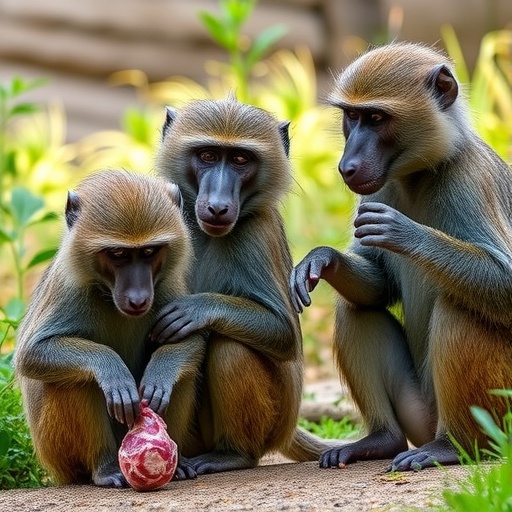
In a remarkable convergence of primatology and social anthropology, scientists from the German Primate Center (DPZ) in Göttingen have unveiled fascinating insights into the complex social dynamics of Guinea baboons (Papio papio) through an extensive nine-year observational study. This research delves deeply into how these primates transfer meat—a valuable but scarce resource—across their uniquely structured societies, mirroring patterns observed in human hunter-gatherer communities. This discovery propels new understanding about the evolutionary underpinnings of resource sharing and social organization beyond our species.
Guinea baboons showcase an intricate, multi-level social system that has captivated primatologists striving to comprehend the evolutionary intricacies of cooperative behavior. Fundamentally, these societies are arranged hierarchically in three nested tiers: at the base lie “units,” each typically comprising one male, multiple females, and their offspring. Multiple units coalesce to form “parties,” cemented together by long-lasting male bonds often rooted in kinship. These parties further aggregate into “gangs,” which represent the highest collective level. This social architecture provides a remarkable natural laboratory to explore how resource flow is modulated by social closeness and status within such stratified groups.
The transfer of meat among these primates—captured by 109 documented meat-eating events supplemented by an exhaustive repository of behavioral data—underscores the nuanced role of social relations in resource distribution. The researchers’ rigorous analyses reveal that proximity in social bonds significantly increases the likelihood and peacefulness of meat transfers. Unlike active sharing behaviors that might involve deliberate offering, Guinea baboons demonstrate “passive” meat sharing; an individual abandons the carcass after feeding, facilitating its acquisition by socially close associates. In stark contrast, individuals with weaker social ties resort more frequently to theft, indicating competitive dynamics at the margins of social networks.
The parallels drawn between Guinea baboons and human hunter-gatherer societies are striking and groundbreaking. In our ancestors’ societies, meat’s rarity and nutritional richness propelled sophisticated sharing networks to mitigate hunting’s unpredictable returns. Humans distributed meat preferentially within familial groups before extending sharing to wider camp communities, regulated by a complex web of cultural norms and social expectations. This latest primate research corroborates that such tiered distribution strategies may not be uniquely human but could arise from parallel social pressures and benefits embedded within multi-level social frameworks.
At the core of this scientific expedition lies an assertion that social relationship strength—the tapestry of bonds weaving individuals together—directly governs access to coveted resources. Statistical models combining field observations quantified relationship strength, revealing a significant predictive power regarding who obtains meat. This intricately linked social-resource matrix implies that the evolution of cooperation and tolerance may stem substantially from the advantages conferred by structured social affiliations, reinforcing the continuity between cognitive, ecological, and social evolution.
Intriguingly, the study clarifies that Guinea baboons do not engage in proactive sharing strategies resembling deliberate gift-giving. Instead, their form of resource transfer is characterized by social tolerance—individuals refrain from reclaiming meat zealously, permitting close affiliates to capitalize opportunistically. This subtle yet powerful behavioral mechanism indicates that tolerance, rather than active prosociality, may scaffold early evolutionary stages of cooperative meat transfer and sharing, shedding light on foundational habits that could have preceded more complex human cultural behaviors.
Observations at the field station in Simenti, Senegal, solidified these conclusions. Researchers recorded a total of 320 meat transfer incidents predominantly involving males passing meat to females within their unit or to males within the same party. Transfers within units were marked by a striking absence of conflict, underscoring tolerant sharing’s primacy at the society’s base. Beyond unit boundaries, at the party and gang levels, meat transfers became progressively less frequent and fraught with competitive interactions. This gradient speaks to the escalating exclusivity of resource control coinciding with social distance, a dynamic reminiscent of human social hierarchies.
William J. O’Hearn, the study’s lead author, highlights that the findings resonate deeply with hunter-gatherer meat distribution norms, where kinship and social proximity determine early access before resources disseminate more widely. This comparative perspective bridges primate ethology and anthropology, suggesting convergent evolutionary pressures have shaped resource economies across species through similar social architectures.
A broader perspective emerges when considering Julia Fischer’s reflections on the findings. As head of the Cognitive Ethology Laboratory at DPZ, Fischer emphasizes that such multi-level social organizations can produce analogous outcomes in resource exchange across different species. This implies that nest-like social complexity with layered affiliations may be a recurrent evolutionary solution to optimizing resource sharing, arising independently in varied taxa yet culminating in functionally similar behaviors.
Methodologically, the study leveraged a combination of fine-grained behavioral observations and advanced statistical analyses to decode social relationship metrics and correlate them with meat transfer probabilities. This innovative approach represents a significant advance in behavioral ecology, enabling researchers to quantify social structures’ subtle influences on cooperation dynamics within naturalistic settings. As such, this research offers a nuanced blueprint for future inquiries into social evolution linking behavior, ecology, and social network theory.
This research spotlights the importance of social tolerance as an evolutionary precursor to cooperative resource sharing. The pattern observed in Guinea baboons—where meat is passed passively along a spectrum of social ties rather than actively presented—challenges traditional assumptions that cooperation requires active generosity. Instead, it points to tolerance and non-interference as crucial mechanisms that facilitate food sharing within complex societies long before more overt prosocial behaviors evolved.
In conclusion, the study of Guinea baboons’ multi-level social organization and meat sharing behavior not only enriches our understanding of primate social ecology but also provides a compelling window into the evolutionary processes that forged human cooperation. By revealing how social relationship strength orchestrates resource flow in a non-human primate, the research underscores deep biological continuities and offers fresh perspectives on the origins of human sociality, cooperation, and culture.
Web References:
https://dx.doi.org/10.1016/j.isci.2025.113619
Cite Scienmag News
Courtney Benton. (October 23, 2025). Guinea Baboons Follow Established Social Rules to Share Meat, Study Finds. Scienmag. https://scienmag.com/guinea-baboons-follow-established-social-rules-to-share-meat-study-finds/
Courtney Benton. "Guinea Baboons Follow Established Social Rules to Share Meat, Study Finds." Scienmag, 23 October 2025, https://scienmag.com/guinea-baboons-follow-established-social-rules-to-share-meat-study-finds/. Accessed 4 September 2026.
Courtney Benton. "Guinea Baboons Follow Established Social Rules to Share Meat, Study Finds." Scienmag. October 23, 2025. https://scienmag.com/guinea-baboons-follow-established-social-rules-to-share-meat-study-finds/


