


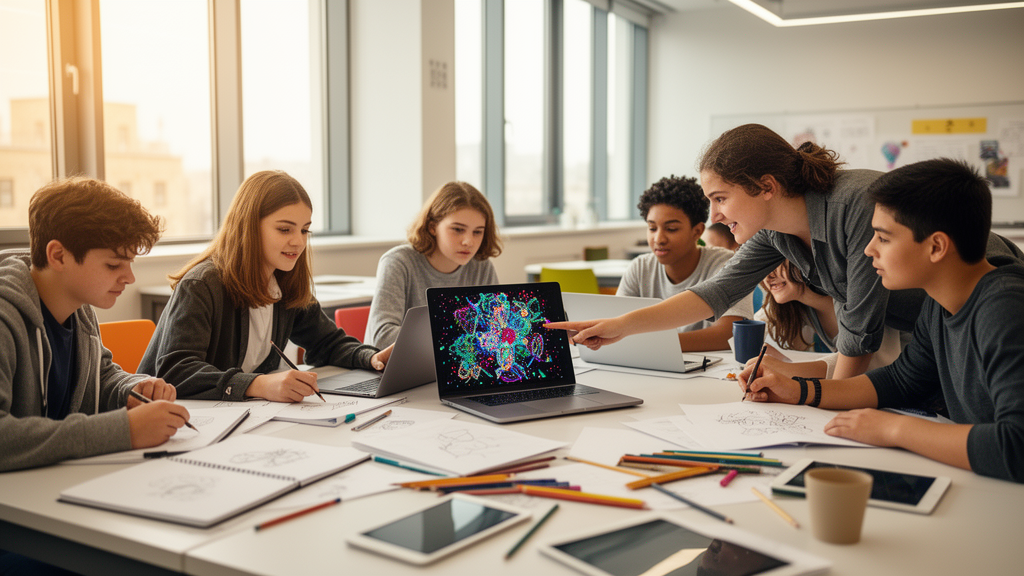
High school students from historically underserved communities can learn to work with generative artificial intelligence as a genuine creative collaborator rather than a shortcut machine, according to a new mixed-methods study published in Discover Education. In the study, a research team led by Jung Won Hur of Auburn University, working with colleagues at Tuskegee University, followed African American high school students through a four-month project in which they designed AI-enhanced mobile applications while using generative AI as a design partner. The work addresses a conspicuous gap in the literature: although most teenagers now encounter AI-driven systems daily, empirical research on how secondary students actually apply AI concepts in authentic, hands-on projects remains scarce, particularly for students with limited access to advanced computing education.
The program unfolded in two phases at a computer science outreach initiative hosted at a Historically Black College and University in the southeastern United States. During a three-and-a-half-week Summer Academy, students received twelve hours of foundational AI instruction layered onto broader computer science training that included block-based programming in MIT App Inventor. The lessons were built around Ng and colleagues’ four-part AI literacy framework, which moves learners from knowing and understanding AI, through using and applying it, to evaluating and creating AI-supported solutions, all while embedding ethical reasoning. Students distinguished AI from non-AI systems, explored supervised versus unsupervised machine learning, compared outputs from ChatGPT, Gemini, and Perplexity, practiced prompt refinement, and generated images with Adobe Express while discussing algorithmic bias, hallucinations, deepfakes, and the environmental footprint of large AI systems.
In the fall phase, fifteen students who completed the full experience worked in small groups for four months to design mobile apps addressing problems relevant to their peers or local communities. Each team was required to propose AI-enabled features that extended app functionality, and they were explicitly encouraged to engage with a generative AI tool of their choice as a collaborative partner throughout ideation, research, wireframing, prototyping, and coding. The project culminated in a face-to-face app competition before a panel of judges, in which students had to justify the AI components of their designs and explain how those components would function for real users.
The design artifacts and presentations revealed that participants had internalized emerging AI concepts in practical form. Across the teams, students proposed recommendation systems, chatbots, content generation tools, personalized tutoring systems, and information verification tools aligned with authentic user needs. One team, Trash to Treasure, designed an app promoting the recycling and repurposing of old compact discs, with AI features that generated personalized upcycling ideas and offered chatbot guidance on recycling decisions. Another, EduQuest, built a recommendation system that analyzed survey responses to suggest universities, housing, and employment opportunities to applicants navigating the college process. A team called Artik tackled misinformation in online artistic communities with proposed fact-checking tools, while Inspiring Bright Mind envisioned an educational app providing age-appropriate AI tutoring and custom instructional materials for teachers.
Interview data showed that students treated AI outputs as raw material for judgment rather than finished products. One tenth-grade participant described her team’s process of generating app name candidates with AI and then reshaping them until something original emerged. Another ninth grader explained how she prompted the system to analyze what users loved and hated about Pinterest, then used that synthesized feedback to guide her team’s design decisions. Students also reported using generative AI to create logos, produce visual assets, and obtain programming advice, consistently describing a cycle of evaluation, modification, and improvement rather than simple acceptance of machine output. The researchers interpret this pattern as evidence of collaborative human-AI interaction, in which the AI contributes ideas while students retain responsibility for evaluation and decision-making.
The quantitative picture was more complicated. On a twenty-item knowledge assessment adapted from the validated AI Literacy Concept Inventory, average scores rose only modestly, from 13.14 before the program to 14.10 afterward, a difference that was not statistically significant. Individual trajectories varied widely: roughly 57 percent of students improved, about 20 percent declined, and the rest showed little or no change. Some students articulated striking conceptual growth, with one participant reporting that she had previously thought AI was just Siri and ChatGPT and now understood everything from personalized advertisements to machine vision that identifies weeds in fields. Others, including one student whose scores fell, could not articulate core ideas such as algorithmic bias when surveyed afterward. The discrepancy suggests, the authors argue, that students’ learning showed up more strongly in their applied design practices than in multiple-choice test performance, underscoring the limits of traditional knowledge measures for assessing AI literacy in diverse learners.
Perceptual measures were similarly nuanced. Composite self-efficacy, intrinsic motivation, and career interest scores shifted only slightly and without statistical significance, although students reported strong perceived gains in professional skills on a follow-up survey, with mean scores above 4.45 on a five-point scale. Collaboration skills drew the highest ratings, including working effectively with others and communicating ideas, consistent with a substantial body of research showing that sustained project-based design work cultivates transferable workplace competencies. The researchers note these are self-reports rather than objective behavioral measures, but the pattern suggests that AI-integrated app design may build both AI-specific competencies and broader professional skills simultaneously.
Perhaps the most revealing findings concerned the instructional challenges that surfaced. Students arrived with widely varying technological readiness; some struggled with basic file management and data uploads, and several admitted they relied almost entirely on smartphones, leaving them inexperienced with the sustained keyboard-based text input that generative AI tools demand. Attitudes toward AI split dramatically. On one end, a team fabricated a needs assessment report with AI instead of collecting genuine data, a misuse they acknowledged and corrected after the fact. On the other end, some students avoided AI entirely for fear of academic punishment. One tenth grader explained that her school monitored iPad use and forbade AI, so she refused to touch it, then reversed course after trying ChatGPT during the program, only to abandon it again when a teammate’s writing was flagged as machine-generated. The study also found that competing software development demands crowded out deeper AI engagement, and that the sheer breadth of AI content compressed into limited instructional hours left some students struggling to consolidate their understanding.
The authors draw three principal implications for educators. First, generative AI should be positioned as a collaborative partner in project-based learning rather than merely a task-completion tool, giving students structured opportunities to ideate, refine, and solve problems alongside AI systems they must learn to evaluate critically. Second, instruction must be differentiated and scaffolded, prioritizing foundational digital skills such as keyboarding alongside tiered AI challenges matched to students’ prior knowledge, a need that is especially acute for students from communities historically excluded from computing education. Third, short bursts of exposure are insufficient; meaningful AI literacy requires sustained, curriculum-embedded time for iterative practice, reflection, and ethical engagement. The study also raises a subtler tension for the field: curiosity about new AI technologies actually declined slightly among participants, possibly because lessons on bias, environmental costs, and hallucinations replaced early enthusiasm with a more critical, realistic view. The researchers caution that their small, single-site sample, participant attrition from 36 initial participants to 15 completers, a middle-school-oriented assessment instrument, and the lead author’s dual role as instructor and researcher all limit generalizability. Future work, they argue, should develop performance-based and design-oriented assessments, explore longer curriculum-integrated programs, and examine how school policies shape whether students learn not just how to use AI, but when and why its use is appropriate.
Subject of Research: AI literacy development among high school students through generative AI-supported project-based mobile app design
Article Title: Cultivating AI literacy among high school students through generative AI as a collaborative partner
Article References: Hur, J. W., Bhuyan, J., Wu, F., Thomas, C., & Koong, K. (2026). Cultivating AI literacy among high school students through generative AI as a collaborative partner. Discover Education, 5(1), Article 805. https://doi.org/10.1007/s44217-026-02092-7
Image Credits: AI Generated
DOI: 10.1007/s44217-026-02092-7
Keywords: AI literacy, generative AI, high school students, project-based learning, mobile app design, African American students, underserved communities, human-AI collaboration, instructional scaffolding, AI ethics, Discover Education, K-12 education
Cite Scienmag News
Courtney Benton. (October 19, 2026). When AI Becomes a Teammate: Teens Learn to Design With, Not Just Use, Generative AI. Scienmag. https://scienmag.com/when-ai-becomes-a-teammate-teens-learn-to-design-with-not-just-use-generative-ai/
Courtney Benton. "When AI Becomes a Teammate: Teens Learn to Design With, Not Just Use, Generative AI." Scienmag, 19 October 2026, https://scienmag.com/when-ai-becomes-a-teammate-teens-learn-to-design-with-not-just-use-generative-ai/. Accessed 19 October 2026.
Courtney Benton. "When AI Becomes a Teammate: Teens Learn to Design With, Not Just Use, Generative AI." Scienmag. October 19, 2026. https://scienmag.com/when-ai-becomes-a-teammate-teens-learn-to-design-with-not-just-use-generative-ai/


