


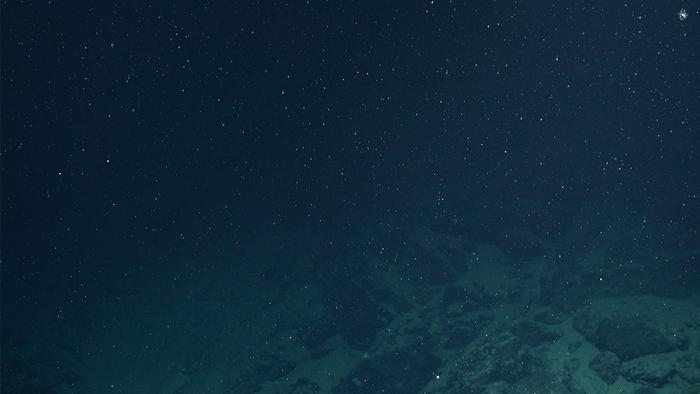
The seafloor is the final destination for all sorts of particles, like sand, mud, organic carbon that provides food for seafloor organisms, and even pollutants. Accumulations of these particles in the deep sea are used to reconstruct past climates, natural hazards and ocean conditions; providing valuable archives of past change that extend far beyond historical records. The lead scientist on the project, Dr Mike Clare of National Oceanography Centre (NOC) explains: “It is important to understand the behavior and pathways of currents that operate in the deep sea, in order to determine pathways of natural and human-made particles and make sense of those records preserved in deposits.”

Credit: MARUM – Center for Marine Environmental Sciences, University of Bremen
The seafloor is the final destination for all sorts of particles, like sand, mud, organic carbon that provides food for seafloor organisms, and even pollutants. Accumulations of these particles in the deep sea are used to reconstruct past climates, natural hazards and ocean conditions; providing valuable archives of past change that extend far beyond historical records. The lead scientist on the project, Dr Mike Clare of National Oceanography Centre (NOC) explains: “It is important to understand the behavior and pathways of currents that operate in the deep sea, in order to determine pathways of natural and human-made particles and make sense of those records preserved in deposits.”
He adds: “However, there have been very few direct measurements made of currents that flow across the seafloor in deep waters. Most are made high above the seafloor, over short timescales, and only at individual locations. Until now we have not understood how dynamic seafloor currents can be in the deep sea.”
A new study that involved researchers from the UK, Canada, Germany and Italy analyzed data from the most extensive array of sensors yet deployed in the deep sea to determine the variability in seafloor currents over four years. Thirty-four deep sea moorings were deployed in up to 2.5 km water depths, equipped with high-frequency Acoustic Doppler Current Profilers – like an underwater speed camera to measure seafloor currents. Previous models suggested that these currents would be continuous and steady, but the new results provided big surprises. Currents sped up and slowed down, sometimes reversed direction completely, and were steered in different directions locally by the irregular seafloor relief.
“These are the first measurements of deep-sea currents across such a large area, long duration and so close to the seafloor. This makes them extremely valuable as they will help improve our models for reconstructing past changes related to climate change in the ocean” said Professor Elda Miramontes of MARUM – Center for Marine Environmental Sciences and Faculty of Geosciences at the University of Bremen, co-author of the study.
The study’s lead author, Dr Lewis Bailey (formerly of NOC and now at University of Calgary) said “The ocean bottom currents offshore Mozambique are far more variable than we expected. Just like currents in the upper ocean, their intensity changes between seasons and can even flip backwards and forwards over the course of several hours”.
Dr Ian Kane of University of Manchester, and a co-author of the study commented “Seeing how these currents behave is a bit like observing the weather in Manchester – always changing and often surprising. But observing change in the deep sea is really challenging and, until now, we have had a poor understanding of what background conditions are like in the deep-sea.”
The lead scientist on the project, Dr Mike Clare of NOC, added: “The deep sea can be extremely dynamic and this study underlines the importance of sustained observations, which provide critical information on understanding the ocean. More detailed observations are critical for understanding the important role bottom currents play in transporting sediment, carbon and pollutants across our planet”.
Journal
Nature Geoscience
Article Title
Highly variable deep-sea currents over tidal and seasonal timescales.
Article Publication Date
25-Jul-2024
Cite Scienmag News
Sloane Callahan. (July 31, 2024). What’s the weather like in the deep sea? Scienmag. https://scienmag.com/whats-the-weather-like-in-the-deep-sea/
Sloane Callahan. "What’s the weather like in the deep sea?" Scienmag, 31 July 2024, https://scienmag.com/whats-the-weather-like-in-the-deep-sea/. Accessed 11 September 2026.
Sloane Callahan. "What’s the weather like in the deep sea?" Scienmag. July 31, 2024. https://scienmag.com/whats-the-weather-like-in-the-deep-sea/

