


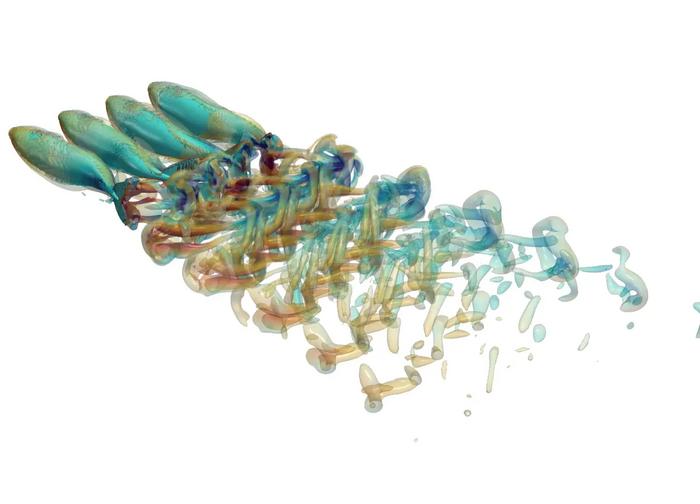
Swimming in schools makes fish surprisingly stealthy underwater, with a group able to sound like a single fish.

Credit: Johns Hopkins University
Swimming in schools makes fish surprisingly stealthy underwater, with a group able to sound like a single fish.
The new findings by Johns Hopkins University engineers working with a high-tech simulation of schooling mackerel, offers new insight into why fish swim in schools and promise for the design and operation of much quieter submarines and autonomous undersea vehicles.
“It’s widely known that swimming in groups provides fish with added protection from predators, but we questioned whether it also contributes to reducing their noise,” said senior author Rajat Mittal. “Our results suggest that the substantial decrease in their acoustic signature when swimming in groups, compared to solo swimming, may indeed be another factor driving the formation of fish schools.”
The work is newly published in Bioinspiration & Biomimetics.
The team created a 3D model based on the common mackerel to simulate different numbers of fish swimming, changing up their formations, how close they swam to one another, and the degrees to which their movements synched. The model, which applies to many fish species, simulates one to nine mackerel being propelled forward by their tail fins.
The team found that a school of fish moving together in just the right way was stunningly effective at noise reduction: A school of seven fish sounded like a single fish.
“A predator, such as a shark, may perceive it as hearing a lone fish instead of a group,” Mittal said. “This could have significant implications for prey fish.”
The single biggest key to sound reduction, the team found, was the synchronization of the school’s tail flapping—or actually the lack thereof.
If fish moved in unison, flapping their tail fins at the same time, the sound added up and there was no reduction in total sound. But if they alternated tail flaps, the fish canceled out each other’s sound, the researchers found.
“Sound is a wave,” Mittal said. “Two waves can either add up if they are exactly in phase or they can cancel each other if they are exactly out of phase. That’s kind of what’s happening here though we’re talking about faint sounds that would barely be audible to a human.”
The tail fin movements that reduce sound also generate flow interaction between the fish that allow the fish to swim faster while using less energy, said lead author Ji Zhou, a Johns Hopkins graduate student studying mechanical engineering.
“We find that reduction in flow-generated noise does not have to come at the expense of performance,” Zhou said. “We found cases where significant reductions in noise are accompanied by noticeable increases in per capita thrust, due to the hydrodynamic interactions between the swimmers.”
The team was surprised to find that the sound reduction benefits kick in as soon as one swimming fish joins another. Noise reduction grows as more fish join a school, but the team expects the benefits to cap off at some point.
“Simply being together and swimming in any manner contributes to reducing the sound signature,” Mittal said. “No coordination between the fish is required.”
Next the team plans to add ocean turbulence into the models and create simulations that allow the fish to swim more “freely.”
Journal
Bioinspiration & Biomimetics
Cite Scienmag News
Violet Maxwell. (April 9, 2024). What’s quieter than a fish? A school of them. Scienmag. https://scienmag.com/whats-quieter-than-a-fish-a-school-of-them/
Violet Maxwell. "What’s quieter than a fish? A school of them." Scienmag, 9 April 2024, https://scienmag.com/whats-quieter-than-a-fish-a-school-of-them/. Accessed 4 September 2026.
Violet Maxwell. "What’s quieter than a fish? A school of them." Scienmag. April 9, 2024. https://scienmag.com/whats-quieter-than-a-fish-a-school-of-them/

