

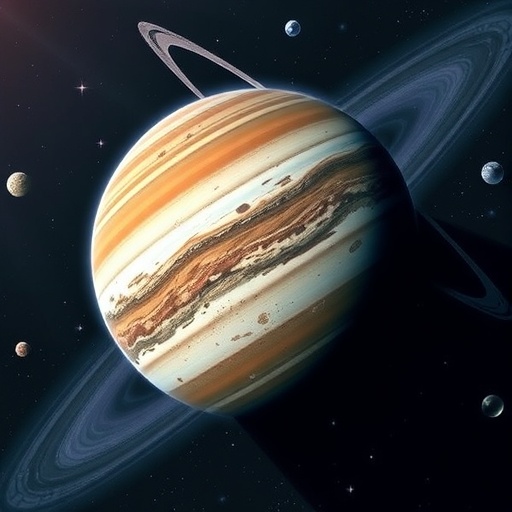
In a groundbreaking study, astronomers have made significant strides in understanding the formation of gas giant planets, specifically within the context of the HR 8799 star system. This research, spearheaded by a team from the University of California San Diego, leverages the impressive capabilities of the James Webb Space Telescope (JWST) to explore the atmospheres of multiple gas giants orbiting a star that is approximately 133 light years away, situated in the constellation Pegasus. Through spectroscopic data, the researchers have unveiled evidence supporting the theory of core accretion as a key mechanism in the formation of these massive celestial bodies.
Gas giants are characterized by their substantial compositions, primarily consisting of helium and hydrogen. Unlike terrestrial planets, they lack solid surfaces and possess dense cores. In our own solar system, Jupiter and Saturn serve as examples of these behemoth planets, but the existence of similar, even larger gas giants has been detected beyond our solar boundaries. Some of these exoplanets are so massive that they challenge the conventional definitions of what constitutes a planet, blurring the distinction between planets and brown dwarfs — substellar objects that are often regarded as “failed stars” due to their inability to initiate hydrogen fusion.
The quest to unravel the formation processes of gas giant planets has long intrigued astronomers. The prevailing theories posit two primary mechanisms: core accretion, where rocky and icy solids coalesce to form larger, solid cores that subsequently attract surrounding gas; and gravitational instability, which involves the rapid collapse of gas surrounding a young star into massive objects. The researchers aimed to determine which of these processes was at play in the HR 8799 system.
The HR 8799 star system consists of four known gas giant planets, all significantly more massive than Jupiter, with each planet orbiting at considerable distances from their parent star. The outer planets’ masses range from five to ten times that of Jupiter, situated at distances ranging from 15 to 70 astronomical units (AU). This configuration raises critical questions regarding the traditional models of planetary formation since earlier predictions suggested that gas giants could not attain such large masses before the young star expelled the primordial gas and dust surrounding it.
Utilizing the advanced spectroscopic capabilities of JWST, the researchers shifted their focus from traditional volatile molecules, which often proved to be inadequate as formation indicators, to refractories, more stable elements like sulfur that exist only in solid form within protoplanetary disks. The detection of sulfur within the atmospheres of these exoplanets provided compelling evidence supporting the core accretion model. Jean-Baptiste Ruffio, a prominent figure in this research effort, highlighted the role of JWST in enabling these groundbreaking observations, stating that “JWST’s unprecedented sensitivity is allowing us to deeply analyze the atmospheres of these planets.”
Noteworthy is HR 8799’s youth, at just 30 million years old—much younger than our solar system, which is approximately 4.6 billion years old. This youthfulness contributes to the brightness of the planetary bodies, making them easier targets for detailed spectroscopic analysis. JWST features the most advanced spectrograph in space, allowing astronomers to observe the light spectra emitted by exoplanets without interference from Earth’s atmospheric molecules. This capability paves the way for fine observations that had previously been unattainable.
Despite the promising technological advancements, the study was not without difficulties. The planets within the HR 8799 system are around 10,000 times fainter than their host star, posing a considerable challenge for observation. Ruffio’s team had to innovate their data analysis techniques to successfully extract meaningful signals from the weak spectral data. Collaborating with Jerry Xuan, who developed intricate atmospheric models to analyze the JWST spectra, the team was able to confirm the presence of sulfur and other molecules in the atmospheres of the gas giants.
The revelations led to a deeper understanding of the formation conditions of these massive planets. Evidence of sulfur—notably detected in the atmosphere of HR 8799 c—suggests that each planet in the system likely formed similarly to Jupiter, defying prior expectations that larger masses would necessitate different formation processes. The findings also indicated these gas giants are more enriched in heavy elements such as carbon and oxygen compared to their parent star, further solidifying the case that they formed as distinct planets rather than through alternative means.
This study raises fascinating questions for the astronomical community. As Ruffio points out, HR 8799 stands out due to its unique composition, hosting four sizable gas giants—an anomaly in itself but prompting curiosity for further investigation. The research opens a dialogue regarding the limits of planetary formation. How massive can planets become while still forming in the traditional sense? Can celestial bodies achieve masses up to 30 times that of Jupiter while adhering to the same formation principles? These questions continue to fuel the scientific exploration of planetary formation.
As this research marks a significant contribution to the understanding of gas giants, it also paves the way for future studies that may further alter our perceptions of planetary formation. The team aspires to uncover more about different systems, one at a time, delving deeper into the cosmos to understand the intricate dance of stellar formation and evolution.
The implications of these findings extend beyond mere curiosity. They challenge existing models of planetary formation and invite the astronomer community to reconsider and refine its underlying theories. The study of the HR 8799 star system highlights the profound capabilities of modern observational technologies, such as the JWST, in unlocking the mysteries of the universe.
In summary, as researchers continue to probe the vast reaches of space, they unravel complex interactions and processes that govern the birth of gas giants, reshaping our understanding of how planetary systems, like our own, come to be. The unfolding story of HR 8799 not only illuminates the processes that shape our universe but also solidifies the remarkable journey of scientific exploration that propels humanity’s quest for knowledge.
Subject of Research: Formation of gas giant planets in the HR 8799 star system
Article Title: Jupiter-like uniform metal enrichment in a system of multiple giant exoplanets
News Publication Date: 9-Feb-2026
Web References: Nature Astronomy
References: None
Image Credits: Jean-Baptiste Ruffio
Keywords
Gas giants, planetary formation, core accretion, gravitational instability, HR 8799, James Webb Space Telescope, spectroscopy, exoplanets.


