


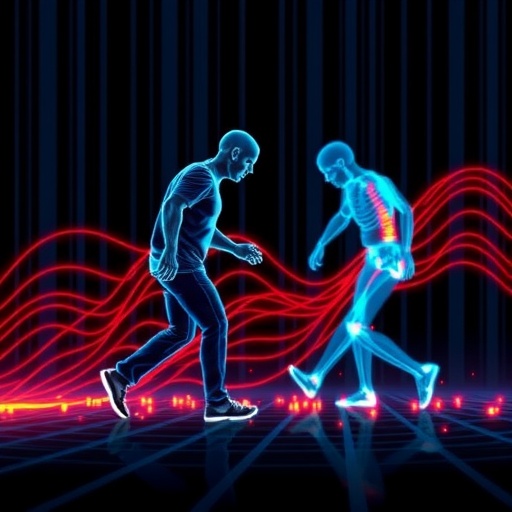
In a groundbreaking advancement at the intersection of neurology and artificial intelligence, researchers have unveiled a machine learning-based methodology to classify individuals with Parkinson’s disease who are at heightened risk of falling. Published recently in npj Parkinson’s Disease, this study spearheaded by Kim, M., Kim, S., Chung, M., et al., presents a technically sophisticated approach that merges clinical data with computational analysis, signaling a pivotal moment in personalized care for Parkinson’s patients.
Falls are a significant concern for Parkinson’s disease (PD) patients, often leading to serious injuries, decreased mobility, and a marked decline in quality of life. Despite extensive clinical attention, predicting which patients are predisposed to fall has remained a complex challenge due to the multifaceted nature of motor symptoms and their fluctuations. This new research leverages machine learning algorithms to discern subtle patterns within clinical and biomechanical datasets, offering a predictive capacity that has long eluded traditional clinical assessments.
At the core of this study is an innovative feature analysis framework rooted in advanced machine learning techniques. The researchers compiled a comprehensive dataset encompassing gait metrics, balance parameters, and other kinematic variables extracted from motion sensors placed on participants. These sensors capture intricate biomechanical signals that reflect nuanced motor control deficits characteristic of Parkinsonian pathology. The dataset was then subjected to rigorous computational scrutiny using supervised learning models, enabling the classification of fallers versus non-fallers with remarkable accuracy.
What distinguishes this study from prior efforts is the meticulous feature selection process that underscores the model’s interpretability and robustness. Rather than relying solely on “black box” models, the researchers incorporated feature importance ranking, enabling clinicians and scientists to understand which physiological markers were most predictive of fall risk. Features such as stride variability, postural sway, and bradykinesia-related parameters emerged as critical indicators, providing actionable insights into the mechanistic underpinnings of falls in PD patients.
The technical sophistication of the machine learning pipeline also involved cross-validation and testing on independent cohorts to ensure the generalizability of the model across diverse patient populations. This approach addresses a common pitfall in biomedical AI, where models often fail to replicate performance outside their training datasets. By demonstrating robust predictive accuracy in multiple cohorts, the study paves the way for scalable deployment in real-world clinical settings.
Clinically, the implications of this research are profound. Early and precise identification of fall risk allows for targeted intervention strategies — including physical therapy, assistive device allocation, and medication adjustment — that could dramatically reduce the incidence of falls. Moreover, this predictive framework offers potential integration into wearable health technology, enabling continuous remote monitoring and real-time risk assessment that would revolutionize patient management.
From a technical perspective, the integration of high-frequency sensor data and machine learning elucidates the dynamic complexities of Parkinsonian gait and balance disorders, which are difficult to capture through conventional observational methods. The study employed gradient boosting classifiers and random forest algorithms, which excel at handling heterogeneous data and nonlinear interactions, critical for interpreting the multifactorial symptoms of Parkinson’s disease.
This research also exemplifies how interdisciplinary collaboration propels medical innovations. Neurophysiologists, data scientists, and clinicians worked in concert, bridging gaps between domains to engineer solutions that are both scientifically rigorous and practically deployable. Their shared expertise facilitated not only the collection and analysis of high-dimensional data but also contextualized findings within clinical paradigms crucial for patient care.
Moreover, the study acknowledges the dynamic progression of Parkinson’s disease and the temporal variability of fall risk. Longitudinal data analysis and adaptive machine learning models are suggested as future directions, emphasizing the potential for predictive models that evolve with a patient’s condition. This longitudinal approach could capture disease progression nuances, enabling even more personalized risk stratification and intervention.
Safety and ethical considerations are integral to deploying AI in healthcare, and the authors addressed these by ensuring data privacy and patient consent adherence. They also discussed the transparency of their algorithms, advocating for explainable AI that clinicians can trust, which is vital for adoption in medical practice where accountability and interpretability underpin treatment decisions.
In addition to its clinical utility, the research contributes to the growing body of evidence endorsing AI’s role in neurology. It demonstrates that machine learning can transcend diagnostic functions and expand to predictive modeling and risk stratification, marking a paradigm shift in managing chronic neurological disorders. The ability to transform raw sensor data into meaningful clinical predictions bridges the gap from bench to bedside.
The findings could influence healthcare policy and resource allocation by enabling more efficient prioritization of patients requiring intensive fall prevention programs. This could ultimately reduce healthcare costs associated with falls, such as hospitalizations and long-term rehabilitations, underscoring the societal impact of integrating AI into neurological care pathways.
Another critical dimension is patient empowerment. By understanding their individualized fall risk, patients can actively engage in preventive strategies, mobilizing efforts from caregivers and healthcare providers alike. Enhanced communication and shared decision-making become feasible when accurate risk stratification informs personalized care plans.
In summary, the work led by Kim, M. and colleagues epitomizes the potential of machine learning to transform Parkinson’s disease management by meticulously characterizing and predicting fallers. It redefines how clinicians assess risk, moving beyond subjective evaluations toward data-driven, objective analysis. As this technology matures, it promises to deliver not only improved patient outcomes but also a blueprint for harnessing AI in other complex neurological disorders.
As Parkinson’s Disease continues to affect millions worldwide, interventions grounded in intelligent data analytics could shift the paradigm from reactive to proactive care. This pioneering study is a testament to the future of precision medicine, where digital biomarkers and machine learning collaboratively optimize patient safety and quality of life against the challenges posed by progressive neurodegeneration.
Cite Scienmag News
Cassandra Pierce. (April 12, 2026). Machine Learning Identifies Fall Risk in Parkinson’s. Scienmag. https://scienmag.com/machine-learning-identifies-fall-risk-in-parkinsons/
Cassandra Pierce. "Machine Learning Identifies Fall Risk in Parkinson’s." Scienmag, 12 April 2026, https://scienmag.com/machine-learning-identifies-fall-risk-in-parkinsons/. Accessed 5 September 2026.
Cassandra Pierce. "Machine Learning Identifies Fall Risk in Parkinson’s." Scienmag. April 12, 2026. https://scienmag.com/machine-learning-identifies-fall-risk-in-parkinsons/


