


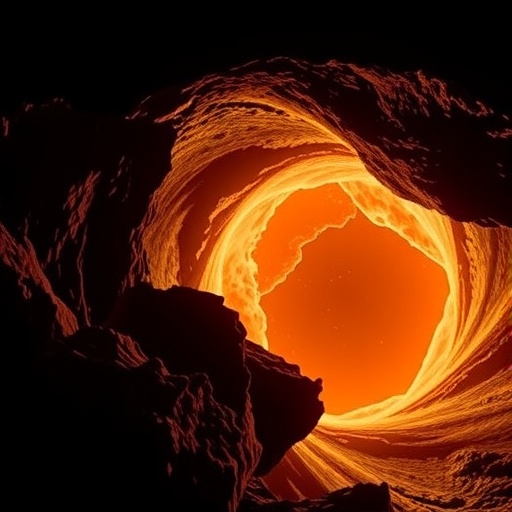
In a groundbreaking development for planetary science, researchers from the University of Trento have unearthed substantial evidence suggesting the existence of a large, empty lava tube beneath the harsh and cloud-laden surface of Venus. This discovery not only expands our understanding of volcanic processes beyond Earth but also provides a compelling insight into the geological history of our solar system’s second planet. Until now, the harsh conditions on Venus, characterized by high temperatures and thick sulfuric acid clouds, have hindered detailed observations of its surface operations, leaving many aspects of its volcanic activity shrouded in mystery.
The research team identified this potential subterranean feature through comprehensive analysis of radar imagery. Utilizing data from the Synthetic Aperture Radar (SAR) onboard NASA’s Magellan mission, the researchers meticulously examined the Nyx Mons region—a site named after the Greek goddess of night. Their findings reveal signs indicative of a volcanic cavity, providing critical validation of long-held theories regarding volcanism on Venus.
Lorenzo Bruzzone, the leader of this research initiative, emphasizes the significant implications of such a discovery for planetary science. He articulates how limited direct observations of Venus make any potential confirmations particularly critical. “The identification of a volcanic cavity is incredibly important,” states Bruzzone, “as it allows us to validate theories that have been conjectured for many years.” This pivotal finding not only enhances our comprehension of volcanic phenomena on Venus but also encourages further exploration of the planet’s complex environmental factors.
Given the challenges faced when detecting lava tubes on other celestial bodies, the implications of finding one on Venus are extraordinary. Lava tubes, which typically form when underground lava flow cools and solidifies, can remain hidden from direct view. Instead, they often reveal themselves through surface collapses that result in depressions or pits. This scenario becomes even more complicated on Venus due to its dense atmosphere and thick cloud cover that obscures traditional visual imaging techniques, necessitating reliance on radar data for geological examination.
The Magellan spacecraft, which mapped Venus’s surface between 1990 and 1992, utilized radar to penetrate the planet’s clouds and provide an unprecedented glimpse of its topography. By analyzing localized surface collapses in the Nyx Mons region using innovative imaging techniques developed in Bruzzone’s laboratory, the researchers were able to identify a sizable subsurface conduit that they interpret as a lava tube, or pyroduct, with an impressive diameter of around one kilometer and a depth of at least 375 meters. Such dimensions suggest that this subsurface structure is not only extensive but also provides fertile ground for further investigation into Venusian geology.
Factors inherent to Venus—such as its atmospheric density and lower gravitational pull—could significantly influence the formation of lava tubes. The rapid cooling of lava flows in this environment might allow for the quick establishment of a robust insulative crust. This contrasts with conditions on Earth, where surface conditions can vary greatly, impacting the cooling rates and formation of subterranean structures.
The dimensions of the identified lava tube present an intriguing contrast to those typically observed on Earth or even theorized for Mars. Bruzzone highlights that the tube’s scale might exceed expectations based on terrestrial observations, particularly noting the vast lava channels that Venus exhibits, which dwarf those found on its planetary neighbors. This correlation reinforces the hypothesis that Venus is an unparalleled model for studying volcanic and geological processes on rocky planets.
While the current research predominantly examines the tube’s accessibility at the skylight, considerations of the nearby geographic features and other similar pits provide compelling evidence that the lava conduits may extend significantly—potentially stretching over distances of at least 45 kilometers. The team acknowledges that verification of this hypothesis, along with the identification of additional lava tubes, will necessitate access to more refined radar data—something that future mission plans, such as ESA’s Envision and NASA’s upcoming Veritas, aim to address.
Both Envision and Veritas will be equipped with advanced radar systems capable of capturing higher-resolution surface images, allowing for more thorough examinations of Venus’s terrain. Envision, in particular, will include an innovative orbital ground-penetrating radar, known as the Subsurface Radar Sounder, which has the potential to probe the planet’s depths and possibly even uncover additional lava tubes without the dependency on visible surface openings.
This discovery not only signifies a critical turning point in the exploration of Venus but also lays the groundwork for the future of planetary science. With continued advancements in technology and analytical techniques, researchers hope to uncover more secrets about this neighboring planet that could change our understanding of volcanic activity across the solar system. Efforts underway promise a wealth of knowledge that may redefine our perceptions of not only Venus but the geological narratives of other planets as well.
As researchers continue to delve into the enigmatic world of Venus, this newfound information holds the key to unlocking deeper understandings of planetary evolution, paving the way for a future where we can make meaningful comparisons across our solar system’s diverse planetary bodies. The findings from the University of Trento could mark the commencement of a thrilling chapter in planetary exploration, preparing us for further insights into the complexities of volcanic activity and surface conditions on Venus, and by extension, on other celestial realms.
In light of these revelations, the scientific community remains eager for future missions that will enhance our imaging capabilities and expand our knowledge horizon, offering a glimpse into the volcanic history of Venus and its potential parallels with Earth and beyond. As we stand at the precipice of new discoveries, one cannot help but feel a renewed vigor for the enduring pursuit of understanding our cosmic neighbors.
Keywords
Venus, lava tube, volcanic activity, planetary science, radar imagery, subterranean geology, Magellan mission, Nyx Mons, remote sensing, ground-penetrating radar.
Cite Scienmag News
Grant Pearson. (February 9, 2026). Discovery of Subsurface Lava Tube on Venus Provides Insights into Planet’s Geologic Activity. Scienmag. https://scienmag.com/discovery-of-subsurface-lava-tube-on-venus-provides-insights-into-planets-geologic-activity/
Grant Pearson. "Discovery of Subsurface Lava Tube on Venus Provides Insights into Planet’s Geologic Activity." Scienmag, 9 February 2026, https://scienmag.com/discovery-of-subsurface-lava-tube-on-venus-provides-insights-into-planets-geologic-activity/. Accessed 3 September 2026.
Grant Pearson. "Discovery of Subsurface Lava Tube on Venus Provides Insights into Planet’s Geologic Activity." Scienmag. February 9, 2026. https://scienmag.com/discovery-of-subsurface-lava-tube-on-venus-provides-insights-into-planets-geologic-activity/


