


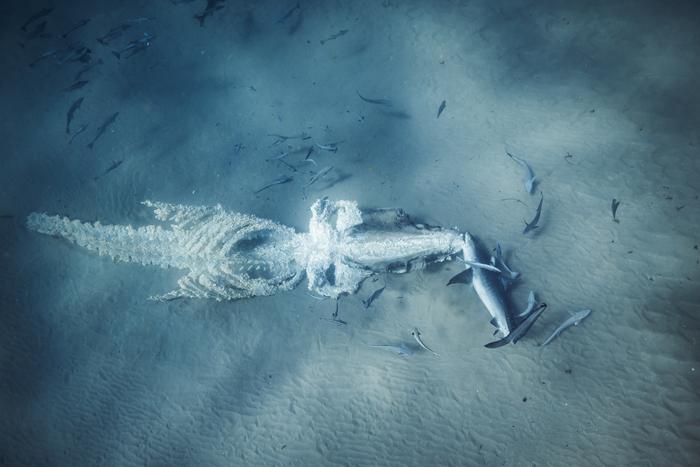
A string of whale strandings on the East Australian Coastline and questions around the appropriate disposal methods for the remains has prompted a new study that highlights a sustainable, cultural and ecosystem beneficial offshore removal or decomposition.

Credit: Laura Gourgas
A string of whale strandings on the East Australian Coastline and questions around the appropriate disposal methods for the remains has prompted a new study that highlights a sustainable, cultural and ecosystem beneficial offshore removal or decomposition.
Dr Olaf Meynecke, from Griffith University’s Whales and Climate Research Program, led the case study, in which a 14m female humpback whale was found floating deceased – likely to due to ship strike – in the coastal waters off Queensland’s Noosa Heads in July 2023.
The remains were intercepted before washing up on the shoreline, then repositioned 30km offshore and fitted with a satellite tag that tracked its position as it drifted with the wind and currents for 6 days before falling to the seabed.
While Dr Meynecke said it was always unfortunate to see these gentle giants deceased, the remains provided a first-ever scientific opportunity to test and develop a prediction method for the whale drift trajectory, allowing the whales’ nutrients to stay in the marine ecosystem and assisted authorities with decision making.
“As we’ve seen more and more whales stranding on Australian beaches in past years, the effective, safe and culturally sensitive removal of whale remains near or on public beaches has become a major issue,” he said.
“Our study shows that forecasting of where whale remains might end up when floating at sea is possible with surprisingly high accuracy.”
There are seven known methods to remove the remains of washed-up whales from our beaches, the most common of all in Australia being to have them transferred to landfill.
Other methods include transporting to a rendering facility for by-products, composting, burials, natural decomposition on the beach, sinking the remains and using explosives to break the remains down – all of which can be costly, technically logistical and can pose public health risks.
Towing whale remains out to deeper waters, as in this pilot study led by Dr Meynecke, has also been used in Australia and internationally previously, but not all these disposal methods were successful due to the remains drifting back to shore or interrupting shipping lanes.
Dr Meynecke said these findings now provided an initial forecasting tool to predict where whale remains would drift, and would offer the additional benefit of retaining the nutrients from decomposition within the marine ecosystem. Scavengers such as tiger sharks also play a crucial role in breaking down whale remains quickly.
“Perished whales provide a substantial nutrient source for marine ecosystems, and strategically placing whale remains offshore can enhance nutrient cycling and foster biodiversity, contribute to carbon removal and marine floor enrichment for up to seven years,” Dr Meynecke said.
“Their gradual decomposition sustains scavengers and detritivores, and support microbial communities and deep-sea organisms.
“The best strategy for handling whale remains depends on multiple factors and should be decided on a case-by-case basis. Offshore disposal can be an ethical, cost-effective, and safe option if managed appropriately.
“By integrating scientific research and practical management strategies presented in our study, we can enhance our ability to predict and effectively manage the drift of whale remains, ensuring that ecological benefits are maximised while minimising adverse impacts.”
The study ‘Dead on the beach? Predicting the drift of whale remains improves management for offshore disposal’ has been published in the Journal of Marine Science and Engineering.
Journal
Journal of Marine Science and Engineering
Article Title
Dead on the beach? Predicting the drift of whale remains improves management for offshore disposal
Cite Scienmag News
Violet Maxwell. (July 9, 2024). Whale remains tracked to highlight sustainable disposal benefits. Scienmag. https://scienmag.com/whale-remains-tracked-to-highlight-sustainable-disposal-benefits/
Violet Maxwell. "Whale remains tracked to highlight sustainable disposal benefits." Scienmag, 9 July 2024, https://scienmag.com/whale-remains-tracked-to-highlight-sustainable-disposal-benefits/. Accessed 3 September 2026.
Violet Maxwell. "Whale remains tracked to highlight sustainable disposal benefits." Scienmag. July 9, 2024. https://scienmag.com/whale-remains-tracked-to-highlight-sustainable-disposal-benefits/

