


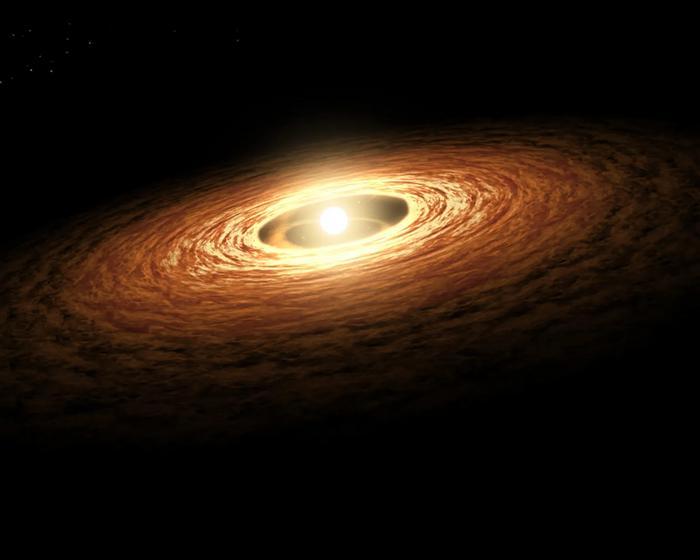
An international team of astronomers has used NASA’s James Webb Space Telescope to study the disk of gas and dust around a young, very low-mass star. The results reveal the largest number of carbon-containing molecules seen to date in such a disk. These findings have implications for the potential composition of any planets that might form around this star.

Credit: NASA/JPL-Caltech
An international team of astronomers has used NASA’s James Webb Space Telescope to study the disk of gas and dust around a young, very low-mass star. The results reveal the largest number of carbon-containing molecules seen to date in such a disk. These findings have implications for the potential composition of any planets that might form around this star.
Rocky planets are more likely than gas giants to form around low-mass stars, making them the most common planets around the most common stars in our galaxy. Little is known about the chemistry of such worlds, which may be similar to or very different from Earth. By studying the disks from which such planets form, astronomers hope to better understand the planet formation process and the compositions of the resulting planets.
Planet-forming disks around very low-mass stars are difficult to study because they are smaller and fainter than disks around high-mass stars. A program called the MIRI (Mid-Infrared Instrument) Mid-INfrared Disk Survey (MINDS) aims to use Webb’s unique capabilities to build a bridge between the chemical inventory of disks and the properties of exoplanets.
“Webb has better sensitivity and spectral resolution than previous infrared space telescopes,” explained lead author Aditya Arabhavi of the University of Groningen in the Netherlands. “These observations are not possible from Earth, because the emissions from the disk are blocked by our atmosphere.”
In a new study, this team explored the region around a very low-mass star known as ISO-ChaI 147, a 1 to 2 million-year-old star that weighs just 0.11 times as much as the Sun. The spectrum revealed by Webb’s MIRI shows the richest hydrocarbon chemistry seen to date in a protoplanetary disk – a total of 13 different carbon-bearing molecules. The team’s findings include the first detection of ethane (C2H6) outside of our solar system, as well as ethylene (C2H4), propyne (C3H4), and the methyl radical CH3.
“These molecules have already been detected in our solar system, like in comets such as 67P/Churyumov–Gerasimenko and C/2014 Q2 (Lovejoy),” added Arabhavi. “Webb allowed us to understand that these hydrocarbon molecules are not just diverse but also abundant. It is amazing that we can now see the dance of these molecules in the planetary cradles. It is a very different planet-forming environment than we usually think of.”
The team indicates that these results have large implications for the chemistry of the inner disk and the planets that might form there. Since Webb revealed the gas in the disk is so rich in carbon, there is likely little carbon left in the solid materials that planets would form from. As a result, the planets that might form there may ultimately be carbon-poor. (Earth itself is considered carbon-poor.)
“This is profoundly different from the composition we see in disks around solar-type stars, where oxygen bearing molecules like water and carbon dioxide dominate,” added team member Inga Kamp, also of the University of Groningen. “This object establishes that these are a unique class of objects.”
“It’s incredible that we can detect and quantify the amount of molecules that we know well on Earth, such as benzene, in an object that is more than 600 light-years away,” added team member Agnés Perrin of Centre National de la Recherche Scientifique in France.
Next, the science team intends to expand their study to a larger sample of such disks around very low-mass stars to develop their understanding of how common or exotic such carbon-rich terrestrial planet-forming regions are. “The expansion of our study will also allow us to better understand how these molecules can form,” explained team member and principal investigator of the MINDS program, Thomas Henning, of the Max-Planck-Institute for Astronomy in Germany. “Several features in the Webb data are also still unidentified, so more spectroscopy is required to fully interpret our observations.”
This work also highlights the crucial need for scientists to collaborate across disciplines. The team notes that these results and the accompanying data can contribute towards other fields including theoretical physics, chemistry, and astrochemistry, to interpret the spectra and to investigate new features in this wavelength range.
The James Webb Space Telescope is the world’s premier space science observatory. Webb is solving mysteries in our solar system, looking beyond to distant worlds around other stars, and probing the mysterious structures and origins of our universe and our place in it. Webb is an international program led by NASA with its partners, ESA (European Space Agency) and CSA (Canadian Space Agency).
Journal
Science
Article Title
Abundant hydrocarbons in the disk around a very-low-mass star
Article Publication Date
6-Jun-2024
Cite Scienmag News
Grant Pearson. (June 6, 2024). Webb finds plethora of carbon molecules around young star. Scienmag. https://scienmag.com/webb-finds-plethora-of-carbon-molecules-around-young-star/
Grant Pearson. "Webb finds plethora of carbon molecules around young star." Scienmag, 6 June 2024, https://scienmag.com/webb-finds-plethora-of-carbon-molecules-around-young-star/. Accessed 3 September 2026.
Grant Pearson. "Webb finds plethora of carbon molecules around young star." Scienmag. June 6, 2024. https://scienmag.com/webb-finds-plethora-of-carbon-molecules-around-young-star/

