


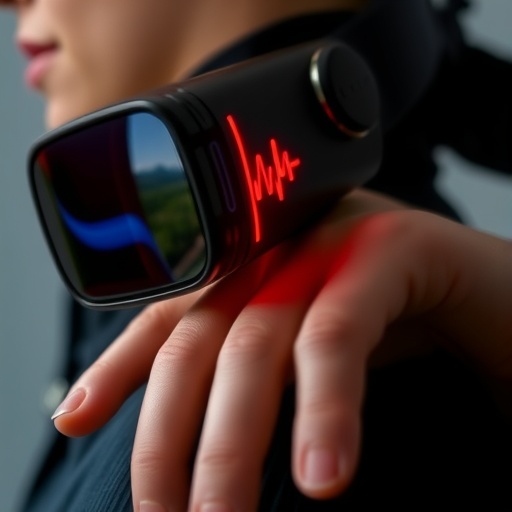
Northwestern University engineers have pioneered an innovative wearable polygraph system designed to continuously monitor physiological stress with unprecedented precision and convenience. Unlike traditional polygraph machines, which are often portrayed in media as lie detectors yet primarily measure stress responses, this new generation device transcends mere deception detection by offering a comprehensive, real-time understanding of the body’s multifaceted stress signals without the confines of clinical settings.
This ultra-lightweight, skin-interfaced device adheres comfortably to the chest, simultaneously capturing a constellation of bio-signals including cardiac electrical activity, respiratory patterns, electrodermal activity, peripheral blood flow, and cutaneous temperature variations. By integrating these physiological parameters, the system constructs a holistic portrait of the autonomic nervous system’s dynamic response to stress, offering clinicians and researchers a powerful tool to decode subtle and often imperceptible signals hidden deep within the body’s complex regulatory mechanisms.
The design draws inspiration from traditional polygraph technology but revolutionizes its form factor and capabilities. Whereas conventional polygraphs rely on an array of cumbersome wires attached to various parts of the body, this device consolidates multiple sensor modalities into an ultra-thin, flexible bandage that moves naturally with the wearer’s skin. This seamless integration is enabled by cutting-edge materials science and bioengineering, allowing for long-duration wear without compromising comfort or data fidelity. The system’s total weight is under 8 grams, roughly comparable to eight paperclips, underscoring its potential for continuous use in diverse environments.
Critically, the device sidesteps reliance on biochemical markers such as those found in blood or saliva, focusing instead on biophysical parameters that are less invasive and easier to measure continuously. A miniaturized inertial measurement unit captures subtle motions related to breathing and heartbeats, while embedded microphones detect acoustic phenomena tied to cardiac and pulmonary function. Thermal sensors discern changes in skin temperature and heat flux, reflecting alterations in blood flow, and electrodermal sensors track the skin’s electrical conductivity fluctuating with sweat gland activity—a well-established proxy for sympathetic nervous system activation.
Data collected by the sensors are wirelessly transmitted to companion devices like smartphones or tablets, where sophisticated machine learning algorithms analyze the synchronized data streams in real time. This advanced analytical framework deciphers complex physiological patterns associated with stress states, enabling dynamic feedback and actionable insights. Such continuous, multiplexed monitoring marks a significant leap from snapshot assessments traditionally used in stress evaluation, which often miss transient or cumulative effects.
The development was catalyzed by pressing clinical needs articulated by pediatricians at the Ann & Robert H. Lurie Children’s Hospital of Chicago. Infants and non-verbal patients who cannot self-report pain or discomfort stand to benefit greatly from objective stress measurement technologies. Conventional assessments rely heavily on caregivers’ observations of crying, facial expressions, and movement, which can be subjective and inconsistent. This device aims to provide an unbiased, quantifiable measure of stress, potentially transforming care paradigms for the vulnerable.
Validation studies attest to the device’s accuracy and versatility. In controlled experiments mimicking lie-detector protocols, the wearable captured stress responses reliably, aligning closely with measurements from commercial polygraph systems. Cognitive challenge tests, such as speech comprehension in noisy environments, demonstrated the system’s sensitivity to escalating mental workload, correlating with independently recorded pupil dilation metrics—a recognized stress indicator.
The device’s utility extends to clinical sleep monitoring, where it identified respiratory irregularities and nighttime awakenings with accuracy rivaling hospital-grade polysomnography but with far less intrusion. Additionally, stress responses measured during emergency medical training highlighted a negative correlation between stress intensity and task performance, underscoring the device’s potential to optimize decision-making under pressure by alerting users to debilitating stress thresholds.
Looking forward, the research team aims to broaden clinical trials to encompass larger and more diverse patient populations, enhancing personalization through adaptive algorithms that can tailor stress detection parameters to individual physiological baselines. Integration into hospital and home care settings is anticipated, offering continuous monitoring capabilities to aid in diagnosing sleep disorders, tracking mental health trajectories, and providing preemptive alerts for impending medical complications based on stress biomarkers.
Plans are underway to augment the device with additional sensing capabilities, particularly electroencephalography (EEG), which would facilitate direct measurement of brain activity related to stress perception. This advancement could revolutionize the ability to distinguish between stress and pain, even outside clinical environments, providing invaluable data on how cognitive and emotional stressors influence physiological states.
In an era marked by unprecedented stress levels globally, this wearable polygraph system represents a transformative approach to detecting and managing stress. By pinpointing stress signatures before subjective awareness or symptomatic manifestation, it empowers individuals and healthcare providers with real-time insights, potentially mitigating the adverse health effects associated with chronic stress. This innovation transcends the limits of current methods by amalgamating engineering, physiology, and artificial intelligence into a single, wearable platform that harmonizes precision with practicality.
The collaborative effort spearheaded by John A. Rogers, a world-renowned bioengineer at Northwestern University, along with pediatric autonomic medicine expert Dr. Debra E. Weese-Mayer, exemplifies interdisciplinary synergy shaping the future of biomedical sensing. Their work sets a precedent for non-invasive, continuous monitoring technologies that prioritize patient comfort without sacrificing data richness, promising a new frontier in personalized stress management and healthcare.
Supported by the Querrey Simpson Institute for Bioelectronics, this study underscores the potential for bioelectronics to revolutionize clinical diagnostics and patient monitoring. As the technology progresses toward broader implementation, it heralds a future wherein invisible physiological stress signals become visible, measurable, and manageable, improving outcomes for patients across all age groups and health conditions.
News Publication Date:
13-May-2026
Web References:
http://dx.doi.org/10.1126/sciadv.aed3162
Cite Scienmag News
Ophelia Keating. (May 13, 2026). Wearable Polygraph Unveils Hidden Stress Levels. Scienmag. https://scienmag.com/wearable-polygraph-unveils-hidden-stress-levels/
Ophelia Keating. "Wearable Polygraph Unveils Hidden Stress Levels." Scienmag, 13 May 2026, https://scienmag.com/wearable-polygraph-unveils-hidden-stress-levels/. Accessed 3 September 2026.
Ophelia Keating. "Wearable Polygraph Unveils Hidden Stress Levels." Scienmag. May 13, 2026. https://scienmag.com/wearable-polygraph-unveils-hidden-stress-levels/


