


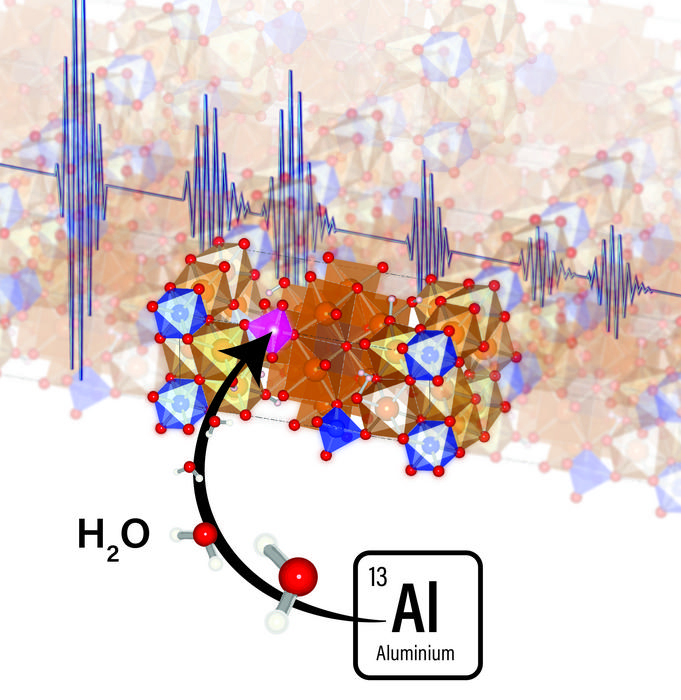
Dense Hydrous Magnesium Silicates (DHMSs) are generally considered as primary water carriers from the shallow lithosphere to the deep mantle transition region (MTR; 410–660 km in depth). Among DHMSs, Superhydrous phase B (hereafter, SuB) holds the chemical formula, Mg10Si3H3O18. This phase is believed to hold a large amount of water and thus may have an important role in the water storage capacity of the MTR and the transportation of water to the deeper parts of the Earth’s interior; but because of its relative instability against the high temperature of the Earth’s mantle, SuB is generally associated with cold regions, such as the inner parts of the subducted slab. A recent experimental study conducted at Ehime University, however, showed that when aluminum incorporates SuB, its stability against temperature is drastically improved (Kakizawa et al., AmMin 2018), allowing this mineral to remain stable at pressure and temperature conditions matching those of the Earth’s lower mantle.

Credit: Geodynamics Research Center, Ehime University
Dense Hydrous Magnesium Silicates (DHMSs) are generally considered as primary water carriers from the shallow lithosphere to the deep mantle transition region (MTR; 410–660 km in depth). Among DHMSs, Superhydrous phase B (hereafter, SuB) holds the chemical formula, Mg10Si3H3O18. This phase is believed to hold a large amount of water and thus may have an important role in the water storage capacity of the MTR and the transportation of water to the deeper parts of the Earth’s interior; but because of its relative instability against the high temperature of the Earth’s mantle, SuB is generally associated with cold regions, such as the inner parts of the subducted slab. A recent experimental study conducted at Ehime University, however, showed that when aluminum incorporates SuB, its stability against temperature is drastically improved (Kakizawa et al., AmMin 2018), allowing this mineral to remain stable at pressure and temperature conditions matching those of the Earth’s lower mantle.
In 2022, the same Ehime University research team reported the longitudinal (VP) and shear (VS) velocities of SuB (Xu et al., GRL 2022) using the X-ray and ultrasonic techniques implemented in a multi-anvil apparatus at the beamline BL04B1, located at the synchrotron facility, SPring-8, in Japan. The results showed that the presence of SuB could be correlated with the low seismic velocities observed in subducted slab regions. This time, they carried out similar high pressure and high temperature measurements on SuB samples doped with aluminum (Fig.1). Their new data suggest that incorporation of aluminum in SuB (Al-bearing SuB in Fig.2) promotes unusual variations of velocities with an increase in water content compared to the velocities of SuB without aluminum (Al-free SuB in Fig.2).
This new finding, in addition to the knowledge that the stability against temperature and capacity to store water of SuB are improved when aluminum is present in its structure, suggests that the Al-bearing SuB may account for seismically visible anomalies at the bottom of the MTR and beneath subduction zones in the uppermost lower mantle. These results should greatly contribute to tracing the existence and recycling of the former hydrated lithospheric crust in the Earth’s lower mantle and interpreting seismic velocities in terms of mantle composition, and estimate the amount of water that could be passed down to the deep mantle.
Journal
Geophysical Research Letters
Cite Scienmag News
Violet Maxwell. (August 7, 2024). Water delivered to the mantle by aluminum enriched hydrated slabs? Scienmag. https://scienmag.com/water-delivered-to-the-mantle-by-aluminum-enriched-hydrated-slabs/
Violet Maxwell. "Water delivered to the mantle by aluminum enriched hydrated slabs?" Scienmag, 7 August 2024, https://scienmag.com/water-delivered-to-the-mantle-by-aluminum-enriched-hydrated-slabs/. Accessed 5 September 2026.
Violet Maxwell. "Water delivered to the mantle by aluminum enriched hydrated slabs?" Scienmag. August 7, 2024. https://scienmag.com/water-delivered-to-the-mantle-by-aluminum-enriched-hydrated-slabs/

