


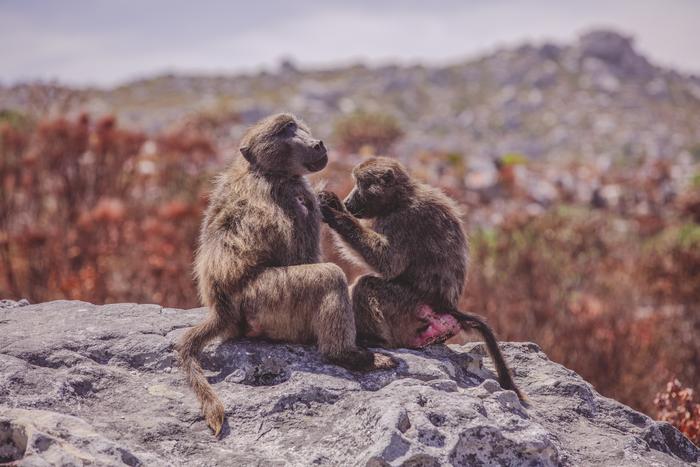
A new study from Swansea University has revealed a surprising relationship between grooming behaviour and physiological stress in wild female baboons, addressing a crucial gap in our understanding of how sociality is linked to health and fitness in animals.

Credit: Charl Steenkamp
A new study from Swansea University has revealed a surprising relationship between grooming behaviour and physiological stress in wild female baboons, addressing a crucial gap in our understanding of how sociality is linked to health and fitness in animals.
Published in the journal Biology Letters, the researchers studied wild chacma baboons in South Africa. Tracking collars with motion sensors provided data on how much time each baboon spent giving or receiving grooming. The baboons’ physiological stress levels were estimated by measuring concentrations of glucocorticoid metabolites in their faeces.
Consistent with previous work, the team found that higher average grooming rates were linked to lower average stress levels, suggesting that grooming has long-term positive effects on health and fitness. However, when the researchers time-matched the high-resolution grooming and physiological stress data, they found that when baboons spent more time grooming (both giving and receiving), higher physiological stress levels followed, contrary to expectations.
This finding suggests that the long-term positive link between physiological stress and grooming is unlikely to be subserved by grooming itself because, in the short term, grooming is physiologically costly.
High-resolution grooming data from collars can now be used to study how this short-term hormone–behaviour relationship might change across environmental and social contexts and, if deployed in other social animals, confirm how widespread this phenomenon is.
Dr Charlotte Christensen, a former Swansea University PhD student now based at the University of Zurich, commented: “Our findings challenge the conventional view that grooming is purely relaxing and suggest that the immediate physiological costs may be outweighed by long-term fitness benefits.”
Senior author Dr Ines Fürtbauer, head of the Behavioural Ecology & Endocrinology lab at Swansea University, emphasised the broader implications: “This study provides valuable insights into the proximate mechanisms of social bonding and stress regulation. Understanding these dynamics can help us better comprehend the health and survival strategies of social animals.”
This research highlights the importance of exploring the link between social behaviours and physiological stress at different time scales, with sometimes counterintuitive results, contributing to the ongoing debate about the costs and benefits of sociality in animals.
Journal
Biology Letters
Subject of Research
Animals
Article Title
More allogrooming is followed by higher physiological stress in wild female baboons
Article Publication Date
7-Aug-2024
Cite Scienmag News
Courtney Benton. (August 7, 2024). Unexpected link between grooming and physiological stress in wild baboons. Scienmag. https://scienmag.com/unexpected-link-between-grooming-and-physiological-stress-in-wild-baboons/
Courtney Benton. "Unexpected link between grooming and physiological stress in wild baboons." Scienmag, 7 August 2024, https://scienmag.com/unexpected-link-between-grooming-and-physiological-stress-in-wild-baboons/. Accessed 3 September 2026.
Courtney Benton. "Unexpected link between grooming and physiological stress in wild baboons." Scienmag. August 7, 2024. https://scienmag.com/unexpected-link-between-grooming-and-physiological-stress-in-wild-baboons/

