


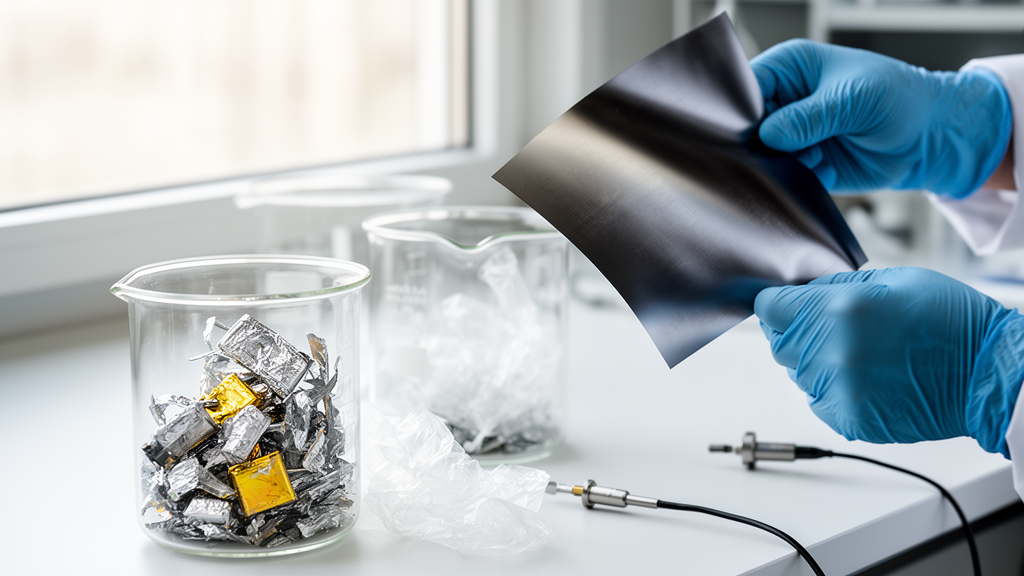
Two of the modern world’s most stubborn waste streams — spent lithium-ion battery cathodes and discarded plastic packaging — have been fused into a single high-tech material that can soak up microwave radiation with remarkable efficiency. In a study published in Advanced Composites and Hybrid Materials, researchers in China describe a one-step pyrolysis process that converts nickel cobalt manganese oxide (NCM) cathode scrap and low-density polyethylene (LDPE) into sea urchin-like carbon nanotube architectures capable of absorbing more than 99.9999 percent of incident microwave energy at a thickness of just 1.63 millimeters. The work arrives at a moment when the rollout of 5G and next-generation 6G networks is intensifying concerns about electromagnetic interference and pollution, driving demand for absorbers that are simultaneously lightweight, thin, broadband, and cheap enough to deploy at scale.
The central innovation is what the team calls a carbon-supply-driven kinetic regulation strategy. In conventional catalytic growth of carbon nanotubes, metal nanoparticles derived from the battery cathode act as catalysts while a carbon source — here the polyethylene — decomposes at high temperature and feeds carbon atoms into the growing tube. The researchers realized that the ratio between the cathode material and the plastic does far more than set how much carbon is available; it governs the local carbon flux at each catalyst particle, and therefore the speed and manner in which nanotubes elongate. By simply adjusting the NCM-to-LDPE mass ratio, they could continuously tune nanotube length and, crucially, the density of structural defects woven into the graphitic walls.
That tuning revealed a subtle and previously underappreciated competition. As the carbon supply increases, the nanotubes first become more crystalline and better graphitized, but beyond a certain point the influx of carbon begins to generate defects instead of healing them. The team tracked this balance using Raman spectroscopy, monitoring the ratio of the defect-related D band to the graphitic G band. Rather than rising or falling steadily, this intensity ratio traced a volcano-shaped curve as the feed ratio changed — climbing, peaking, and then declining. The researchers interpret this non-monotonic behavior as evidence of an intrinsic tug-of-war between graphitization and defect generation, and they argue that the optimal point on that volcano is precisely where microwave absorption performance peaks.
The reason lies in the physics of how microwave absorbers work. An effective absorber must do two things at once: it must let waves enter rather than reflect them away, and it must then dissipate the absorbed energy as heat. Conductive networks made of interconnected carbon nanotubes dissipate energy through conduction losses, as induced currents encounter resistance and die away. Defects and heterogeneous interfaces, by contrast, act as sites of dipolar polarization — regions where charge accumulates and reorients under the oscillating electric field of the incoming wave, converting electromagnetic energy into heat. Too much conductivity causes impedance mismatch and surface reflection; too many defects destroy the conductive pathways. The best absorbers sit at a delicate balance between the two regimes.
The optimized material, designated NCC-6.7, hits that balance with striking precision. Its sea urchin-like architecture — nanotubes radiating outward from catalyst particles like spines from a shell — creates an interconnected conductive network for conduction loss while preserving abundant structural defects and heterogeneous interfaces for dipolar polarization. In testing, the material achieved a minimum reflection loss of −63.45 dB at a thickness of only 1.63 millimeters, a figure that corresponds to reflecting roughly one part in two million of the incident power. At an even thinner 1.46 millimeters, it maintained an effective absorption bandwidth of 4.25 gigahertz, meaning it suppresses reflections across a wide swath of the microwave spectrum relevant to modern communications.
Thickness matters enormously in practical electromagnetic protection. Traditional absorbers often require millimeters to centimeters of material to achieve comparable attenuation, adding weight and bulk to aircraft, vehicles, base stations, and wearable electronics. An absorber that works at under two millimeters can be laminated into enclosures, woven into fabrics, or applied as a coating without meaningful weight penalty. The Chinese team went a step further and processed their optimized powder into a textile, demonstrating that the material retains its absorbing function in a flexible, fabric-like form. The textile also exhibited enhanced corrosion resistance and reduced electromagnetic scattering compared with reference materials, properties the authors highlight as important for marine applications, where salt spray and humidity rapidly degrade many functional coatings.
The sustainability logic of the study is as significant as the performance numbers. Spent lithium-ion batteries are accumulating worldwide as electric vehicles reach end of life, and their NCM cathodes contain nickel, cobalt, and manganese that are both valuable and environmentally problematic in landfill. Meanwhile, low-density polyethylene remains one of the most widely produced and least effectively recycled plastics. Most recycling streams handle these wastes separately, and co-upcycling them into a single functional product — rather than merely recovering raw elements — multiplies the value extracted from each ton of waste. Here, the battery supplies the catalytic metal centers and part of the inorganic framework, while the plastic supplies the carbon feedstock, so each waste stream compensates for the other’s shortcomings in the pyrolysis reaction.
The process is also attractive from a manufacturing standpoint because it is a single-step co-pyrolysis. There is no need to first extract and purify metals from the cathode, synthesize nanotubes separately, and then composite them; instead, mixing shredded waste in the right proportion and heating it under controlled conditions produces the final absorber directly. The authors frame their contribution as establishing a kinetics–structure–property paradigm: by understanding how a process parameter — the carbon supply rate — controls nanostructure formation, one can program the structure that delivers the desired property. That paradigm, they suggest, can be extended to other mixed-waste systems and other functional nanomaterials beyond microwave absorption.
The broader context is a growing global effort to mitigate electromagnetic pollution as wireless devices proliferate. Electromagnetic interference threatens not only communications quality but also the reliability of precision electronics, medical equipment, and autonomous systems, and regulators and manufacturers alike are seeking absorbers that are inexpensive, durable, and environmentally benign. Materials derived from waste streams offer a rare alignment of incentives: they address a pollution problem on the input side while solving one on the output side. If the co-pyrolysis approach can be scaled beyond the laboratory — maintaining precise control over feed ratios and pyrolysis conditions at industrial throughput — it could turn two disposal liabilities into feedstock for a growing market in electromagnetic protection.
For now, the study stands as a vivid demonstration that the boundary between waste and advanced material can be surprisingly thin. A shredded battery cathode and a discarded plastic bag, heated together under the right kinetic conditions, grow into spiny carbon architectures that outperform many purpose-built absorbers. The researchers, led by Han-Ming Zhang of Hebei University of Science and Technology along with corresponding authors Ting Shi and Ningning Cao, describe the resulting textile as a promising candidate for flexible electromagnetic protection and marine environments. As 6G networks loom and battery waste mounts, the idea that the cure for one form of technological pollution might be manufactured from the byproducts of another is likely to resonate far beyond the materials science community.
Subject of Research: Carbon nanotube microwave absorbers synthesized from spent battery cathodes and plastic waste
Article Title: Carbon-Supply-Programmed CNT Growth for Ultrathin Microwave Absorbers from Waste Batteries and Plastics
Article References: Carbon-Supply-Programmed CNT Growth for Ultrathin Microwave Absorbers from Waste Batteries and Plastics. (n.d.). https://doi.org/10.1007/s42114-026-02121-x
Image Credits: AI Generated
DOI: 10.1007/s42114-026-02121-x
Keywords: carbon nanotubes, microwave absorption, lithium-ion battery recycling, plastic waste valorization, pyrolysis, nanocomposites, defect engineering, 5G, electromagnetic pollution, sustainable materials, low-density polyethylene, NCM cathode
Cite Scienmag News
Denise Maddox. (October 15, 2026). Waste Batteries and Plastic Transformed Into Ultrathin Shields Against Electromagnetic Pollution. Scienmag. https://scienmag.com/waste-batteries-and-plastic-transformed-into-ultrathin-shields-against-electromagnetic-pollution/
Denise Maddox. "Waste Batteries and Plastic Transformed Into Ultrathin Shields Against Electromagnetic Pollution." Scienmag, 15 October 2026, https://scienmag.com/waste-batteries-and-plastic-transformed-into-ultrathin-shields-against-electromagnetic-pollution/. Accessed 15 October 2026.
Denise Maddox. "Waste Batteries and Plastic Transformed Into Ultrathin Shields Against Electromagnetic Pollution." Scienmag. October 15, 2026. https://scienmag.com/waste-batteries-and-plastic-transformed-into-ultrathin-shields-against-electromagnetic-pollution/


