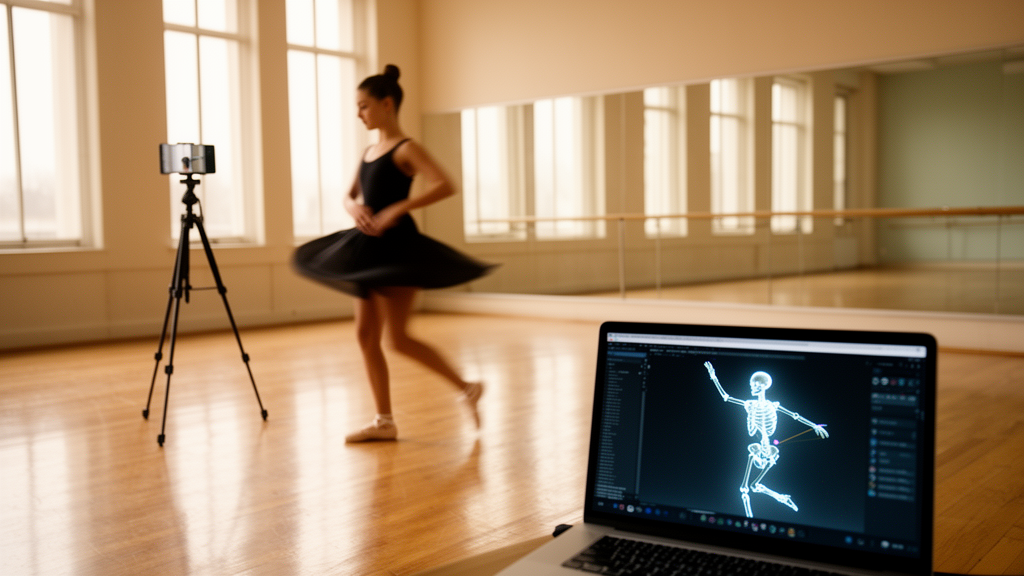
Dance has always been one of the most demanding art forms to teach. A single movement involves dozens of joints, precise timing, expressive intent, and years of accumulated technique that instructors traditionally assess with nothing more than trained eyes and intuition. Now a new study published in Discover Artificial Intelligence describes a machine learning framework that can evaluate dance training effectiveness in real time and automatically rewrite a dancer’s practice plan based on what it sees. The system, developed by Lei Qiao of Jiaozuo University in China, combines a graph neural network with an autoencoder and a nature-inspired optimization algorithm into a single pipeline the author calls BO-GNN-AE. In benchmark testing, the framework achieved an F1-score of 0.983, a precision of 0.986, and a recall of 0.982, along with an overall accuracy of 98.88 percent, outperforming a range of conventional neural architectures on the same task.
The core problem the research addresses is that existing motion-analysis tools tend to treat dance as a static classification task. Earlier systems built on support vector machines and k-nearest neighbor classifiers required large amounts of cleanly labeled data and struggled with the sheer variety of human movement. Deep learning approaches such as convolutional and recurrent networks improved recognition but are computationally expensive, data-hungry, and prone to overfitting. Meanwhile, the traditional Instructor Observation Method, in which a teacher judges posture, rhythm, and technique by watching, remains inherently subjective and cannot scale to individualized feedback for every student. The new framework was designed to close this gap by modeling the dancer’s body as a connected structure rather than a collection of independent frames, and by feeding its assessments directly into an adaptive engine that adjusts training difficulty, repetition counts, and focus areas on the fly.
The technical heart of the system is its graph representation of the human body. Each detected joint becomes a node in a graph, carrying spatial coordinates and extracted motion features, while edges encode anatomical connections such as shoulder-to-elbow-to-wrist or hip-to-knee-to-ankle. Additional temporal edges link the same joint across consecutive frames, allowing the network to track movement continuity. Two message-passing layers then propagate information across this structure, letting the model learn coordinated multi-joint dynamics without the over-smoothing that deeper graph architectures can introduce. A global pooling operation summarizes the learned representation, and fully connected output layers predict scores for rhythm consistency, joint coordination, posture precision, and overall dance performance. This relational design is what allows the system to understand, for example, how a misaligned hip cascades into an imprecise arm gesture several beats later.
Before any graph learning happens, the raw motion data passes through a carefully engineered preprocessing chain. Pose keypoints and joint coordinates are cleaned with Kalman filtering, a recursive estimation technique that predicts the system’s next state, compares that prediction against the noisy measurement, and blends the two using a calculated gain to produce an optimal estimate. This step corrects missing or irregular frames and compensates for variable recording speeds, yielding smooth temporal trajectories that reveal genuine performance patterns rather than sensor artifacts. Feature extraction follows on two fronts: histogram of oriented gradients, or HOG, captures body shape, movement direction, and dynamic posture changes by computing horizontal and vertical image gradients, their magnitudes, and their angular orientations across overlapping blocks of cells. A second descriptor, local gabor binary pattern across three orthogonal planes, or LGBP-TOP, adds sensitivity to spatial-temporal texture, modeling sequential joint movements, transitions, and stylistic flow, which the study identifies as critical for evaluating rhythm and coordination.
Because these handcrafted descriptors are high-dimensional and partly redundant, an autoencoder compresses them into compact latent vectors. The encoder maps the input through a learned weight matrix into a reduced hidden representation, and the decoder reconstructs the original signal from that bottleneck; minimizing the weighted reconstruction error forces the network to preserve the discriminative essence of the movement while discarding noise. These latent features then become the input to the graph neural network, which learns the inter-joint coordination and temporal dependencies needed for accurate scoring. The final ingredient is Bobcat Optimization, a metaheuristic algorithm inspired by the hunting behavior of bobcats, which iteratively refines candidate solutions through a monitoring phase that pursues high-value prey positions and a chasing phase that exploits promising regions of the search space. Here, it tunes hyperparameters such as the learning rate, the depth of message passing, and the dimensionality of the latent space, improving convergence and generalization while guarding against overfitting.
What makes the framework genuinely adaptive rather than merely diagnostic is its closed-loop decision strategy. After each performance evaluation, the system compares normalized scores for rhythm consistency, posture precision, joint coordination, and movement interaction against thresholds calibrated from instructor annotations and validation tests. If rhythm falls below threshold, the training pace is slowed and extra repetitions are added until timing stabilizes. Posture deficits trigger corrective visual guidance and joint-specific exercises, while coordination problems prompt simplified choreography that escalates in difficulty as skill develops. When all scores exceed their thresholds, the system progressively raises choreographic complexity and synchronization demands. The new scores generated after each training cycle feed back into the model, so the plan evolves continuously with the dancer, a design the study says supports personalized progress without overtraining.
Training and evaluation relied on the Dance Heritage Visual Dataset, a publicly available collection spanning eight Indian classical dance forms at low, medium, and high performance levels, alongside material from styles including jazz, ballet, flamenco, tango, and tap. The image set contains 364 labeled training images and 166 test images, with video sequences organized across 26 directories capturing varying movement quality and rhythm precision. Experiments ran in Python 3.10 with PyTorch 2.x on a workstation equipped with an Intel i9 processor, an NVIDIA RTX 4090 GPU, and 64 GB of RAM. Against ten competing models, including a transformer-CNN hybrid with dynamic and static streams, a 3D convolutional network, a pseudo-3D residual network, a convolutional LSTM, and a lightweight vision transformer, the proposed framework posted the best results on every headline metric, reaching 98.88 percent accuracy where the strongest baseline, the 3D CNN, managed 96.91 percent.
The system also proved fast enough for practical use, delivering an inference speed of 88 frames per second and a computational latency of just 11.2 milliseconds, which the author notes is essential for real-time feedback during practice. Comparisons with the unoptimized GNN-AE baseline showed consistent gains from the optimization stage across six personalization metrics: skill improvement rate rose from 0.86 to 0.88, learning retention from 0.85 to 0.89, engagement score from 0.90 to 0.93, feedback accuracy from 0.88 to 0.91, adaptability index from 0.92 to 0.95, and consistency score from 0.90 to 0.93. An ablation study confirmed that each component earns its place: removing the graph network caused the largest performance drop because the model lost its grasp of spatial-temporal joint relationships, while removing the autoencoder or the optimizer degraded representation quality and convergence respectively. Testing across beginner, intermediate, and advanced skill levels showed the adaptive behavior remained consistent regardless of learner ability.
The study is candid about its limitations. All results come from offline experiments on a single public dataset, so performance may reflect dataset-specific bias rather than true generalization across dance styles, participants, and recording conditions. Qualitative failure analysis revealed that the system sometimes confuses movements with similar postures but different hand, finger, or facial gestures, and that costume occlusion, rapid turns, motion blur, low lighting, and unusual camera angles degrade feature extraction. The educational impact, including learning efficiency, retention, error reduction, and instructor workload, has not yet been measured in live classrooms, and the author emphasizes that the framework is intended to assist teachers rather than replace them. Future work will pursue classroom-based longitudinal studies, cross-dataset validation spanning ballet, contemporary, and street dance, multi-view video capture, attention-based temporal modeling, improved occluded-pose estimation, and integration with wearable sensors. Even so, the results mark a striking step toward dance studios where an algorithm watches every arabesque and mudra, scores it against expert references in milliseconds, and quietly reshapes tomorrow’s lesson plan around the dancer’s weakest joint.
Subject of Research: A graph neural network with autoencoder and metaheuristic optimization for evaluating dance training effectiveness and dynamically adjusting training plans
Article Title: A graph neural network-based system for evaluating dance training effectiveness and dynamically adjusting training plans
Article References: A graph neural network-based system for evaluating dance training effectiveness and dynamically adjusting training plans. (n.d.). https://doi.org/10.1007/s44163-026-01975-w
Image Credits: AI Generated
DOI: 10.1007/s44163-026-01975-w
Keywords: graph neural network, dance training, autoencoder, Bobcat optimization, motion analysis, pose estimation, Kalman filtering, adaptive learning, machine learning, personalized feedback, computer vision, dance education
Cite Scienmag News
Blake Davidson. (October 15, 2026). AI That Watches You Dance: Graph Neural Network Learns to Coach Like a Master Teacher. Scienmag. https://scienmag.com/ai-that-watches-you-dance-graph-neural-network-learns-to-coach-like-a-master-teacher/
Blake Davidson. "AI That Watches You Dance: Graph Neural Network Learns to Coach Like a Master Teacher." Scienmag, 15 October 2026, https://scienmag.com/ai-that-watches-you-dance-graph-neural-network-learns-to-coach-like-a-master-teacher/. Accessed 15 October 2026.
Blake Davidson. "AI That Watches You Dance: Graph Neural Network Learns to Coach Like a Master Teacher." Scienmag. October 15, 2026. https://scienmag.com/ai-that-watches-you-dance-graph-neural-network-learns-to-coach-like-a-master-teacher/